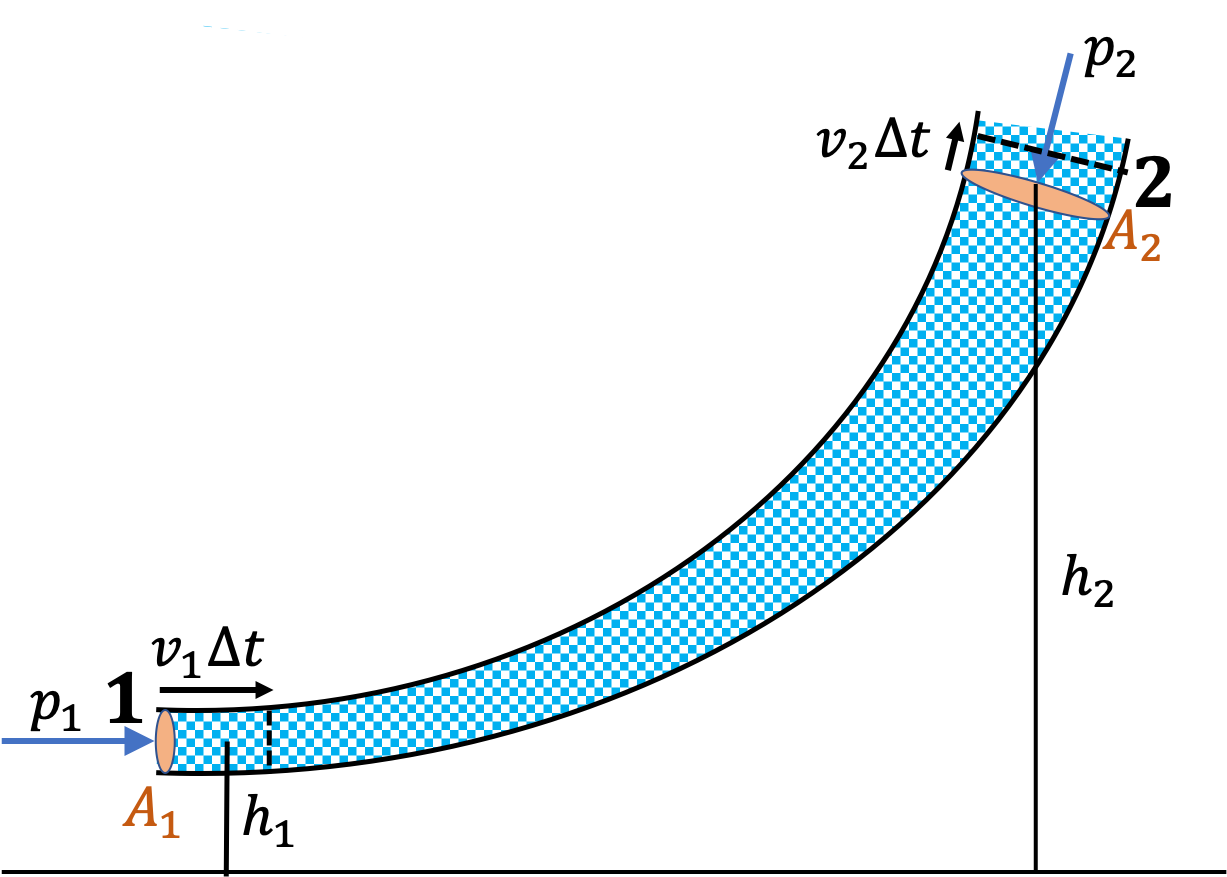
Example 18.5. Pumping Water in a Tall Building.
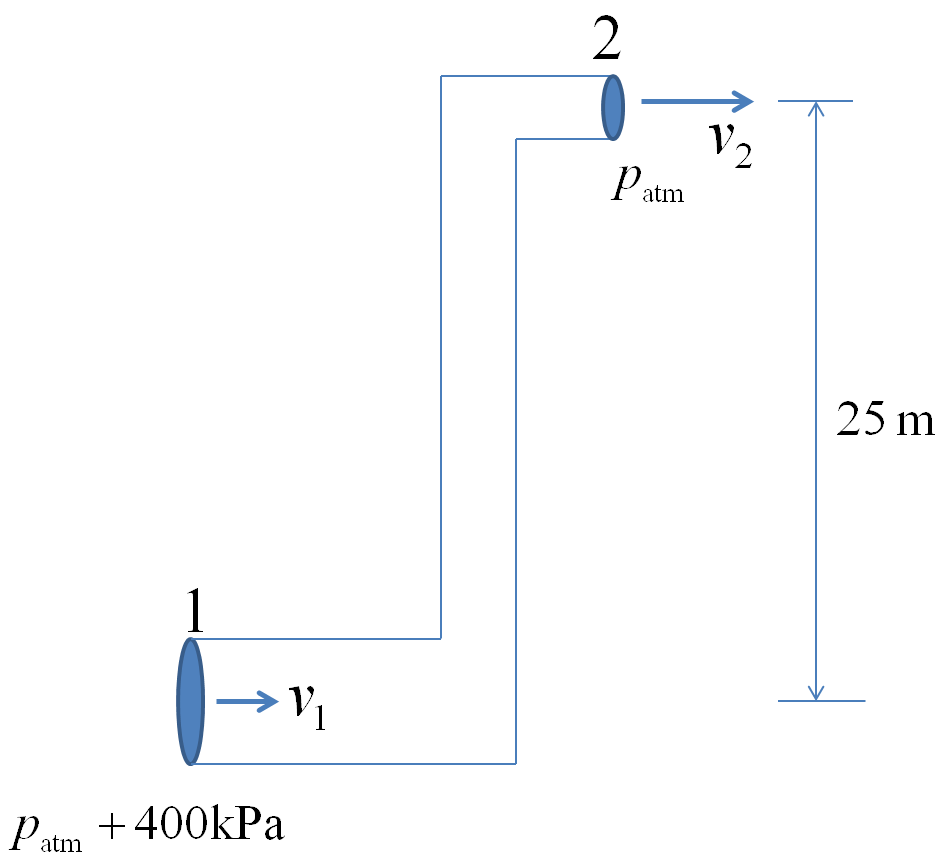
Water is to be pumped from the basement of a tall building such that \(15\text{ l/min}\) of water must come out froma faucet of inner diameter \(2.5\text{ cm} \) at a height \(30\text{ m}\text{.}\) The water is being pumped into a pipe of diameter \(5.0\text{ cm} \text{.}\) Assume no branching, and if branching, then all other branches are closed off. Assume nonviscous flow.
(a) What are the speeds of flow in the (i) basement and at (ii) faucet?
(b) What is the pressure at the pump?
Answer.
Solution 1. a
First, we find the speed of flow at the faucet by using the volume flow rate given. We need to convert that into the SI units.
\begin{equation*}
Q = 15\text{ l/min} \times \dfrac{10^{-3} \text{ m}^3\text{/l}} {60\text{ s/min}} = 2.5\times 10^{-4}\text{ m}^3\text{/s}.
\end{equation*}
Let subscript 1 refer to the pipe at the pump and 2 to the pipe at the faucet. Then, \(A_2 v_2 = Q \) gives
\begin{equation*}
v_2 = \dfrac{Q}{A_2} = \dfrac{2.5\times 10^{-4}}{ \pi\times 0.0125^2}= 0.51\text{ m/s}.
\end{equation*}
From \(A_1 v_1 = A_2 v_2\text{,}\) we get
\begin{equation*}
v_1 = \dfrac{A_2}{A_1}\, v_2 = \left( \dfrac{2.5}{5} \right)^2\, 0.51 = 0.128\text{ m/s}.
\end{equation*}
Solution 2. b
Bernoulli’s equation applies here since flow is nonviscous. The pressure against which water comes out of faucet is the atmospheric pressure. Using 1 for pump’s locaiton and 2 for the faucet’s location, we will have
\begin{align*}
p_1 \amp = p_2 + \dfrac{1}{2}\rho (v_2^2 - v_1^2) + \rho g (h_2-h1) \\
\amp = 1.013\times 10^{5} + 1000\left[ \dfrac{1}{2} (0.51^2 - 0.128^2) + 9.81\times 30 \right] \\
\amp = 2.95\times 10^{5}\text{ Pa}.
\end{align*}