Example 16.22. Stress of the Same Weight on Different Areas.
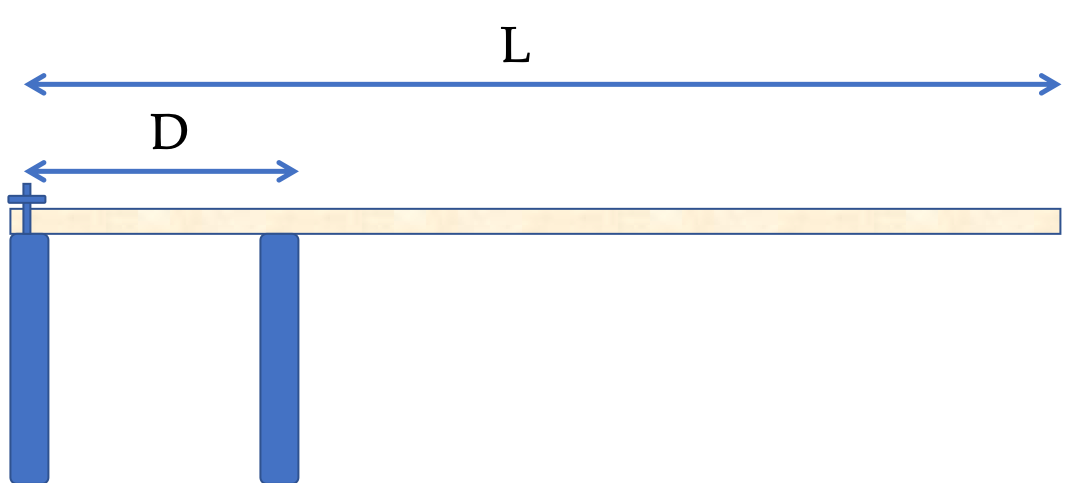
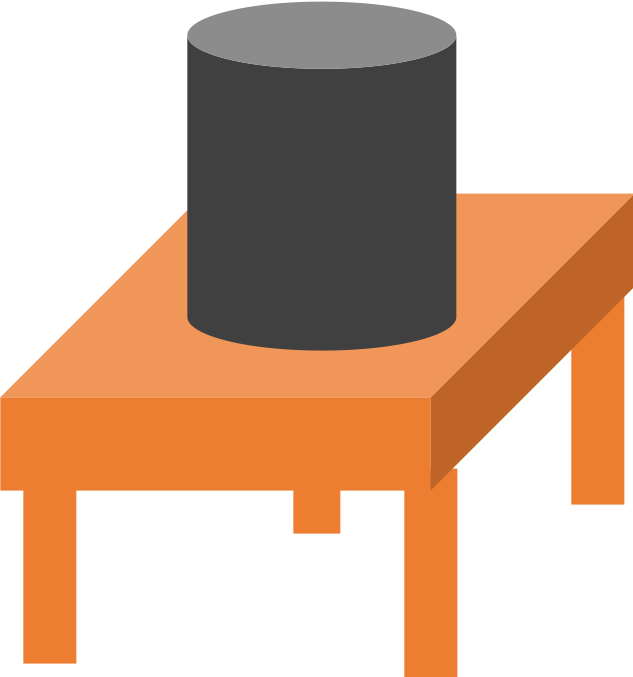
A heavy machine, of mass \(2,000\text{ kg}\text{,}\) is placed on a table of mass \(100\text{ kg}\text{.}\) The surface area of contact between the machine and table is \(1000\text{ cm}^2\text{.}\) The table has four legs, each with the area of contact with the floor equal to \(20\text{ cm}^2\text{.}\)
(a) What is the stress in the table in the region where the machine is placed?
(b) What is the stress in the legs of the table?
Answer.
Solution 1. (a)
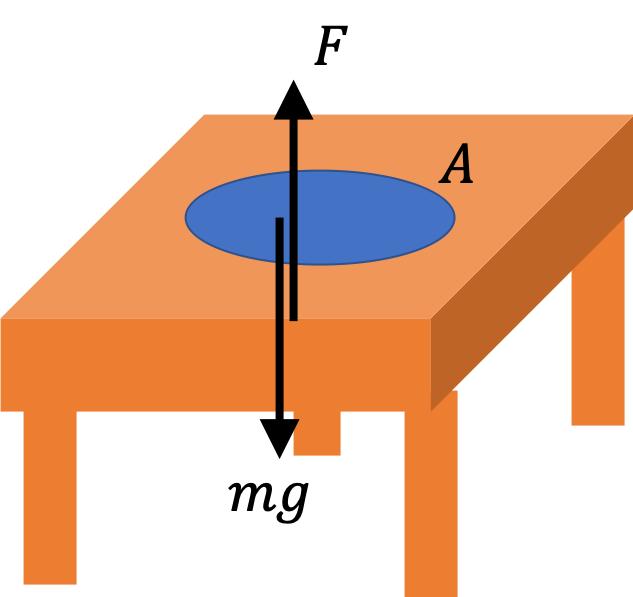
This force acts over the area
\begin{equation*}
A = 1000\times 10^{-4} \text{ m}^2.
\end{equation*}
Therefore, stress will be
\begin{equation*}
\dfrac{F}{A} = \dfrac{19620}{1000\times 10^{-4} } = 1.96\times 10^{5}\text{ N/m}^2.
\end{equation*}
Solution 2. (b)
(b) The weight of the machine is now balanced by four normal forces, one on each leg, from the floor. The molecular forces in the legs of the table must balance these normal forces. Let \(F\) be force in each leg.
\begin{equation*}
F = \dfrac{2000\times 9.81}{4} = 4,910\text{ N}.
\end{equation*}
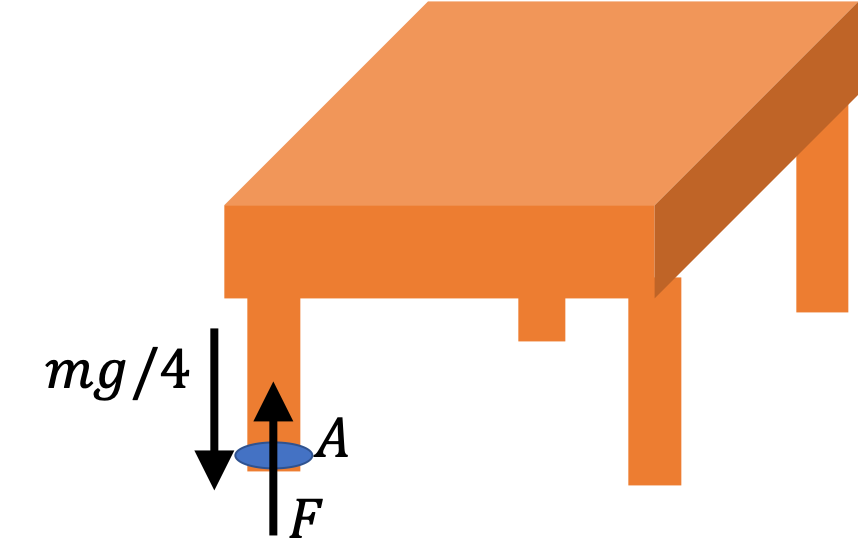
This acts over the area of contact
\begin{equation*}
A = 20\text{ cm}^2 = 2.0\times 10^{-3}\text{ m}^2.
\end{equation*}
Therefore, stress in the legs is
\begin{equation*}
\dfrac{F}{A} = \dfrac{4,910\text{ N}}{2.0\times 10^{-3}\text{ m}^2} = 2.45\times 10^{6}\text{ N/m}^2.
\end{equation*}