
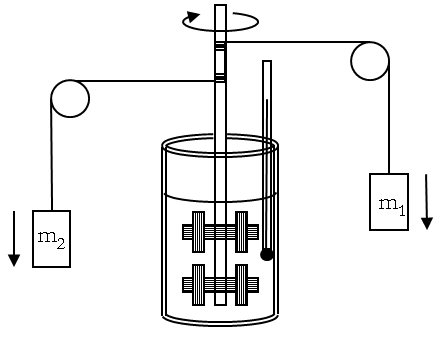
Example 19.3. Temperature Rise in Joule Experiment.
In a Joule experiment \(1\text{ kg}\) of liquid water in a \(200\text{ g}\) copper container is stirred by flywheels when two blocks each weighing \(5\text{ kg}\) drop by a height of \(1.5\text{ m}\text{.}\) Assuming that all heat generated by the resistance against the motion of the flywheel goes in raising the temperature of the water and the container, what will be the rise in the temperature? Assume that kinetic energy of blocks do not increase much during the fall.
Solution.
The potential energy of the two blocks is converted to the kinetic energy of the flywheels and kinetic energy of the blocks. We ignore KE of blocks and assume the KE of flywheels is expended in raising the temperature of the water, the container and the flywheels. We will ignore the energy in raising the temperature of the container and the flywheels since they are very small compared to the energy in raising the temperature water. Energy to raise the temperature of wateris given by the following formula
\begin{equation*}
m_{w}\, c_{w} \, |\Delta T|,
\end{equation*}
where \(m_{w}\) is mass of water, \(c_{w}\) the specific heat of water with value \(1.0\text{ cal/g.}^\circ\text{C}\text{,}\) and \(|\Delta T|\) the change in its temperature. We equate this to the energy lost by the falling blocks to get
\begin{equation*}
m_{w}\, c_{w} \, |\Delta T| \approx 2\times m g h.
\end{equation*}
Solving this for \(|\Delta T|\text{,}\) we get
\begin{align*}
|\Delta T| \amp = \frac{2 m g h}{m_{w}\ c_{w}} \\
\amp = \frac{2\times 5\ \text{kg} \times 9.81\ \text{m/s}^2 \times 1.5\ \text{m}}{1000\ \text{g}\times 1.0\ \text{cal/g}.^{\circ}\text{C}\times 4.186\ \text{J/cal}} \\
\amp \approx 0.035^{\circ}\text{C}.
\end{align*}

