
1. Magnetic Moment of an Orbitting Electron.
An electron moves in a circular orbit of radius \(0.05\text{ nm}\) with speed \(1.0\times 10^{5}\text{ m/s}\text{.}\) What is its magnetic dipole moment. Assume the motion of electron is fast enough to constitute a steady current.
Hint.
Solution.
Assuming motion of the electron as charge continuously moving in a circle, we find current by noting that one unit of electron’s charge moves past a point in one period.
\begin{equation*}
I = \dfrac{\Delta q}{\Delta t} = \dfrac{e}{T},
\end{equation*}
with \(T\) being the time for an electron to complete one cycle.
\begin{equation*}
T = \dfrac{2\pi R}{v} = \dfrac{2\pi \times 0.05\text{ nm}}{1.0\times 10^{5}\text{ m/s}} = 3.14\times 10^{-15}\text{ s}.
\end{equation*}
Therefore,
\begin{equation*}
I = \dfrac{1.6\times 10^{-19}\text{ C}}{ 3.14\times 10^{-15}\text{ s} } = 5.1\times 10^{-5}\text{ A}.
\end{equation*}
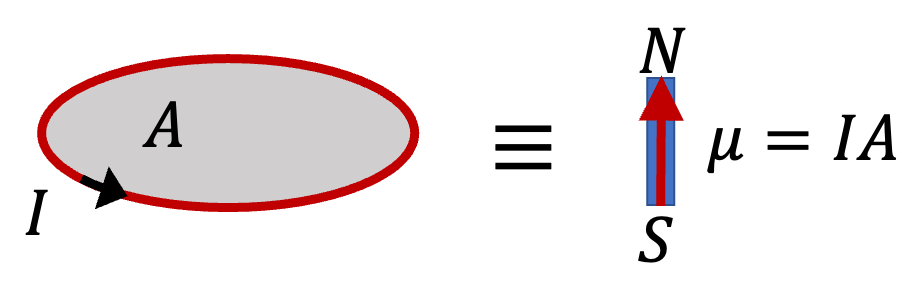
Now, we can get the magnetic dipole moment by multiplying this with the area of the loop.
\begin{align*}
\mu \amp = I A = 5.1\times 10^{-5}\text{ A} \times \pi \times (0.05\times 10^{-9}\text{ m})^2 \\
\amp = 4.0\times 10^{-25}\, A.m^2.
\end{align*}

