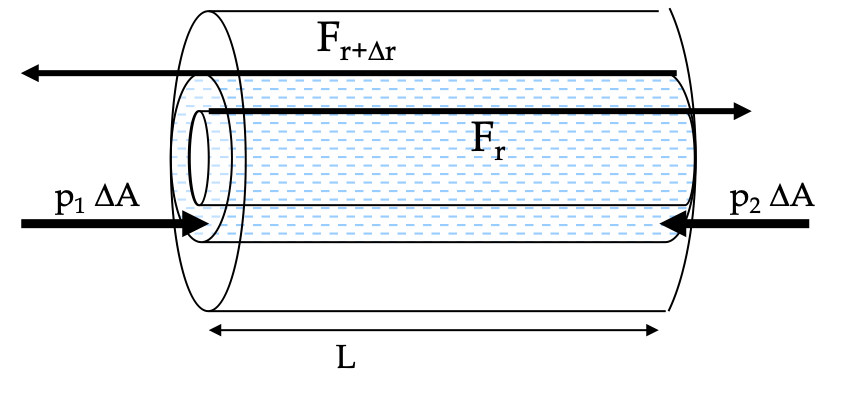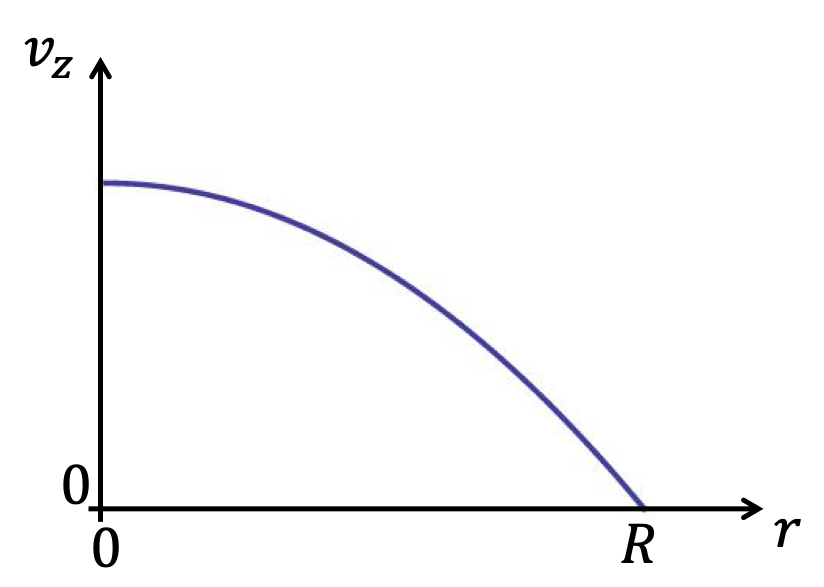
Example 18.29. Determining Diameter of Vein from Pressure Difference and Length of Vein.
One liter of blood flows per day through a narrow vein of length \(5\text{ cm}\) which has a pressure difference of \(0.5\text{ atm}\) across its length. What is the diameter of the vein?
Data: \(\eta_\text{blood} = 2.7\text{ cP}\text{.}\)
Solution.
The Poiseuille’s law says that
\begin{equation*}
Q = \frac{\pi R^4}{8\eta L} \Delta p.
\end{equation*}
Therefore,
\begin{equation*}
R = \left( \frac{8\eta L}{\pi \Delta p}\ Q\right )^{1/4}.
\end{equation*}
In this problem, various given quantities should be first converted into the same system of units. We will convert them into standard SI system.
\begin{align*}
\amp Q = 1 \frac{\text{L}}{\text{Day}} = \frac{10^{-3}\ \text{m}^3}{24\times 3600\ \text{s}} = 0.01157 \ \text{m}^3\text{s}\\
\amp \Delta p = 0.5\ \text{atm} = 2.53\times 10^{4}\ \text{Pa} \\
\amp L = 0.05\ \text{m} \\
\amp \eta = 2.7\ \text{cP} = 2.7\times 10^{-3}\ \text{Pa.s}
\end{align*}
Therefore, \(R = 112\, \mu\text{m}\text{.}\) The diameter of the vein would be \(224\, \mu\text{m}\text{.}\)