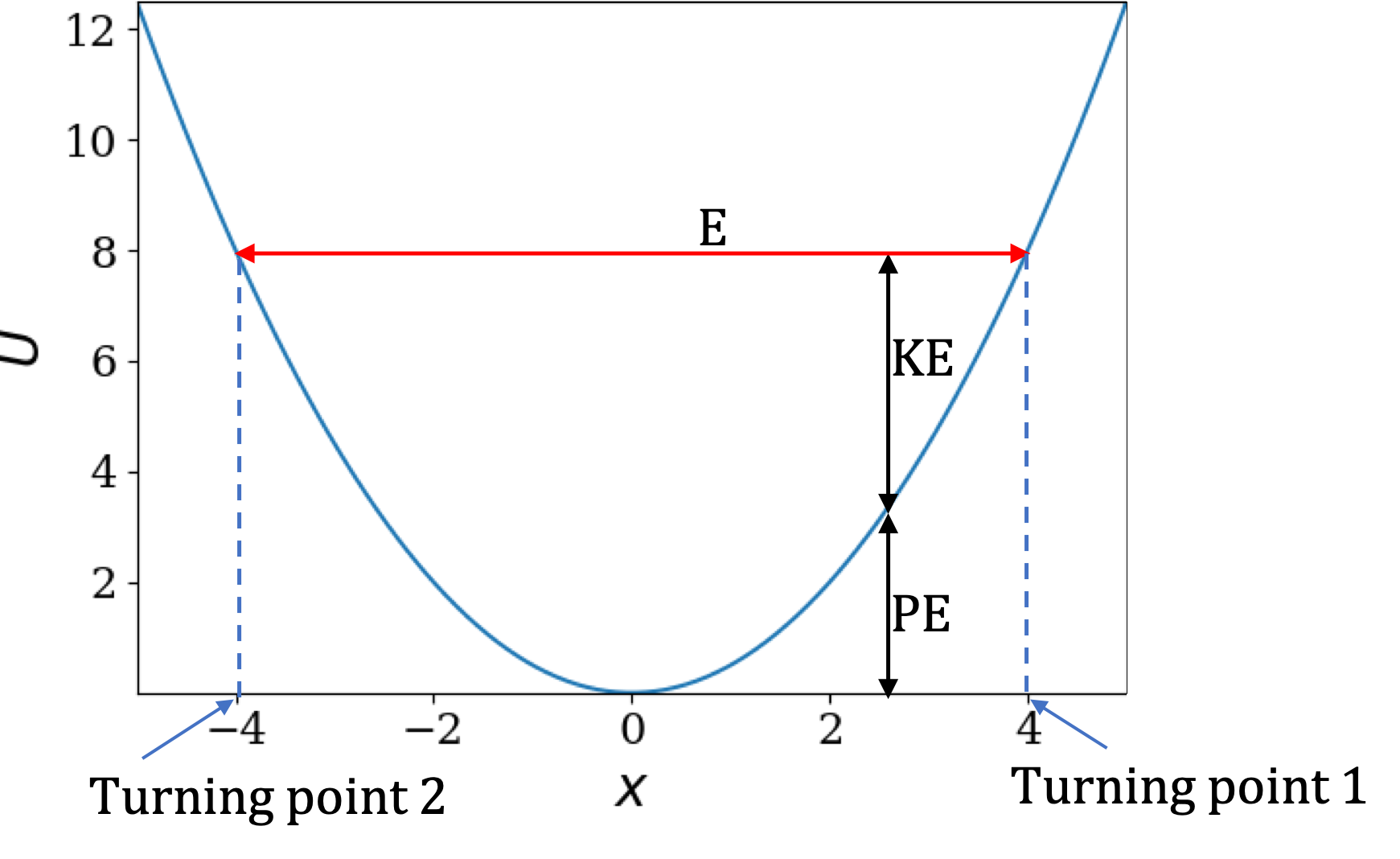
Since block has no friction on it, its energy will be conserved. Let us denote the original position as point A, equilibrium as point B and
\(1.5\text{ cm}\) from the equilibrium as point C.
(a) When block is at point A, it is not moving, therefore all energy is in the potential energy stored in the spring. We convert all length units to \(\text{meter}\text{.}\)
\begin{equation*}
E_A = \frac{1}{2}kx_A^2 = \frac{1}{2}(180)(0.03)^2 = 0.081\text{ J}.
\end{equation*}
When block is at point B, the spring is neither stretched nor compressed, therefore there is no potential energy stored in the spring. Hence, all the energy which the system started out with must be in the form of kinetic energy of the block.
\begin{equation*}
E_B = \frac{1}{2}mv_B^2 = \frac{1}{2}(0.6)\,v_B^2 = 0.3\, v_B^2.
\end{equation*}
Equating the energy at B to the energy at A we find
\begin{equation*}
0.3\, v_B^2 = 0.081\ \ \Longrightarrow\ \ v_B = 0.52\text{ m/s}.
\end{equation*}
(b) When block is at point C, which could be on either side of the equilibrium a distance of \(1.5\text{ cm}\) away from the equilibrium, the spring is either compressed or stretched. Therfore, there will be potential energy stored in the spring. But, the stored potential energy is less than the starting energy, hence, the rest of the energy will be in the form of kinetic energy of the block.
\begin{equation*}
E_C = \frac{1}{2}mv_C^2 + \frac{1}{2}kx_C^2= 0.3\, v_C^2 + 0.020.
\end{equation*}
Equating \(E_C\) to \(E_A\text{,}\) and solving for \(v_C\) we find the speed when the block is \(1.5\text{ cm}\) from the equilibrium to be
\begin{equation*}
0.3\, v_C^2 + 0.020 = 0.081 \ \ \Longrightarrow\ \ v_C = 0.45\text{ m/s}.
\end{equation*}