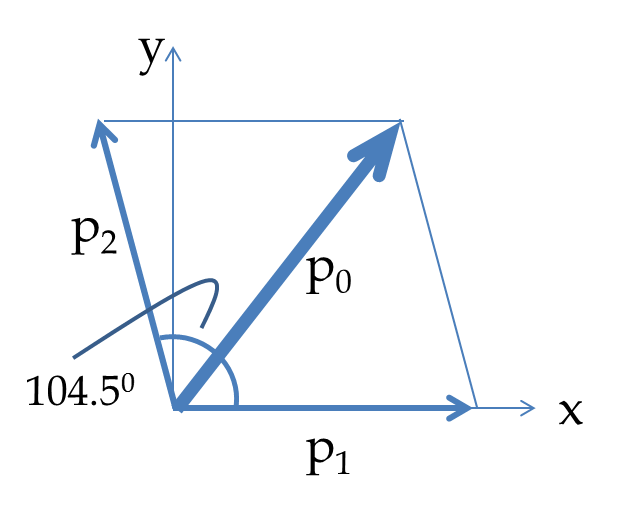
(a) Let
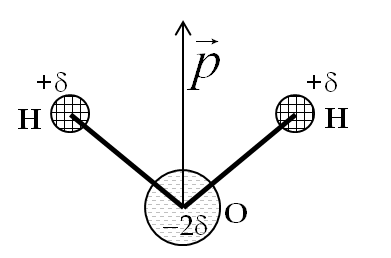
\(p\) be the unknown dipole moment of each OH bond. The dipole moment of the water molecule is equal to the vector sum of the dipole moments of the OH bonds which are at an angle of
\(104.5^{\circ}\text{.}\)
Let \(p\) denote the magnitude of the dipole moment of the OH bond, denoted as \(\vec p_1\) and \(\vec p_2\) in the figure. Equating the \(x\)-component of the dipole moment \(\vec p_0\) of the water molecule to the sum of the \(x\)-components of the OH bonds gives
\begin{equation*}
p_0\:\cos(\theta/2) = p + p\cos\theta,
\end{equation*}
where \(\theta = 104.5^{\circ}\text{,}\) the angle between the OH bonds. Solving for \(p\) we get
\begin{equation*}
p = \left[ \dfrac{\cos(\theta/2)}{1+ \cos\theta} \right] \: p_0.
\end{equation*}
Now, putting the numerical values we find the following for the magnitude of the dipole moment of the OH bond.
\begin{equation*}
p = \left[ \dfrac{\cos(52.25^{\circ})}{1+ \cos(104.5^{\circ})} \right] \times 6.1 \times 10^{-30}\: \textrm{C.m} = 4.98\times 10^{-30}\: \textrm{C.m}.
\end{equation*}