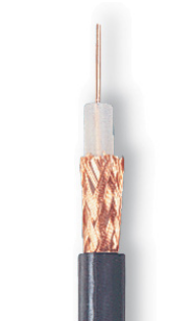
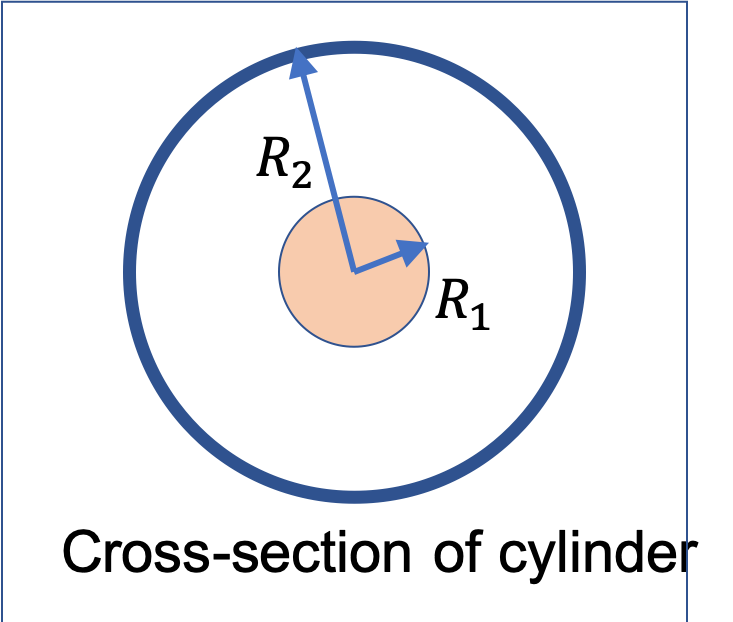
We will find below that capacitance per unit length is given by
\begin{equation*}
C/L = \dfrac{2\pi\epsilon_0}{\ln\left(R_2/R_1 \right)},
\end{equation*}
if there is nothing between the two conductors, and
\begin{equation*}
C/L = \dfrac{2\pi\epsilon_0\epsilon_r}{\ln\left(R_2/R_1 \right)},
\end{equation*}
if there is a material of dielectric constant \(\epsilon_r\) filling the space between the conductors.
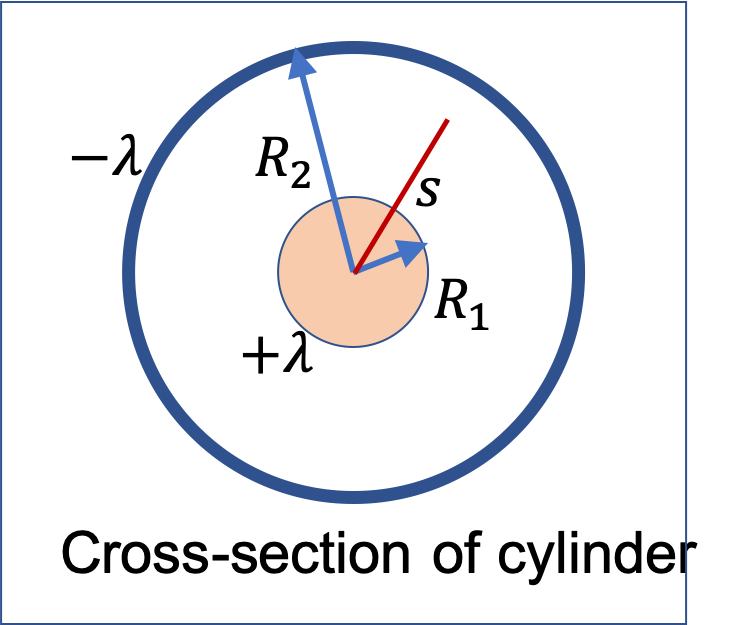
As always, to get capacitance, we will place charges on the two conductors and find the potential difference between them. The ratio of potential difference to the charge will be identified to be the capacitance.
By applying Gauss’s law, you can show that the electric field of these charges is
\begin{equation*}
E = \begin{cases}
0 \amp s \lt R_1\\
\dfrac{1}{2\pi\epsilon_0}\, \dfrac{\lambda}{s} \amp R_1 \lt r \lt R_2\\
0 \amp s \gt R_2
\end{cases}
\end{equation*}
Integrating this from outer plate to inner plate will give the potential difference. For students with Calculus background, you should do that integral. For othere, use the following answer.
\begin{equation*}
V = \phi_+ - \phi_- = \dfrac{\lambda}{2\pi\epsilon_0}\, \ln\left(\dfrac{R_2}{R_1} \right).
\end{equation*}
Dividing \(\lambda\) by \(V\text{,}\) we get capacitance per unit length of a cylindrical capacitor, which we will denote by a compound symbol \(C/L\text{,}\) to be
\begin{equation*}
C/L = \dfrac{2\pi\epsilon_0}{\ln\left(R_2/R_1 \right)}.
\end{equation*}
If the space between the two wires is occupied by an dielectric/insulator of dielectric constant \(\epsilon_r\text{,}\) then capacitance is increased by a multiple of \(\epsilon_r\text{.}\)
\begin{equation*}
(C/L)_\text{with dielectric} = \epsilon_r\, C/L = \dfrac{2\pi\epsilon_0\epsilon_r}{\ln\left(R_2/R_1 \right)}.
\end{equation*}