An atom has a permanent magnetic dipole moment if the vector sum of magnetic dipole moments of its electrons is not zero. When an atom is placed in an external magnetic field, a magnetic dipole moment is also induced in the atom as we will see now. The induced dipole moment occurs in every material regardless of whether the material has a permanent magnetic dipole moment or not.
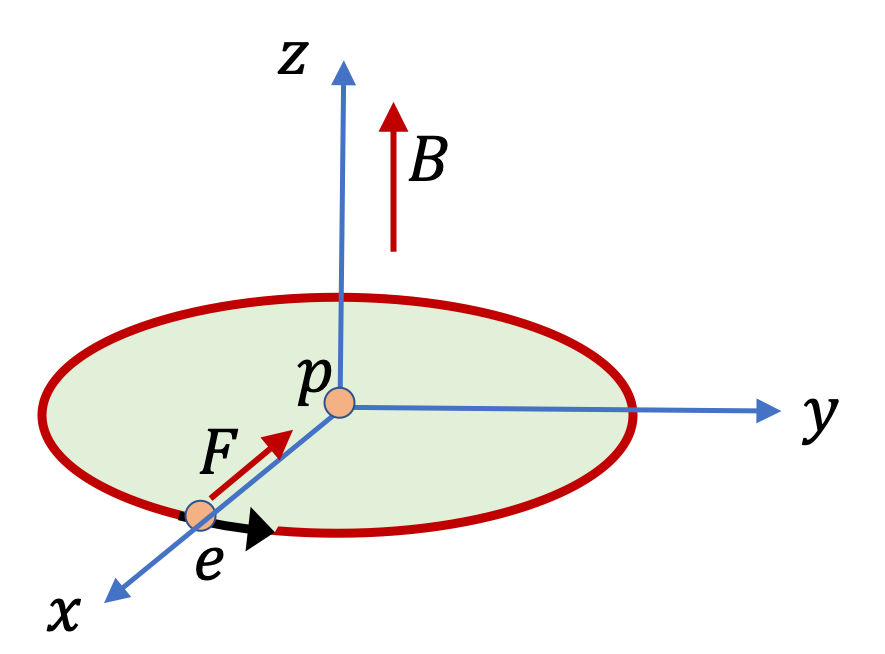
To see the emergence of an induced magnetic dipole moment in a material, consider a hydrogen atom and model the motion of the electron as a uniform circular motion of radius
\(R\) and constant speed
\(v\text{,}\) which is an gross simplification of the actual situation, but it will do for our purpose here.
In the absence of any magnetic field, the net force on the electron would be the electric force from the proton in the nucleus. Therefore, its acceleration will be centripetal.
\begin{equation}
\frac{1}{4\pi\epsilon_0} \frac{e^2}{R^2} = m_e\frac{v^2}{R}.\tag{37.20}
\end{equation}
When the atom is placed in an external magnetic field \(\vec B\text{,}\) there will be an additional force on the moving electron given by \(\vec F= -e\vec v\times\vec B\text{.}\)
If the radius of the orbit under new forces is to remain the same as the old radius, then the speed must change to \(v'\) to satisfy the changes equation of the uniform circular motion:
\begin{equation}
\frac{1}{\pi\epsilon_0} \frac{e^2}{R^2} + |e|v'B = m_e\frac{v'^2}{R}. \tag{37.21}
\end{equation}
\begin{equation*}
|e|v'B = \frac{m_e}{R}\left( v'^2-v^2\right) = \frac{m_e}{R}(v'+v)(v'-v).
\end{equation*}
Assuming the change in speed \(\Delta v = v'-v\) to be small, we can replace \(v'+v\) by \(2v\) on the right side since \(v'\approx v\) and obtain the following for the change in the speed.
\begin{equation*}
\Delta v = \frac{|e|BR}{2m_e} \gt 0.
\end{equation*}
Notice that when we turn on a magnetic field, electron speeds up. This additional speed at the same radius will result in additional angular momentum. The angular momentum vector will be positive
\(z\) direction in
Figure 37.8. Therefore, we will get the following change in the
\(z\)-component of the angular momentum.
\begin{equation*}
\Delta L_z = m_e R\Delta v = \frac{1}{2}\, |e| BR^2.
\end{equation*}
With \(\vec \mu_e = - g_e \vec L\text{,}\) we will conculde that this will induce a agnetic dipole moment in the direction opposite to that of the external magnetic field. That is in the negative \(z\) axis here.
\begin{equation*}
\Delta \mu_z = -g_e\Delta L_z = -\dfrac{g_e}{2}\,|e| R^2 B.
\end{equation*}
Writing this in the vector notation we have induced dipole moment vector to be
\begin{equation*}
\Delta \vec\mu = -\dfrac{g_e}{2}\,|e|R^2\vec B.
\end{equation*}
In terms of Bohr magneton \(\mu_B\text{,}\) this will be
\begin{equation*}
\Delta \vec\mu = -\dfrac{1}{2\hbar}\,|e|R^2\vec B\, \mu_B.
\end{equation*}
We find that induced magnetic moment is directed opposite to the applied magnetic field. The magnetic field of oppositely directed induced magnetic dipoles reduce the magnetic field inside the material. The phenomenon of reduced magnetic field in a magnetic material is called diamagnetic effect.
The induced magnetic dipole moments due to the diamagnetic effect are usually considerably less than the permanent magnetic dipole moments if the later is present in a material, e.g., in paramagents and ferromagents. Therefore, although induced magnetic dipoles are created in all materials, the diamagnetic effect is most evident in the substances, such as Bismuth, that have no permanent magnetic dipole moments.