Example 10.25. Moment of Inertia of a Dumbbell.
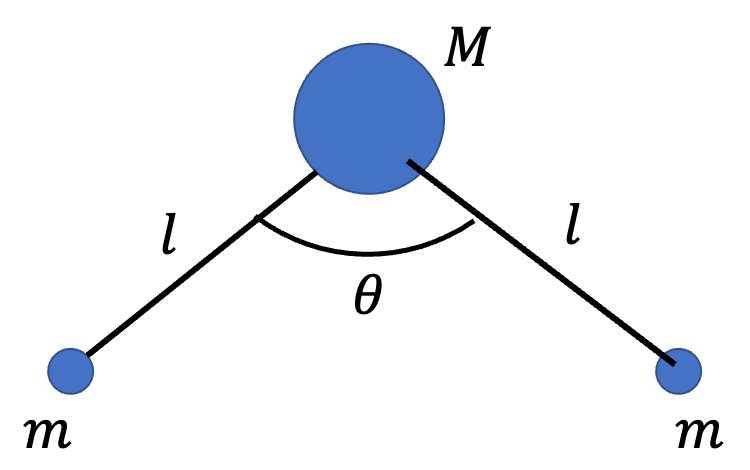
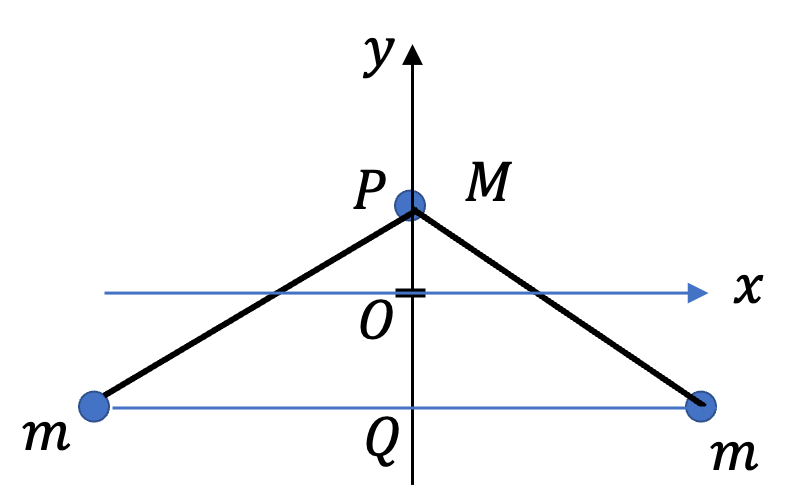
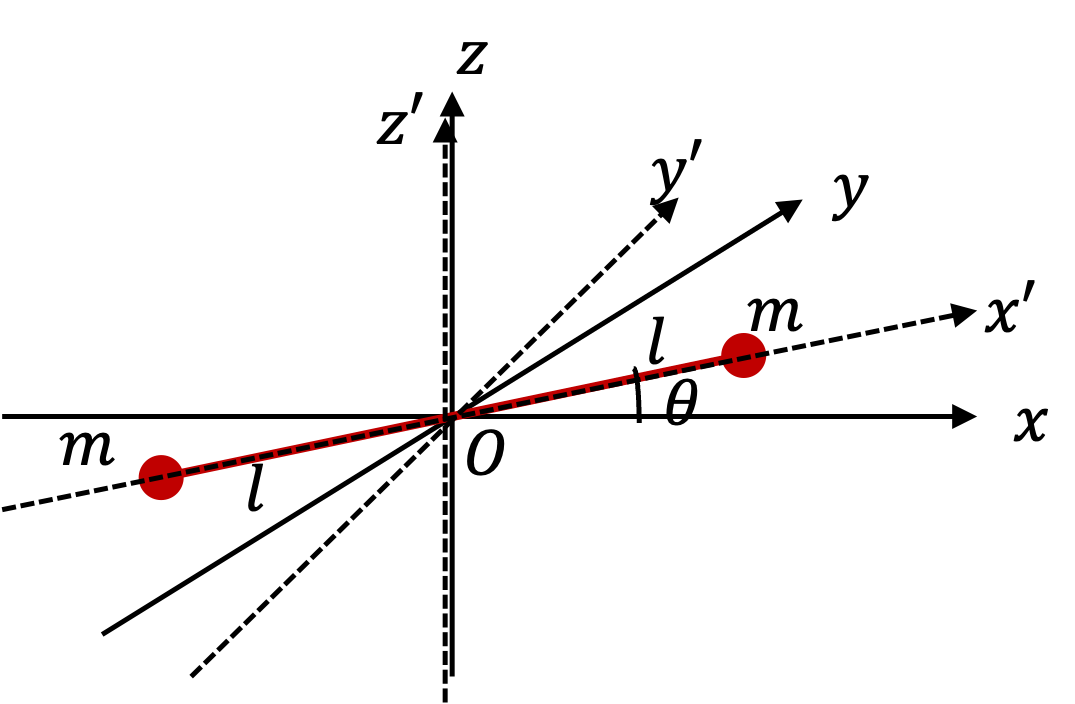
We want to find moment of inertia of a dumbbell with respect to two different coordinate systems shown in Figure 10.26. Find all nine moments of inertia in \(Oxyz\) and \(Ox'y'z'\text{.}\)
Solution.
We need coordinates of the two masses in the two systems. From Figure 10.26, we read off the following for the mass (say 1) on the right.
\begin{gather*}
x_1 = l\cos\theta,\ \ y_1 = l \sin\theta,\ \ z_1 = 0\\
x'_1 = l,\ \ y'_1 = 0,\ \ z'_1 = 0
\end{gather*}
The coordinates of the other particle are negative of these values. Therefore, we get the following moments of inertia in \(Oxyz\text{.}\)
\begin{align*}
\amp I_{xx} = 2m l^2 \sin^2\theta,\ \ I_{yy} = 2m l^2 \cos^2\theta,\ \ I_{zz} = 2m l^2,\\
\amp I_{xy} = -2m l^2 \sin\theta\,\cos\theta,\ \ I_{xz} = 0,\ \ I_{yz} = 0.
\end{align*}
Organizing this in matrix we have the following in \(Oxyz\text{.}\)
\begin{equation*}
{\bf I} =
\begin{pmatrix}
2m l^2 \sin^2\theta \amp -2m l^2 \sin\theta\,\cos\theta \amp 0\\
-2m l^2 \sin\theta\,\cos\theta \amp 2m l^2 \cos^2\theta \amp 0\\
0 \amp 0 \amp 2m l^2
\end{pmatrix}
\end{equation*}
In \(Ox'y'z'\text{,}\) we will get
\begin{align*}
\amp I_{x'x'} = 0,\ \ I_{y'y'} = 2m l^2,\ \ I_{z'z'} = 2m l^2,\\
\amp I_{x'y'} = 0,\ \ I_{x'z'} = 0,\ \ I_{y'z'} = 0.
\end{align*}
Organizing this in matrix we have the following in \(Ox'y'z'\text{.}\)
\begin{equation*}
{\bf I'} =
\begin{pmatrix}
0 \amp 0 \amp 0\\
0 \amp 2m l^2 \amp 0\\
0 \amp 0 \amp 2m l^2
\end{pmatrix}
\end{equation*}