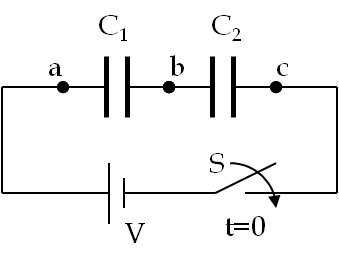
Capacitor circuits can be built by connecting capacitors in series or in parallel or neither. When capacitors are placed in series the capacitance decreases and when they are in parallel the capacitance increases, as we will see below by finding a formula for the equivalent capacitance.
By the conservation of charge, you can easily see that the charge of the two plates will be same,
\(\pm Q\text{.}\) But, the voltage drop across the two capacitors will depend upon their capacitance, since for each capacitor, we must have
\(V_i = Q/C_i\text{.}\)
\begin{equation*}
V_1 = \frac{Q}{C_1};\ \ \ V_2 = \frac{Q}{C_2}
\end{equation*}
The voltages \(V_1\) and \(V_2\) drop in series and therefore add up to the voltage of the source \(V\text{,}\) according to Kirchhoff’s loop rule.
\begin{equation*}
V = V_1 + V_2.
\end{equation*}
Hence,
\begin{equation*}
V = \frac{Q}{C_1} + \frac{Q}{C_2} = Q \left( \frac{1}{C_1} + \frac{1}{C_2}\right)
\end{equation*}
This equation can be used to define an equivalent capacitance \(C_\text{series}\) of the two capacitors in series by imagining replacing the circuit with another circuit with the same source but ony one capacitor charged to the same amount as the capcitors here.
\begin{equation*}
V = \dfrac{Q}{C_\text{series}}.
\end{equation*}
Equating the \(V\)’s and canceling out the \(Q\)’s we get equivalent capacitance in terms of the original capacitances.
\begin{equation}
\frac{1}{C_\text{series}} = \frac{1}{C_1} + \frac{1}{C_2}.\tag{34.61}
\end{equation}
Similar arguments lead to the equivalent capacitance of \(N\) capacitors connected in series.
\begin{equation}
\frac{1}{C_\text{series}} = \frac{1}{C_1} + \frac{1}{C_2} + \cdots + \frac{1}{C_N}.\tag{34.62}
\end{equation}
We find that the formula for capacitors in series is similar to the formula for resistors in parallel. The net capacitance of capacitors in series is lower than the lowest capacitance in series. Hence, capacitance decreases when you connect capacitors in series.
This result makes sense when you think in terms of a parallel plate capacitor. The capacitance of a parallel plate capacitor decreases inversely with the distance between plates. By connecting plates in series, we are effectively increasing the distance between the plates, and hence a reduction in capacitance is expected here. When capacitors with very different capacitances are connected in series, you may be able to simply ignore the capacitors with high capacitance since they may contribute insignificantly compared to the effective capacitance of the group.