
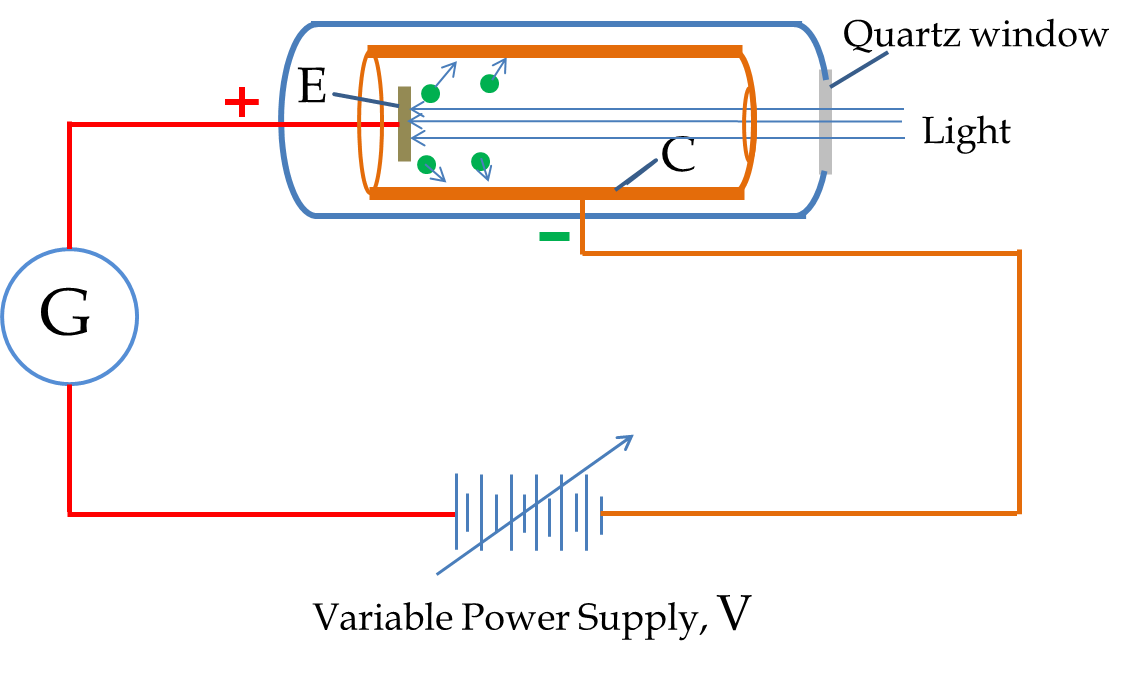
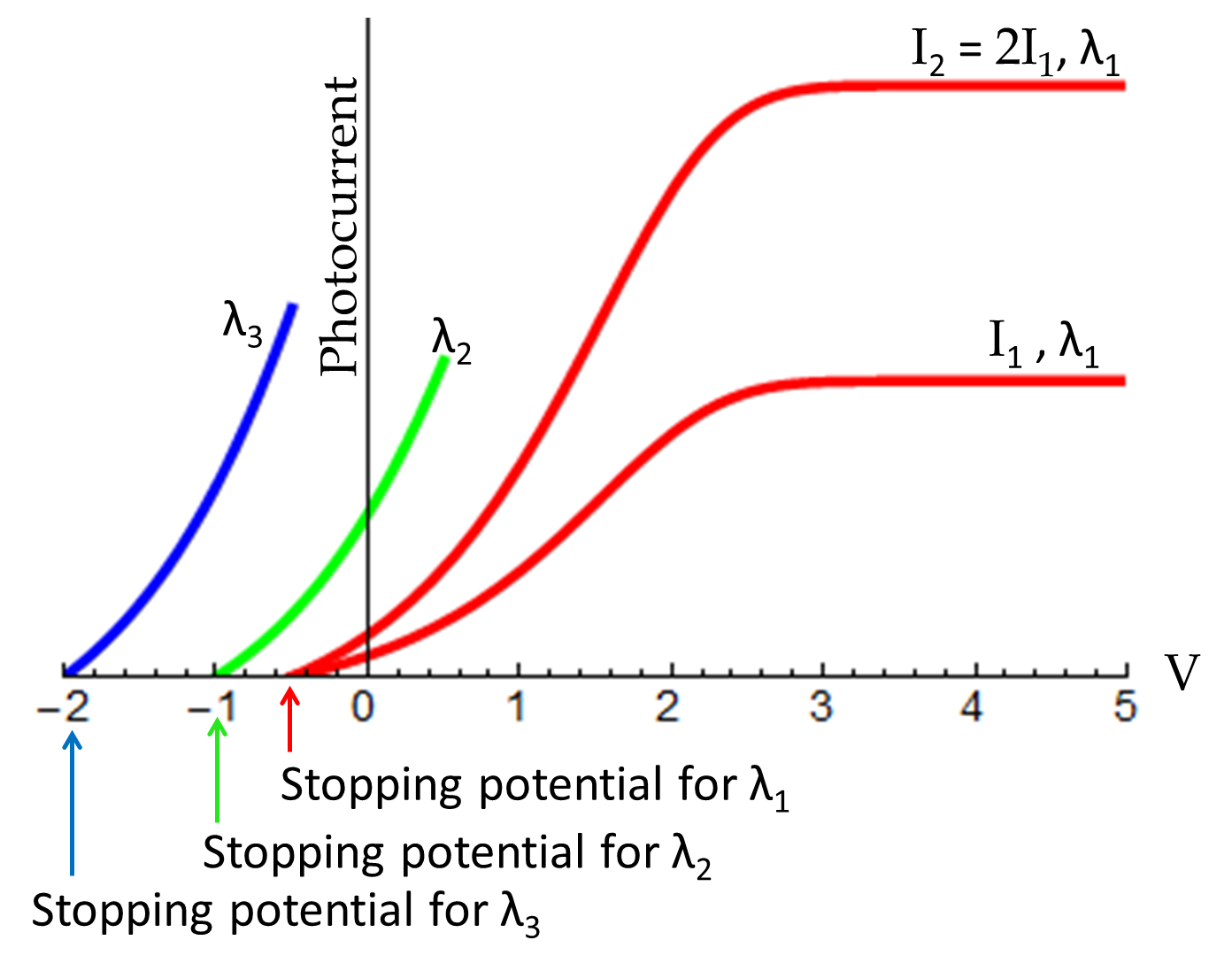
In a photoelectric experiment on sodium it is found that the photoelectrons emitted by an ultraviolet light can be stopped by applying a stopping voltage of 4.0 V. (a) What is the maximum largest speed of these photoelectrons? (b) If the work function of sodium is 2.28 eV, what is the frequency of the ultraviolet light incident on the metal?
Hint.
Answer.
Solution.
(a) The weakest bound electron will be ejected with the largest kinetic energy, hence the largest speed. Equating the energy of the electron corresponding to the stopping potential to the kinetic energy of the most energetic electron gives
\begin{equation*}
\frac{1}{2} m_e v^2_{\textrm{max}} = e V_0.
\end{equation*}
Solving for \(v_{\textrm{max}}\) we get
\begin{equation*}
v_{\textrm{max}} = \sqrt{\frac{2eV_0}{m_e}}.
\end{equation*}
Now, we put the numerical values to obtain
\begin{align*}
v_{\textrm{max}} \amp = \sqrt{\frac{2\times 4.0\:\textrm{eV}\:c^2}{m_ec^2}} = c\times \sqrt{\frac{8.0\:\textrm{eV}}{0.511\times 10^6\:\textrm{eV}}}\\
\amp = 0.004 c = 1.2\times 10^6\:\textrm{m/s},
\end{align*}
where I used \(m_ec^2 = 0.511\:\textrm{MeV}\text{.}\) The speed is \(1.2\times 10^6\:\textrm{m/s}\text{,}\) which is quite a large speed, but only 0.4\% of the speed of light, which justifies the use of the non-relativistic formula for the kinetic energy.
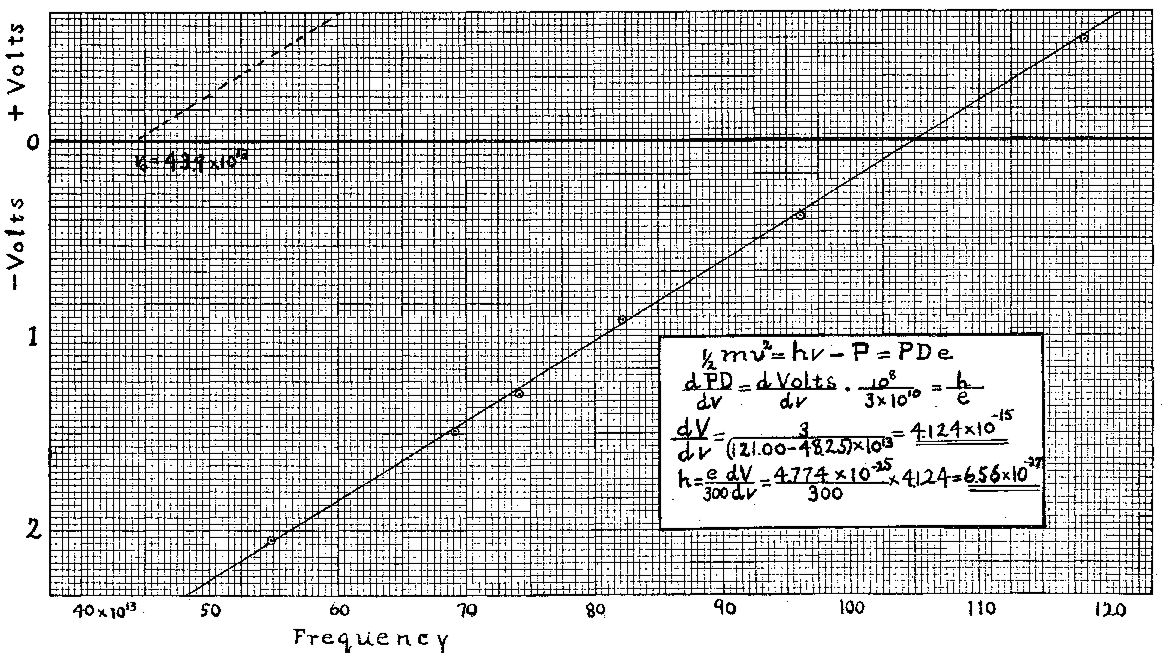
(b) Now, using Einstein’s equation we can determine the frequency of the photon of the ultraviolet light.
\begin{equation*}
f =\frac{ eV_0 + W}{h} = \frac{ 4.0\:\textrm{eV} + 2.28\:\textrm{eV}}{4.1357 \times 10^{-15}\:\textrm{eV.s}} =1.52\times10^{15}\:\textrm{Hz}.
\end{equation*}

