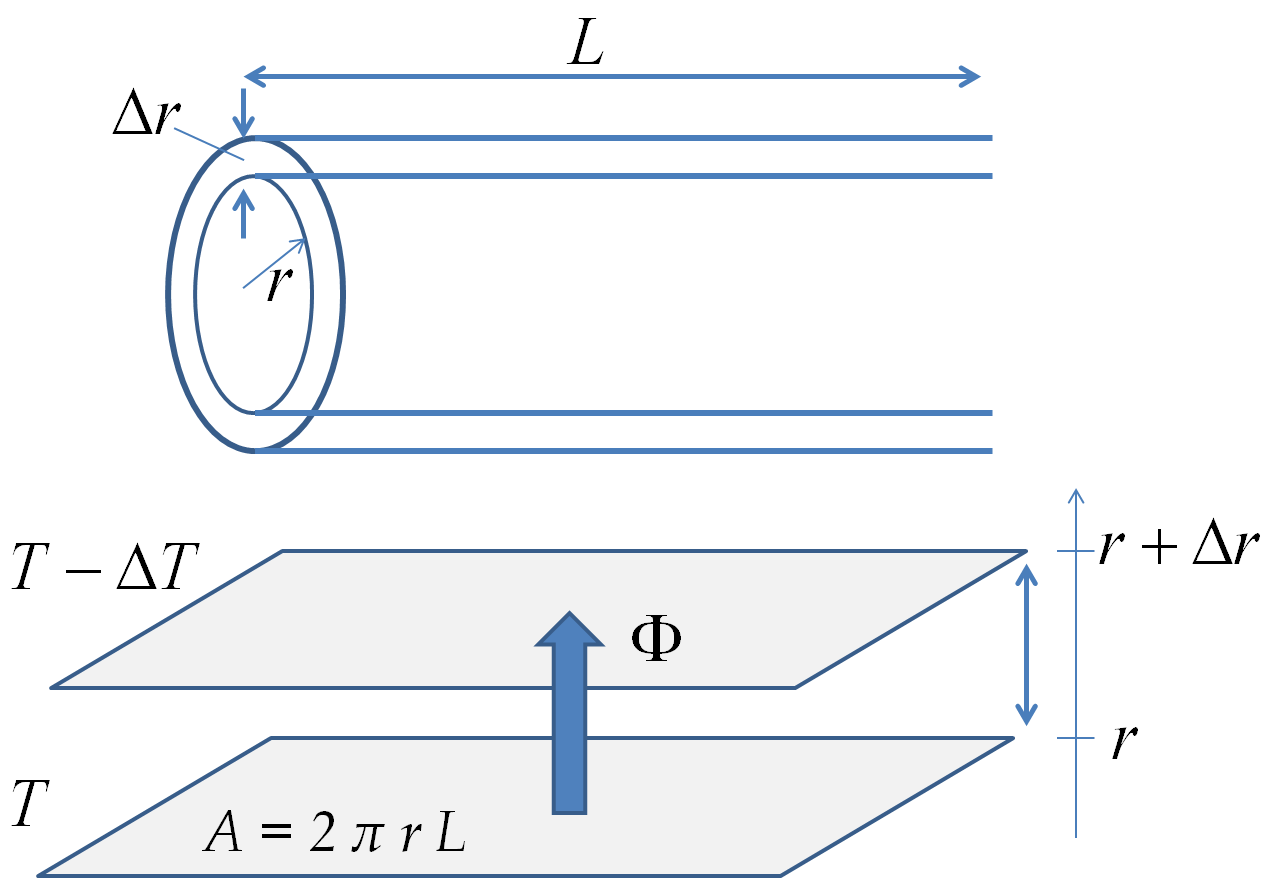
Let
\(\Delta h\) be the height of the ice frozen in time
\(\Delta t\) when the thickness of the ice is
\(h\text{.}\) The heat released at the bottom of the ice layer of thickness
\(h\) will be conducted through the ice layer to the lower temperature environment above.
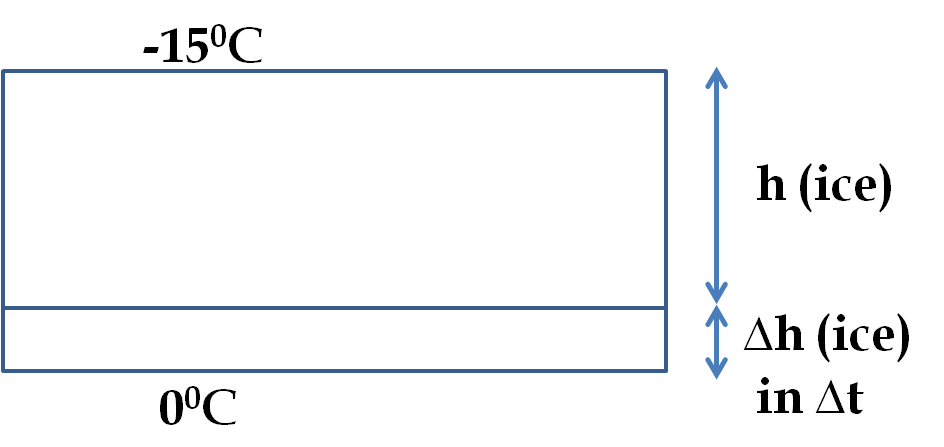
Let \(l_m\) be the latent heat of freezing of ice. We can calculate the flux \(\Phi\) of heat by dividing the heat released by the area of the lake and the time \(\Delta t\text{.}\)
\begin{equation}
\Phi = \frac{\Delta Q}{A \Delta t} = \frac{(\rho_{\text{ice}} A \Delta h)\ l_m}{A \Delta t} = \frac{\rho_{\text{ice}} A \Delta h\ l_m}{\Delta t}. \tag{23.22}
\end{equation}
This will equal the flux written in terms of the conductivity \(k_{\text{ice}}\) of the ice, the thickness \(h\) of the ice at the time and the temperature difference \(\Delta T = T_{\text{below}} - T_{\text{above}}\text{.}\)
\begin{equation}
\Phi = k_{\text{ice}} \frac{\Delta T }{h}. \tag{23.23}
\end{equation}
\begin{equation*}
\frac{\rho_{\text{ice}} A \Delta h\ l_m}{\Delta t} = k_{\text{ice}} \frac{\Delta T }{h}.
\end{equation*}
Solving this for \(\Delta h/\Delta t\) we get
\begin{equation}
\frac{\Delta h}{\Delta t} = \frac{k_{\text{ice}}\Delta T }{\rho_{\text{ice}} l_m}\ \frac{1}{h}. \tag{23.24}
\end{equation}
Putting in numerical values we find the rate of freezing when \(h = 2\text{ cm}\text{.}\)
\begin{align*}
\frac{\Delta h}{\Delta t} \amp = \frac{0.00478\ \text{cal/s.cm.K}\times 15\ \text{K}}{1\ \text{g/cm}^3\times 79.8\ \text{cal/g} \times 2\ \text{cm}} \\
\amp = 4.5\times 10^{-4}\ \text{cm/s} = 1.61\ \text{cm/h}.
\end{align*}