Logo image

Physics Bootcamp

Section 4.10 Kinematics Bootcamp

Exercises Exercises

Position and Displacement Vectors

Velocity and Speed

Acceleration

Velocity from Acceleration

Constant Acceleration and Projectile Motions

Variable Acceleration

50. Change in Velocity from Area Under Curve of Acceleration vs Time.
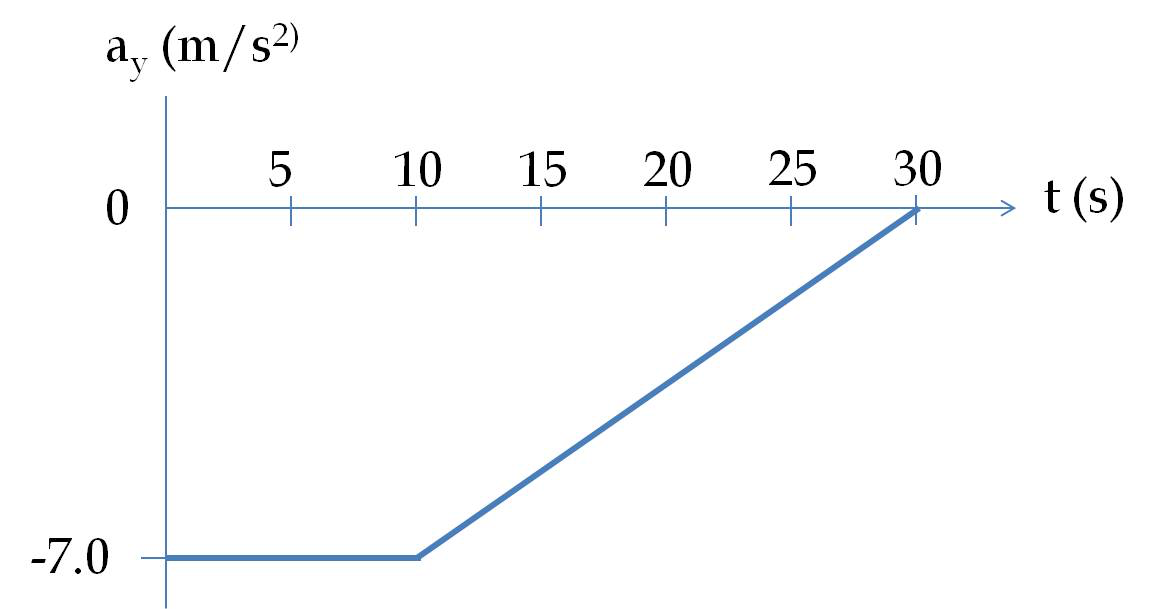
A skydiverโ€™s acceleration changes as the parachute opens up. A coordinate with \(y\) axis pointed vertically up is used to record the acceleration of the skydiver. The skydiver exits from an air plane at vertical velocity component zero. She opens her parachute after \(10 \text{ sec}\text{.}\) We will assume that parachute opens instantaneously at \(10 \text{-sec}\) second mark. For the first \(10\text{ sec}\) the acceleration of the parachuter is \(7 \text{m/s}^2\) pointed down. After the parachute opens at the \(10\text{-sec}\) mark, the \(y\) component of the acceleration comes to zero in another \(20 \text{ sec}\) as shown in Figureย 4.89. Find the velocity of the parachuter at (a) \(t = 10 \text{ sec}\text{,}\) (b) \(t = 30 \text{sec}\text{?}\)
Figure 4.89. Variable acceleration of a parachuter.
Hint.
Use area under the curve.
Answer.
(a) \(-70\text{ m/s}\text{,}\) (b) \(140\text{ m/s}\text{.}\)
Solution 1. a
The area under the curve method for the changing acceleration can be applied to determine the change in velocity over any period. Part (a) is actually over an interval where the acceleration is constant. Therefore, for part (a) we could use either the constant acceleration equations or the area under the \(a\) vs \(t\) method. For part (b) we cannot use the constant acceleration formulas and must resort to variable acceleration method.
(a) The area under the curve method can be applied to the the segment of curve from \(t=0\) to \(t=10 \text{ sec}\text{.}\) The area is that of a rectangle with one side equal to \(-7 \text{ m/s}^2\) and the other side equal to \(10 \text{ sec}\text{.}\) Therefore, the area is \(-70 \text{ m/s}\text{,}\) which is the change in the velocity of the parachuter. Since the initial velocity of the parachuter is given to be zero, the velocity at \(10\text{ sec}\) mark is \(-70\text{ m/s}\text{.}\) The negative sign correctly gives the direction as pointed down since pointed up has been taken to be the positive direction. We can verify that we get the same result from using constant acceleration equations. Here \(v_0=0\text{,}\) \(t=10\text{ sec}\text{,}\) \(a=-7\text{ m/s}^2\text{.}\) Therefore \(v=v_0+at\) gives \(v=-70\text{ m/s}\text{,}\) same as the area under the curve method.
Solution 2. b
(b) This part has variable acceleration, so it would be mistake to use constant acceleration formulas. The area is that of a triangle of height \(-7\text{ m/s}^2\) and the base equal to \(20\text{ sec}\text{.}\) The area is \(-7\times 20/2 = -70\text{ m/s}\text{.}\) Therefore, the change in velocity in the time \(10\text{ sec}\) to \(30\text{ sec}\) is also \(-70\text{ m/s}\text{.}\) Since the velocity at the beginning of this interval was also \(-70\text{ m/s}\text{,}\) the velocity at the end of the interval will be \((-70\text{ m/s}) + (-70\text{ m/s})\text{,}\) or \(-140\text{ m/s}\text{.}\) Thus, velocity at time \(t=30\text{ sec}\) is \(140\text{ m/s}\) pointed down.

Relative Motion

Miscellaneous

58. Height from Time to Fall from Top to Bottom of Window.
Suppose you live on the \(5^{\text{th}}\) floor of a tall building. Your friend goes to the roof and drops a steel ball from rest while you time the ball as it falls. You find that the ball takes \(0.11\ \text{sec}\) to fall from the top of the window to the bottom of the window, a distance of \(0.8\) meter. How high above the top of the window of the \(5^{\text{th}}\) floor is the roof?
Hint.
First find the speed at the top of the window. Then, use that as initial speed for the problem for just the window.
Answer.
\(2.31\text{ m}\text{.}\)
Solution.
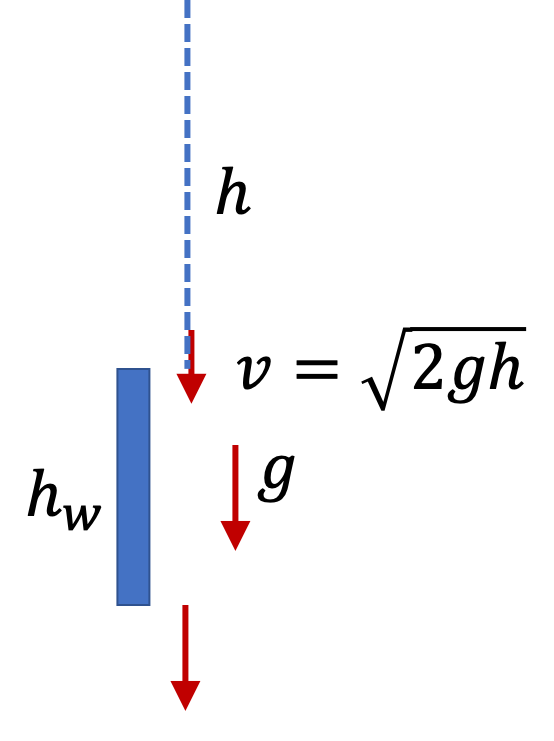
Let \(h\) be the height from top of the window to where the ball was let go from rest. We know that after freely falling this height, the ball would be moving at \(\sqrt{2gh}\text{.}\)
Now, let us look at motion from top of the window to bottom of the window. Let \(t=0\) at the top of window and \(t=t\) at tje bottom.
Then, using positive \(y\) axis pointed up, we have the following
\begin{equation*} v_{yi} = - \sqrt{2gh},\ \ a_y = -g,\ \ \Delta t= t, \ \ y_f-y_i = -h_w. \end{equation*}
Therefore we have the following equation of constant accleration useful in this context.
\begin{equation*} y_f - y_i = v_{yi}\Delta t + \dfrac{1}{2}a_y (\Delta t)^2. \end{equation*}
This gives
\begin{equation*} -h_w = -(\,\sqrt{2gh}\,)\, t -\dfrac{1}{2} g t^2. \end{equation*}
Solving for \(\sqrt{2gh}\) we get
\begin{align*} \sqrt{2gh}\amp = \dfrac{h_w}{t} - \dfrac{1}{2} g t,\\ \amp = \dfrac{0.8}{0.11} - \dfrac{1}{2} \times 9.81\times 0.11 = 7.27 - 0.54 = 6.73. \end{align*}
Therefore,
\begin{equation*} h = \dfrac{6.73^2}{2\times 9.81} = 2.31\text{ m}. \end{equation*}
59. Finding Initial Speed to Clear a Height for a Projectile.
A football leaves the kickerโ€™s foot at \(50^{\circ}\) from the horizontal direction. The football is required to clear a horizontal bar at a height of \(10\text{ m}\) above the ground at a horizontal distance of \(40\text{ m}\text{.}\) Find speed with which ball must leave the kickerโ€™s foot so that it would barely go over the bar.
Hint.
Standard projectile motion setup.
Answer.
\(22.5\text{ m/s}\text{.}\)
Solution.
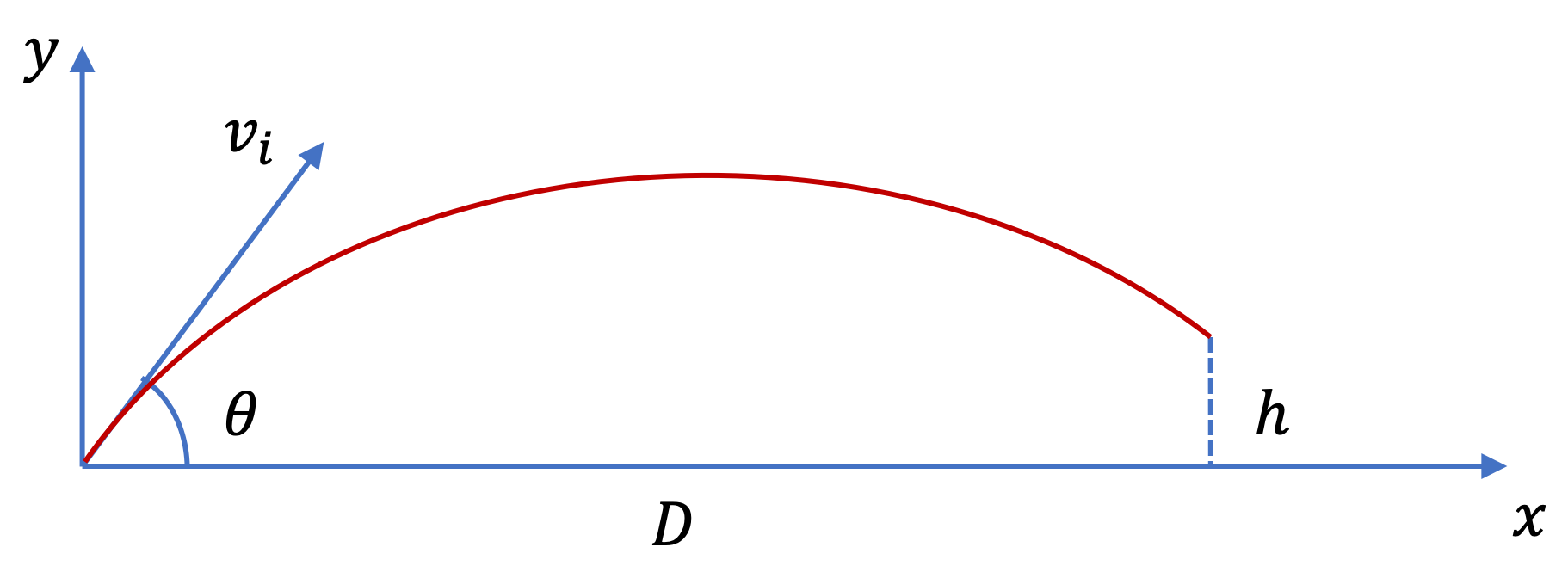
Let \(h\) denote the height to clear and \(D\) the horizontal distance to travel from the launch site as shown in Figureย 4.90. Let \(v_i\) denote the speed at the initial instant and \(\theta\) angle of launch.
Figure 4.90. Setup up for Exerciseย 4.10.59.
With \(t\) the duration of the flight we have the following two equations, one along \(x\) axis with \(a_x=0\) and one along \(y\) with \(a_y=-g\) that is useful to solve this problem.
\begin{align} D \amp = v_i\, t\, \cos\,\theta,\tag{4.68}\\ h \amp = v_i\, t\, \sin\,\theta -\dfrac{1}{2}g t^2,\tag{4.69} \end{align}
replace \(v_i t\) in the second equation to obtain an equation in \(t\) that we can solve for \(t\text{.}\)
\begin{equation*} h = D \tan\,\theta - \dfrac{1}{2}g t^2, \end{equation*}
which gives
\begin{equation*} t^2 = \dfrac{2}{g}(D \tan\,\theta - h ) = (2/9.81)\times(40\tan\,50^\circ - 10 ) = 7.68. \end{equation*}
Therefore,
\begin{equation*} t = \sqrt{7.68} = 2.77\text{ s}. \end{equation*}
Using this in Eq. (4.68) we get speed at initial instant to be
\begin{equation*} v_i = \dfrac{D}{t \cos\,\theta} = \dfrac{40}{2.77\, \cos\,50^\circ} = 22.5\text{ m/s}. \end{equation*}
60. How Far Above the Ground Rocket Piece Came Loose?
A rocket is rising at a constant velocity of \(200\ \text{m/s}\text{.}\) A piece of the rocket comes loose and falls freely to the ground. It takes \(40\ \text{sec}\) for the piece to fall to the ground after dislodging from the rocket. How far above the ground the piece came loose?
Hint.
Use postive \(y\) axis pointed up and use correct signs for directions.
Answer.
\(152\text{ m}\text{.}\)
Solution.
Let positive \(y\) axis point up. Let \(h\) be the required height. Then, we have the following informaion of the free motion during the interval \(\Delta t=50\text {sec}\text{.}\)
\begin{align*} \amp y_i = h, \ y_f=0,\ v_{iy} = +200\text{ m/s},\ v_{fy} =?,\\ \amp a_y=-9.81\text{ m/s}^2,\ \ t = 40\text{ s}. \end{align*}
Using the displacement-time equation we get
\begin{equation*} 0-h =200\times 40 - \dfrac{1}{2}\times 9.81 \times 40^2. \end{equation*}
Solving for \(h\) we get
\begin{equation*} h = 152\text{ m}. \end{equation*}
61. Determining \(g\) from Return Times at Two Heights.
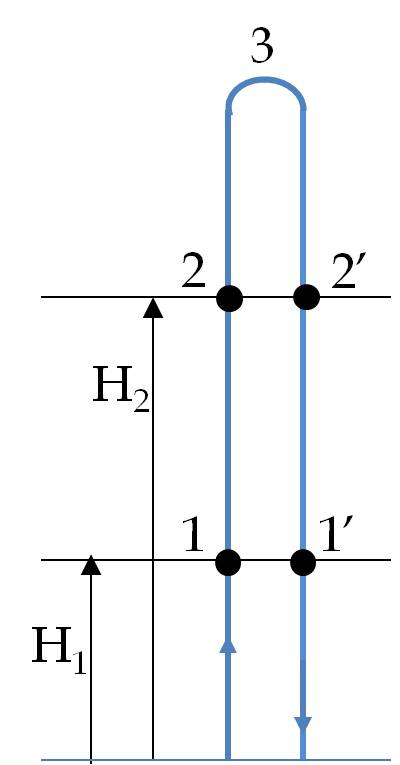
One way to measure the value of \(g\) is to launch a projectile vertically upward and record the return times at two different heights. Let \(T_1\) and \(T_2\) be the two return times, i.e.,the time for 1-3-1โ€™ and 2-3-2โ€™, at heights \(H_1\) and \(H_2\) respectively as shown in Fig. \ref{fig:prob-kin-8}. Deduce the following formula for \(g\) from the heights and times.
\begin{equation*} g = \frac{8\left( H_2 - H_1\right)}{T_1^2 - T_2^2}. \end{equation*}
Hint.
With same launch find the initial speeds at the two heights. Then, use that to get hang times for each height.
Answer.
Ans. already in statement.
Solution.
Let \(v_0\) be the launch speed, and \(v_1\) and \(v_2\) be speeds at heights \(H_1\) and \(H_2\text{.}\) Therefore we will have
\begin{align} v_1^2 \amp = v_0^2 - 2 g H_1 \tag{4.70}\\ v_1^2 \amp = v_0^2 - 2 g H_1 \tag{4.71} \end{align}
Now, when you launch a ball up with a speed \(v\) and if the return time is \(t\text{,}\) then you can set up the \(y_f-y_i=0\) for this to show that.
\begin{equation*} 0 = v t - \dfrac{1}{2} g t^2. \end{equation*}
That is \(gt\) of return time is
\begin{equation*} gt = 2 v. \end{equation*}
Applying this to the two return times we have
\begin{align} \amp gT_1 = 2 v_1,\tag{4.72}\\ \amp gT_2 = 2 v_2.\tag{4.73} \end{align}
Square these and subtract to get
\begin{equation*} g^2 \left( T_1^2 - T_2^2 \right) = 4\left( v_1^2 - v_2^2\right). \end{equation*}
Now using \(v_1^2\) and \(v_2^2\) from Eqs. (4.70) and (4.71), we will get
\begin{equation*} g^2 \left( T_1^2 - T_2^2 \right) = 8\, g\, \left(H_2 - H_1\right). \end{equation*}
Therefore,
\begin{equation*} g = \dfrac{ 8\, \left(H_2 - H_1\right) }{ T_1^2 - T_2^2 }. \end{equation*}