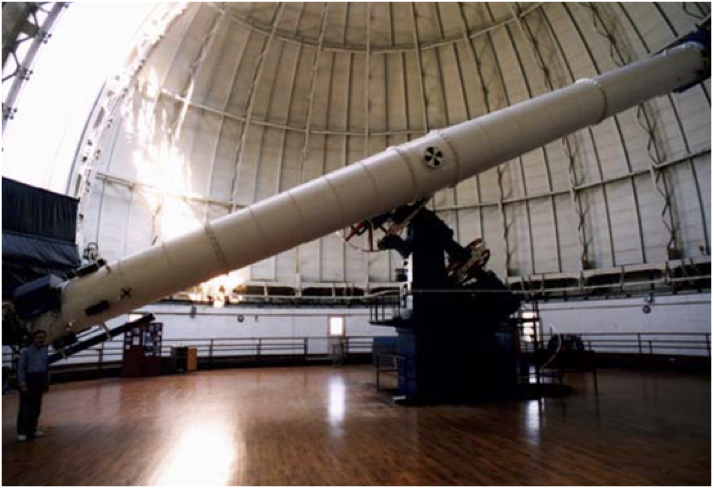
Note that the specification \(18\text{-in}\) of the telescope tells us the diameter of the aperture. Therefore, we have
\begin{equation*}
D = 18\text{ in} = 457.2\text{ mm}.
\end{equation*}
The wavelength is given in another unit. Let’s convert that to \(\text{mm}\) also.
\begin{equation*}
\lambda = 0.580\,\mu\text{m} = 5.8\times 10^{-4}\text{ mm}.
\end{equation*}
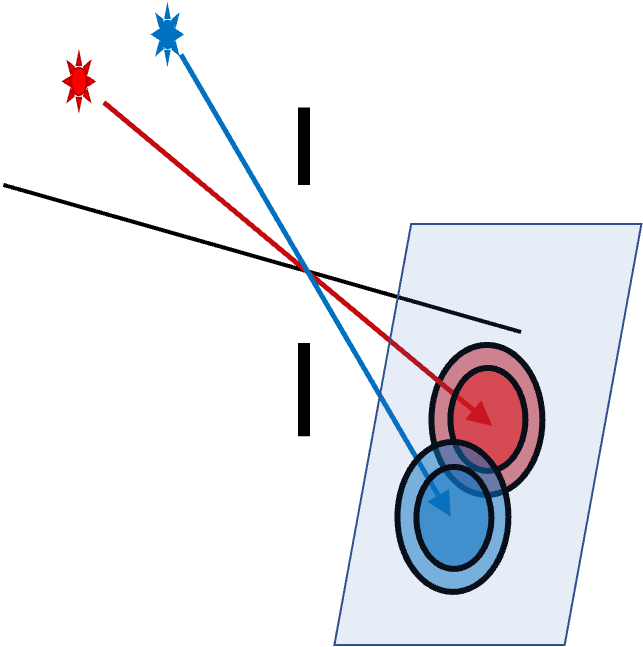
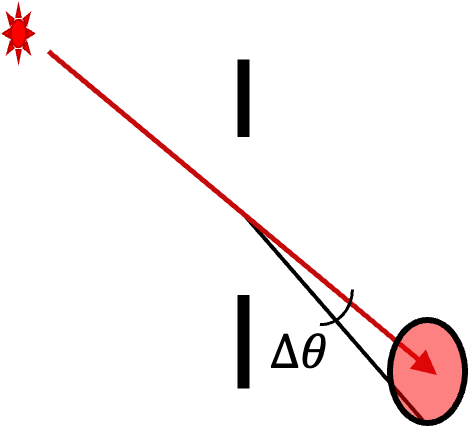
Therefore, full angle subtended by the disk at the converging lens of the CCD camera will be
\begin{equation*}
\theta = 2\times \frac{1.22\lambda}{D} = 3.1\times 10^{-6}\text{ rad}.
\end{equation*}
Now, we can use \(s=R\theta\) with \(R=f\) and \(s=\text{size on the detector}\) gives
\begin{equation*}
s = 35000\,\mu\text{m} \times 3.1\times 10^{-6}\text{ rad} = 0.11\,\mu\text{m}.
\end{equation*}