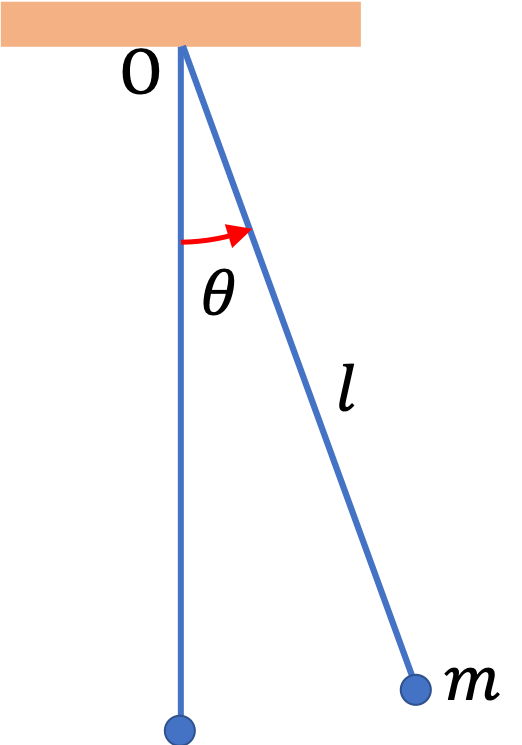
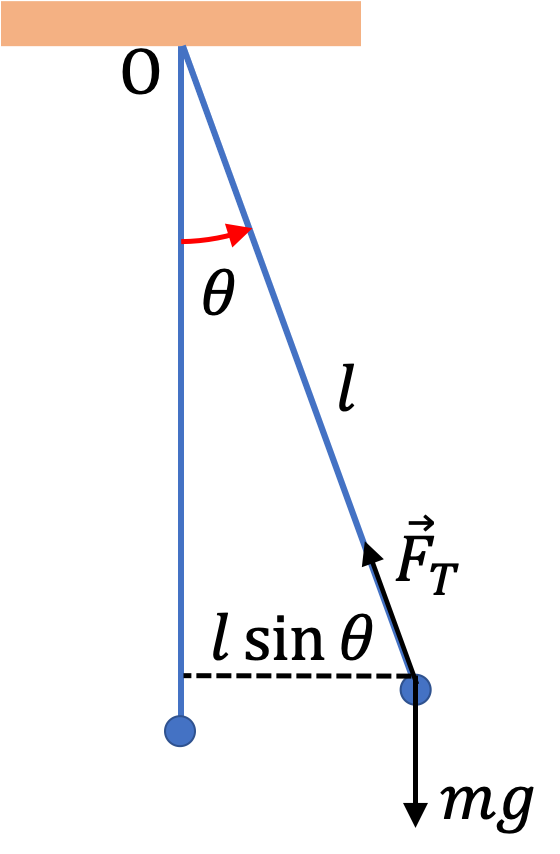
A plane pendulum consists of a bob of mass
\(m\) suspended from a light inextensible cord of length
\(l\) and swinging in a plane. We will assume that the physical dimension of the bob is much smaller than the length of the cord so that we can treat the bob as a point mass.
Let \(\alpha\) denote the angular acceleration. The moment of inertia of bob about the axis is \(I=ml^2\text{.}\) Therefore, the equation of motion is
\begin{equation*}
ml^2\alpha = - mg l \sin\,\theta,
\end{equation*}
where negative sign is due to the clockwise sense. Simplifying we get
\begin{equation}
\alpha = - \dfrac{g}{l}\, \sin\,\theta.\tag{13.26}
\end{equation}
This equation is not analogous to \(a_x =- \omega^2\ x\text{,}\) but if \(\sin\theta\) were to be replaced by \(\theta\text{,}\) we will get equation where acceleration is prportional to the negative of the displacement. It turns out that for small angles in radians you can replace \(\sin\theta\) by \(\theta\text{.}\) We call this small-angle approximation.
\begin{equation}
\sin\,\theta \approx \theta\ \ \ (\theta\text{ in radians.})\tag{13.27}
\end{equation}
This approximation is good to two decimal precision for angles \(\theta \lt 15^\circ= 0.26\text{ rad}\text{.}\) Therefore, in the small-angle approximation
\begin{equation}
\alpha = - \dfrac{g}{l}\, \theta.\tag{13.28}
\end{equation}
We can use analogy to \(a_x =- \omega^2\ x\) to study the motion of the pendulum. Thus, angular frequency of the pendulum will be
\begin{equation}
\omega = \sqrt{ \dfrac{g}{l} },\tag{13.29}
\end{equation}
which means the frequancy of the oscillations
\begin{equation}
f = \dfrac{\omega}{2\pi} = \dfrac{1}{2\pi}\,\sqrt{ \dfrac{g}{l} }, \tag{13.30}
\end{equation}
and the period \(T\)
\begin{equation}
T = \dfrac{1}{f} = 2\pi\,\sqrt{ \dfrac{l}{g} }.\tag{13.31}
\end{equation}
The formula for the period shows that the time period of a small-amplitude pendulum does not depend on either the mass
\(m\) of the pendulum bob or the amplitude of oscillations, but only on the length
\(l\) of the pendulum cord and acceleration due to gravity
\(g\text{.}\)
The dependence of the period on
\(g\) means that the same pendulum will have different periods on different planets. Also, since the value of
\(g\) varies over the surface of the Earth, the same pendulum will run at different rates in different locations on the Earth.