Logo image

Physics Bootcamp

Section 5.6 Circular Motion Bootcamp

Exercises Exercises

Velocity on a Circle

Uniform Circular Motion

Using Polar Coordinates

Miscellaneous

33. (Calculus) Pebble in a Tire of a Moving Car.
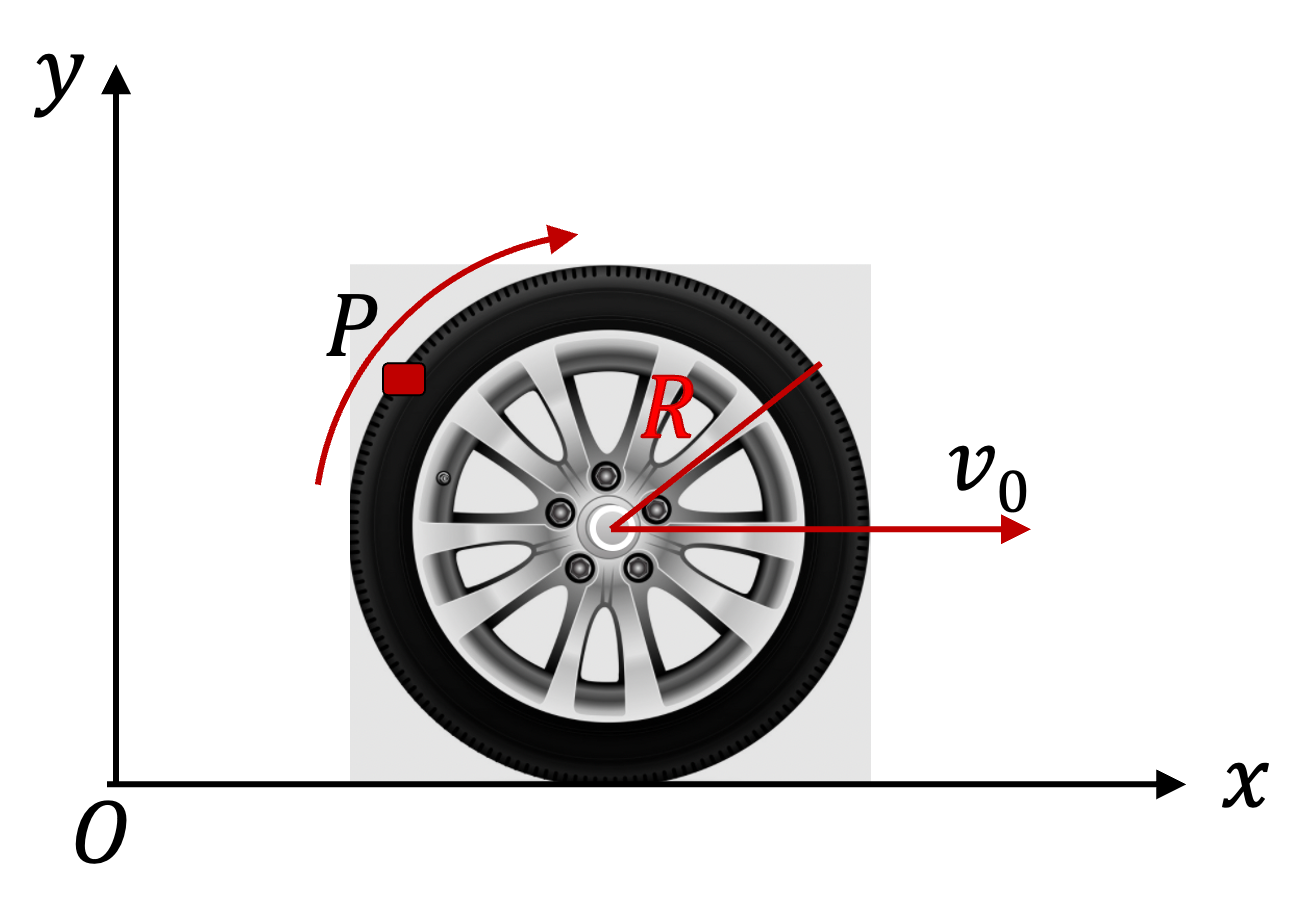
Figureย 5.44 shows a pebble P stuck at the outside of a tire. As the tire rolls, the pebbleโ€™s position in space changes. Suppose tire does not slide but rolls smoothly. The tire has radius \(R\) and is rolling at a constant speed \(v_0 \text{.}\) At \(t=0\text{,}\) the pebble was at the origin.
Figure 5.44. For Exerciseย 5.6.33.
Find the expressions for (a) position, (b) velocity, and (c) acceleration vectors (i.e., magnitudes and directions) at an arbitraru instant \(t\) with respect to the coordinate system given in the figure.
Hint.
(a) Introduce another coordinate system with origin at the center of the tire at all times and \(x\) and \(y\) axes parallel to the one given. Find position in that coordinate system first. Then translate that to the given coordinate system. (b) and (c): use derivatives.
Answer.
(a) \(\vec r = (-R\sin\theta + v_0 t)\; \hat i + (-R\cos\theta)\; \hat j\text{,}\) (b) \(((1 -\cos\theta)\;v_0 , (-\sin\theta)v_0)\text{,}\) (c) \(\text{.}\)
Solution 1. a
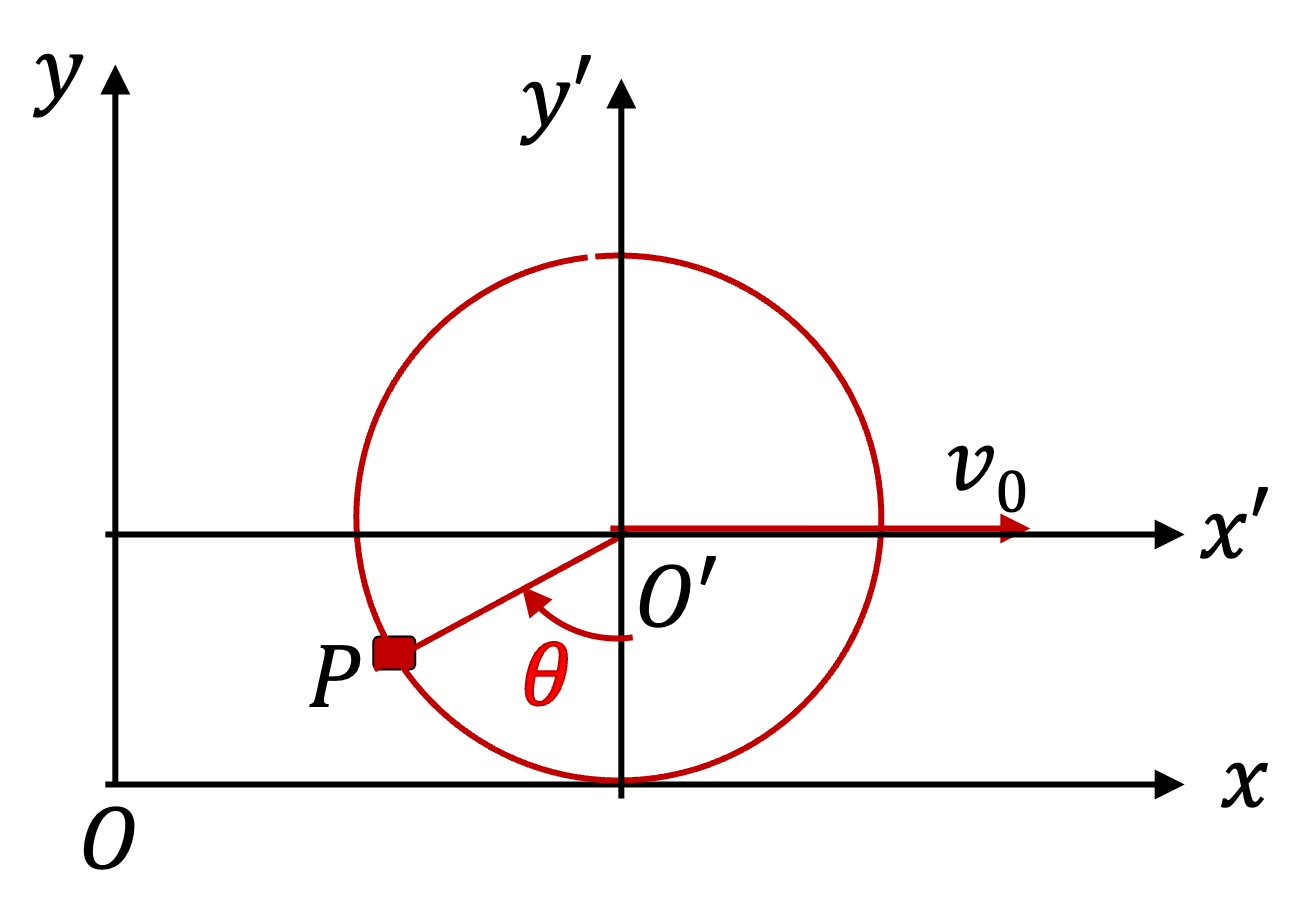
Let us introduce a coordinate system as shown in Figureย 5.45. For convenience, I will define \(\theta\) that measures angle from negative \(y\) axis as shown.
Figure 5.45.
Let \((x,y)\) and \((x',y')\) be the coordinates of P at this arbitrary instant \(t\) with respect to the two coordinate systems. It is immediately clear from the figure that
\begin{align*} \amp y = y',\ \ x = x' + v_0 t.\\ \amp x' = -R\sin\theta,\ \ y'=-R\cos\theta. \end{align*}
Therefore, position \(\vec r\) in original coordinate system will be
\begin{equation*} \vec r = (-R\sin\theta + v_0 t)\; \hat i + (-R\cos\theta)\; \hat j. \end{equation*}
It magnitude is
\begin{align*} r \amp = \sqrt{ x^2 + y^2 }\\ \amp = \sqrt{(-R\sin\theta + v_0 t)^2 + (-R\cos\theta)^2 }\\ \amp = \sqrt{R^2 - (2Rv_0\sin\theta) t + v_0^2t^2 }. \end{align*}
We can indicate direction in space by angle with respect to \(x\) axis by using arctangent.
\begin{equation*} \theta_x = \tan^{-1}(y/x) =\tan^{-1}\left( \frac{-R\cos\theta}{-R\sin\theta + v_0 t} \right). \end{equation*}
Solution 2. b
Now, that we know the components of position, we can obtain components of velocity by taking derivatives. Thus,
\begin{align*} \amp v_x = \frac{dx}{dt} = (-R\cos\theta)\frac{d\theta}{dt} + v_0 \\ \amp v_y = \frac{dy}{dt} = (-R\sin\theta)\frac{d\theta}{dt} \end{align*}
Since the tire is not slipping, the rate at which angle \(\theta\) changes is related to the speed with which center of the tire is moving. The tire has rotated by \(R\Delta\theta\text{,}\) its center has moved \(v_0\Delta t\text{.}\) Equating them we get
\begin{equation*} R\Delta\theta = v_0\Delta t. \end{equation*}
This gives
\begin{equation*} \frac{d\theta}{dt} = \frac{v_0}{R}. \end{equation*}
Using this, we rewrite the components of velocity as
\begin{align*} \amp v_x = (1 -\cos\theta)\;v_0 \\ \amp v_y = (-\sin\theta)v_0. \end{align*}
Therefore, magnitude of velocity, i.e., speed is
\begin{equation*} v = \sqrt{v_x^2 + v_y^2} = v_0\sqrt{ 2 - 2 \cos\theta} = 2 v_0 \left| \sin(\theta/2) \right|. \end{equation*}
Note: this tells us that the speed of pebble when touching the ground is zero (since \(\theta=0\)) and when at the very top, it is \((2\;v_0)\) (since \(\theta=\pi\)). That is, speed of the pebble in \(Oxy\) coordinate system changes as it goes around.
The direction of velocity can again be given with respect to the \(x\) axis by using arctangent.
\begin{equation*} \theta_x = \tan^{-1}(v_y/v_x) = \tan^{-1}\left( \frac{-\sin\theta}{1 -\cos\theta} \right). \end{equation*}
You can further simplify this expression by using double angle formulas. Try that. You should be able to express this without arctangent operation.

Solution 3. c
Now, that we know the components of velocity, we can obtain components of acceleration by taking derivatives. Thus,
\begin{align*} \amp a_x = \frac{dv_x}{dt} = (-v_0 \sin\theta)\frac{d\theta}{dt} \\ \amp a_y = \frac{dv_y}{dt} = (-v_0\cos\theta)\frac{d\theta}{dt} \end{align*}
Replacing \(d\theta/dt\) by \(v_0/R\) as found in (b), we get
\begin{equation*} a_x = -\frac{v_0^2}{R}\;\sin\theta;\ \ a_y = -\frac{v_0^2}{R}\;\cos\theta. \end{equation*}
Therefore, magnitude of acceleration is
\begin{equation*} a = \sqrt{a_x^2 + a_y^2} = \frac{v_0^2}{R}. \end{equation*}
The direction with respect to \(x\) axis will again be obtained by using arctangent.
\begin{equation*} \theta_x = \tan^{-1}(a_y/a_x) = \tan^{-1}(\cot(\theta)). \end{equation*}
Of course, we can write \(cot(\theta)\) as \(\tan(\pi/2 - \theta)\text{.}\) Hence
\begin{equation*} \theta_x = \frac{\pi}{2} -\theta. \end{equation*}
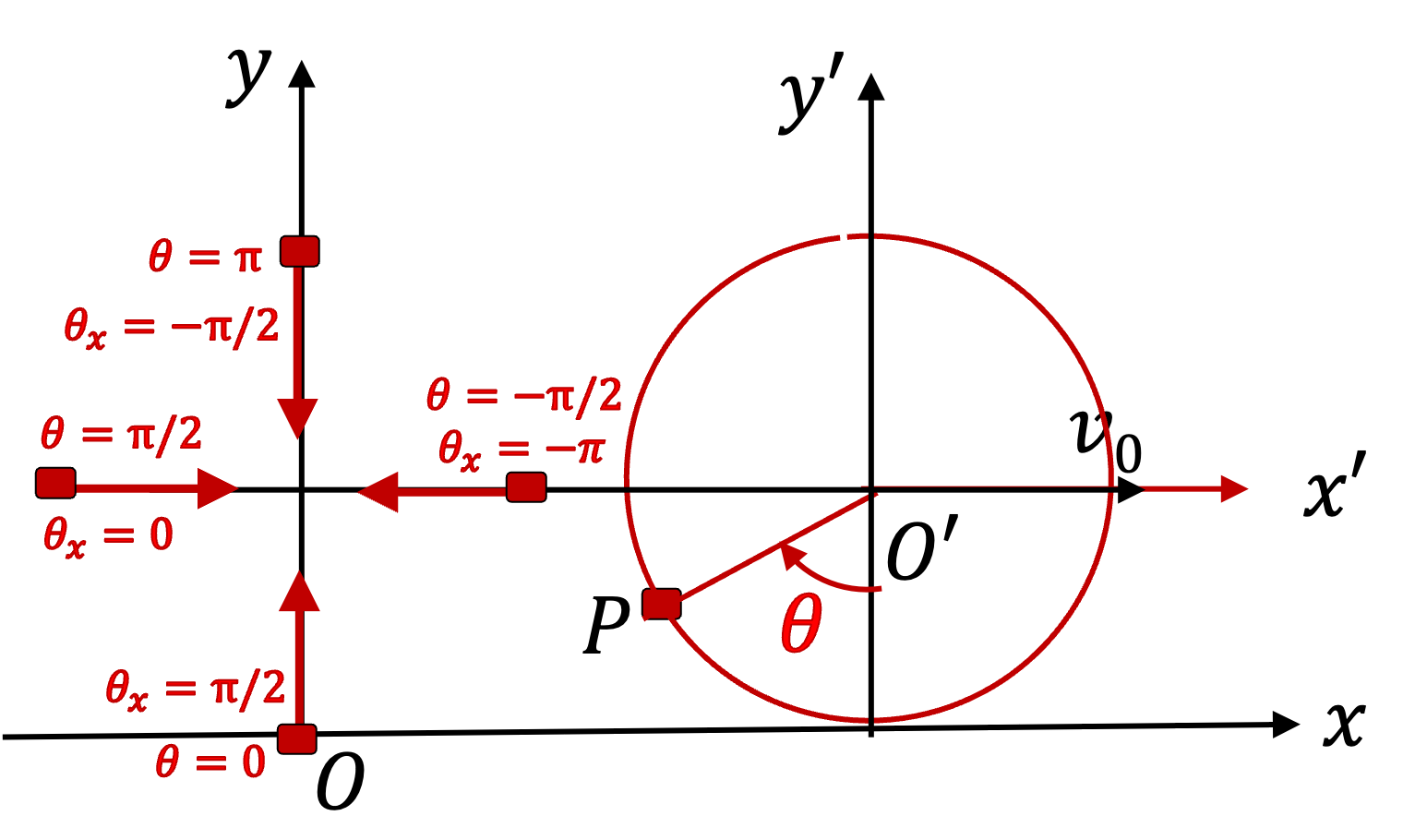
This is actually direction towards the moving center of the tire. Take values of \(\theta=0, \pi/2, \pi, 3\pi/2, 2\pi\) and draw them on the corresponding \(Oxy\) plane. You will see that the direction is always towards the center of the tire as shown in Figureย 5.46.
Figure 5.46.
34. Study Circular Motion from a Given Caertesian Position Vector.
The position of a particle moving in the \(xy\)-plane is given by \(\vec r(t) = b \cos(\pi t) \hat u_x + b \sin(\pi t) \hat u_y\text{,}\) where \(t\) is in sec and \(a\) in cm. (a) Show that the motion is a circular motion, and find the value of the radius of the circle, and find the Cartesian coordinates of the center of the circle. (b) Find an expression for the velocity of the particle at an arbitrary instant \(t\text{.}\) (c) Find an expression for the angular speed of the particle at an arbitrary time \(t\text{.}\) (d) Find an expression of the acceleration of the particle at an arbitrary instant \(t\text{.}\)
Solution 1. a
An object moves in a circle in the \(xy\)-plane if its \(x\) and \(y\) coordinates obeys the following equation for some \(x_0\text{,}\) \(y_0\) and \(r_0\text{.}\)
\begin{equation*} (x-x_0)^2 + (y-y_0)^2 = r_0^2. \end{equation*}
The center of the circle is at \((x_0,y_0)\) and the radius of the circle is given by \(r_0\text{.}\) Let us see if the given position can be written in this form. Recall that \(\vec r = x\ \hat u_x + y\ \hat u_y\text{.}\) Therefore,
\begin{align*} \amp x(t) = b \cos(\pi t)\\ \amp y(t) = b \sin(\pi t) \end{align*}
Now we square the two and add find that
\begin{equation*} x^2 + y^2 = b^2. \end{equation*}
This says that the particle is moving in a circle about the origin as the center and the radius of the circle is equal to \(b\text{.}\)
Solution 2. b
To find the velocity of the particle we can find the \(x\) and \(y\)-components of the velocity from \(x(t)\) and \(y(t)\text{.}\)
\begin{align*} \amp v_x = \frac{dx}{dt} = - \pi b \sin(\pi t)\\ \amp v_y = \frac{dy}{dt} = \pi b \cos(\pi t) \end{align*}
Therefore, the speed of the particle when in the circular motion is
\begin{equation*} v = \sqrt{v_x^2 + v_y^2} = \pi b. \end{equation*}
The direction of the velocity is given by the angle \(\theta\) with respect to the positive \(x\)-axis.
\begin{equation*} \tan\theta = \frac{v_y}{v_x} = -\cot(\pi t) = \tan\left(\pi t - \frac{\pi}{2} \right),\ \textrm{or},\ \tan\left(\pi t + \frac{3\pi}{2} \right). \end{equation*}
Solution 3. c
The angular speed \(\omega\) in a circular motion is equal to radius times the speed.
\begin{equation*} \omega = v /r = \frac{\pi b}{b} = \pi. \end{equation*}
Solution 4. d
The acceleration can be obtained from the components of acceleration obtained by taking time derivatives of the components of the velocity found above.
\begin{align*} \amp a_x = \frac{dv_x}{dt} = - \pi^2 b \sin(\pi t)\\ \amp a_y = \frac{dv_y}{dt} = -\pi^2 b \cos(\pi t) \end{align*}
The magnitude of the acceleration will be
\begin{equation*} \textrm{Magnitude}\ = \sqrt{a_x^2 +a_y^2} = \pi^2 b, \end{equation*}
and the direction given by the angle of the acceleration vector with respect to the positive \(x\) axis will be
\begin{equation*} \tan\theta = \frac{a_y}{a_x} = -\tan((\pi t)), \end{equation*}
which says that the direction of the acceleration changes with time as \(\theta(t) = \pi t\text{.}\)