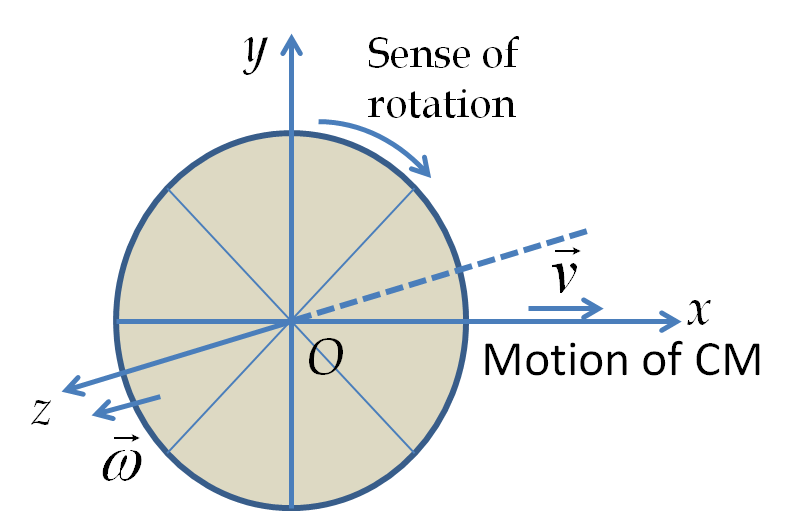
Here, I will illustrate the use of vector form of angular quantities. Let the \(z\)-axis be pointed towards the North. Note that the magnitude of the angular angular velocity is not \(200\,\text{rad}/20\,\text{s}\text{,}\) i.e, 10 rad/s. This would be the average angular velocity. The angular velocity in this question is the instantaneous angular velocity. We would need to first figure out the angular acceleration. All rotational vector quantities are along the \(z\) axis with constant angular acceleration. Therefore, we us the following equation.
\begin{equation*}
\Delta \theta = \omega_{0z} t + \frac{1}{2} \alpha_z t^2.
\end{equation*}
With \(\omega_{0z} = 0\text{,}\) \(\Delta\theta = 200\) rad, and \(t = 20\) s. we obtain.
\begin{equation*}
\alpha_z = \frac{2\Delta \theta}{t^2} = \frac{2\times 200}{20^2} = 1\ \textrm{rad/s}^2.
\end{equation*}
Now, we can obtain the \(z\)-component of the angular velocity at \(t=20\) s.
\begin{equation*}
\omega_z = \omega_{0z} + \alpha_z t = 20\ \textrm{rad/s}.
\end{equation*}
This result could also be obtained from the average angular velocity \(\omega_{ave} = 10\, \text{rad/s}\) towards the \(z\)-axis. Since the acceleration is constant, the average angular velocity is also equal to the average of the instantaneous velocity at the start and at the end.
\begin{equation*}
\omega_z^{ave} = \frac{\omega_{0z} + \omega_{z} }{2} \ \Longrightarrow\ \omega_{z} = 2\omega_z^{ave} - \omega_{0z} = 20\ \textrm{rad/s}.
\end{equation*}
We found that the angular acceleration has the magnitude \(1\, \text{rad/s}^2\) and is pointed due North, and the angular velocity at \(20\, \text{sec}\) mark has the magnitude \(20\, \text{rad/s}\) and is pointed due North.