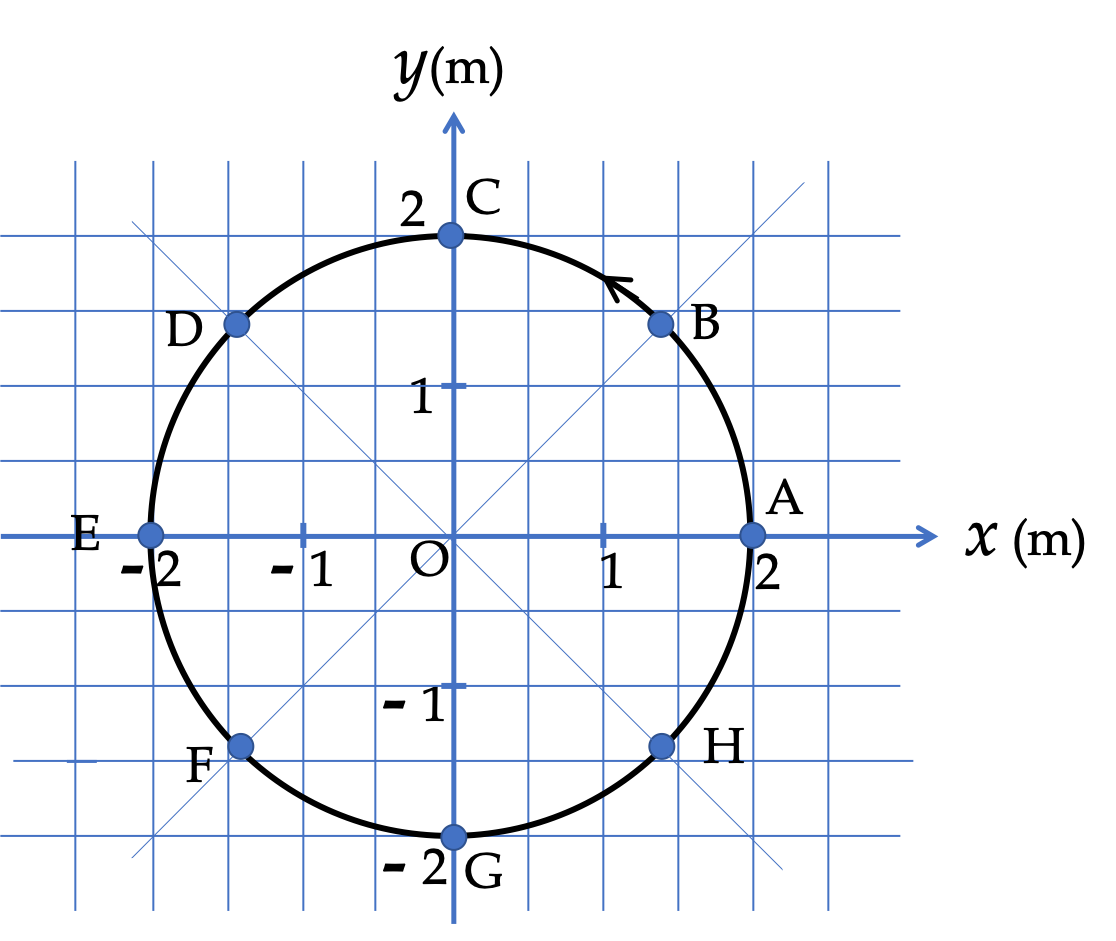
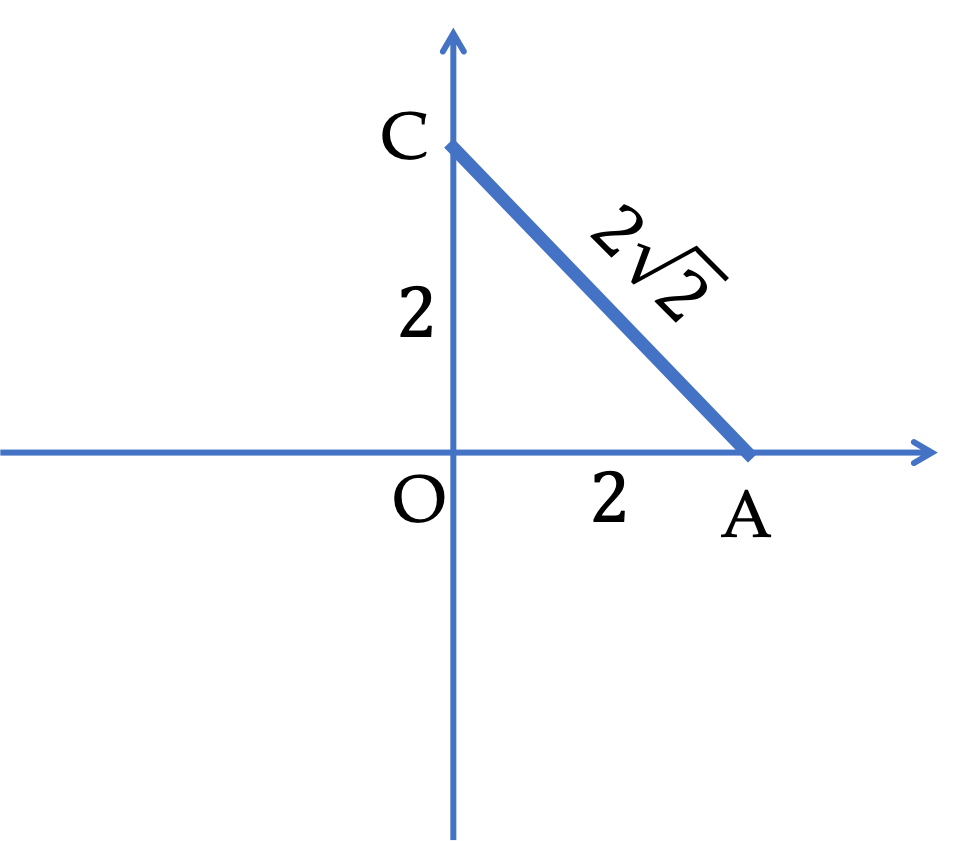
(c) Since the speed is constant, we need to work out just the average speed, which would be just an arc length between any two points divided by time it took. Between A and B, the arc length is
\begin{equation*}
s_{AB} = R\theta = 2\times\dfrac{\pi}{4} = 1.57\text{ m}.
\end{equation*}
This takes \(1\text{ sec}\text{.}\) Therefore, the speed is
\begin{equation*}
v_s = \dfrac{1.57\text{ m}}{1\text{ s}} = 1.57\text{ m/s}.
\end{equation*}
The angle between A and B was \(\pi/4\text{ rad}\text{.}\) Therefore, the angular speed is
\begin{equation*}
\omega = \dfrac{\pi/4\text{ rad}}{1\text{ s}} = 0.785\text{ rad/s}.
\end{equation*}
(d) Since speed is constant, the magnitude of velocity is cinstant also.
\begin{equation*}
\text{Magnitude: } 1.57\text{ m/s}.
\end{equation*}
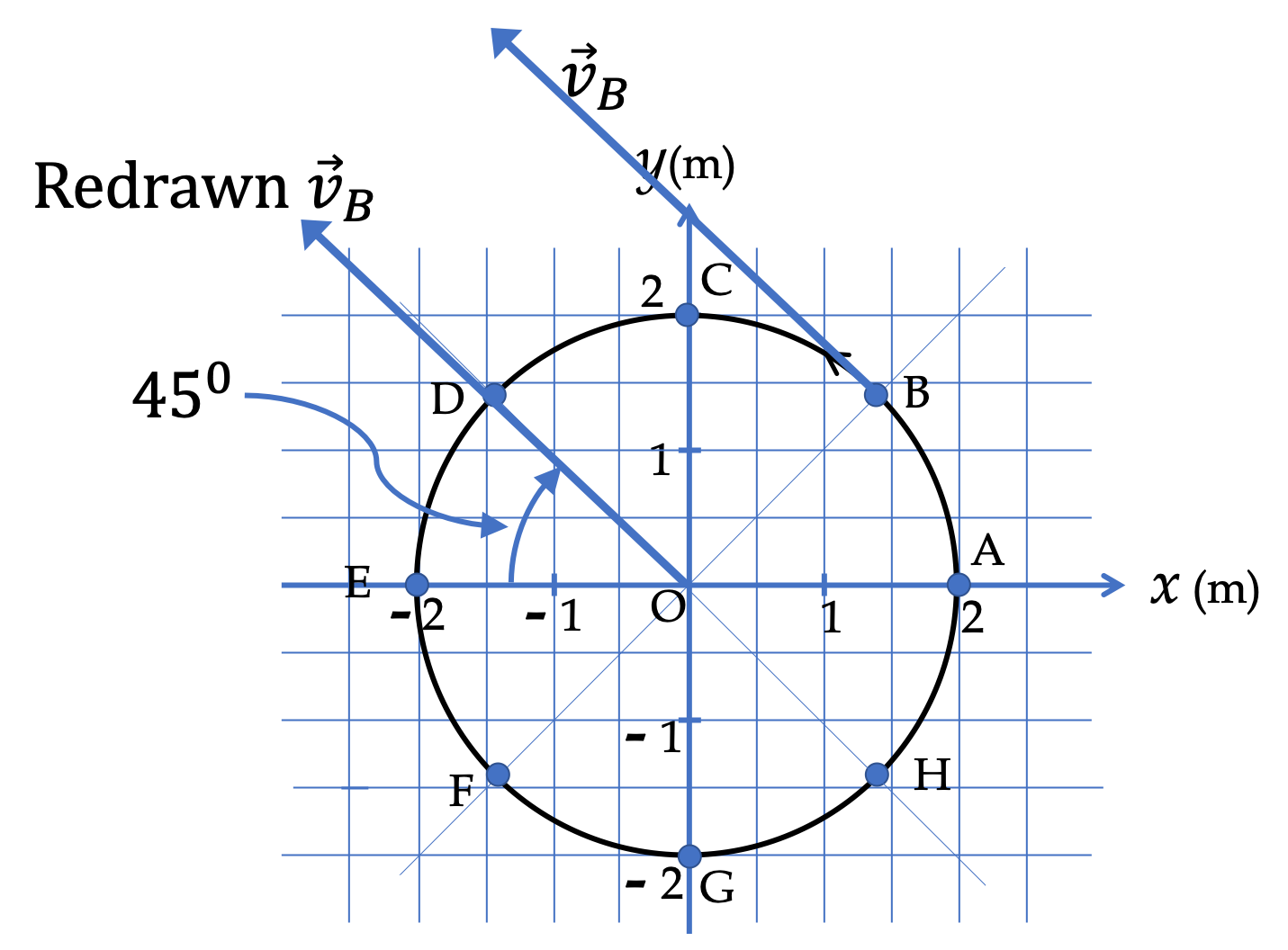
But, the direction of velocity at differnet points are actually different - that makes velocity different at different points here.
A. The velocity at A is pointed towards positive
\(y \) axis.
B. At point B, the velocity has magnitude
\(1.57\text{ m/s}\text{,}\) same as speed there, and the direction is towards
\(45^{\circ} \) clockwise from the negative
\(x\) axis as shown in the figure below. Note how I drew the valeocity as tangent to the circle at point B and then redrew a vector parallel to the velocity vector but the tail at the origin.
C. The velocity at C is pointed towards negative
\(x \) axis.
D. The velocity at D is pointed
\(45^{\circ} \) counterclockwise from the negative
\(x\) axis
E. The velocity at E is pointed towards negative
\(y \) axis.
F. The velocity at F is pointed
\(45^{\circ} \) clockwise from the positive
\(x\) axis
G. The velocity at G is pointed towards positive
\(x \) axis.
H. The velocity at H is pointed
\(45^{\circ} \) counterclockwise from the positive
\(x\) axis