Logo image

Physics Bootcamp

Section 31.9 Electric Potential Bootcamp

Exercises Exercises

Electric Potential

Electric Potential from Electric Field

Miscellaneous

22. Electrostatic Energy Per Ion of a Cubic Crystal.
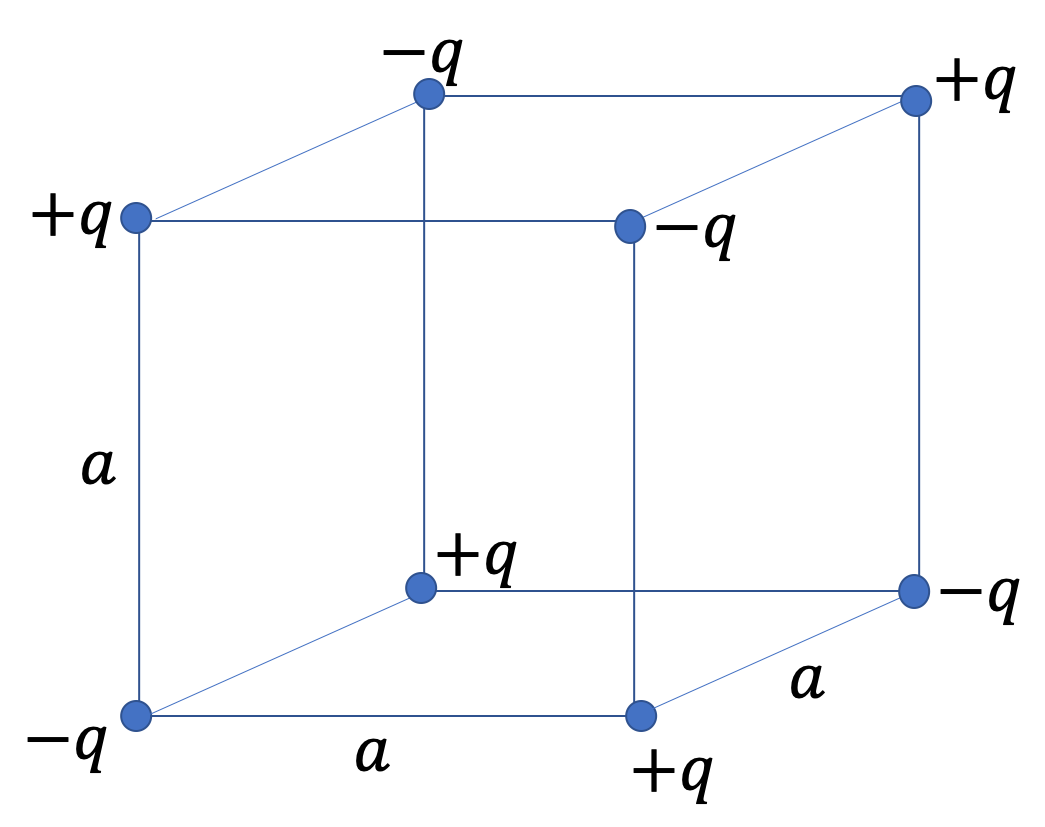
A cubic crystal has oppositely charged ions at adjacent corners of a cube. One such cube is shown in the figure. Find electrostatic energy of this cube per ion in units of \(\text{J}\) and in \(\text{eV}\text{.}\) Here, charge is equal to the electronic charge, \(q=e\) and side \(a = 5.64\times 10^{-10}\text{ m}\text{.}\) These are the data of \(\text{Na}^{+}\text{Cl}^{-}\) crystal.
Hint.
Label the charges and then organize pairs of same distances.
Answer.
\(-3.0\times 10^{-18}\text{ J}\text{,}\) \(-1.86\text{ eV}\text{.}\)
Solution.
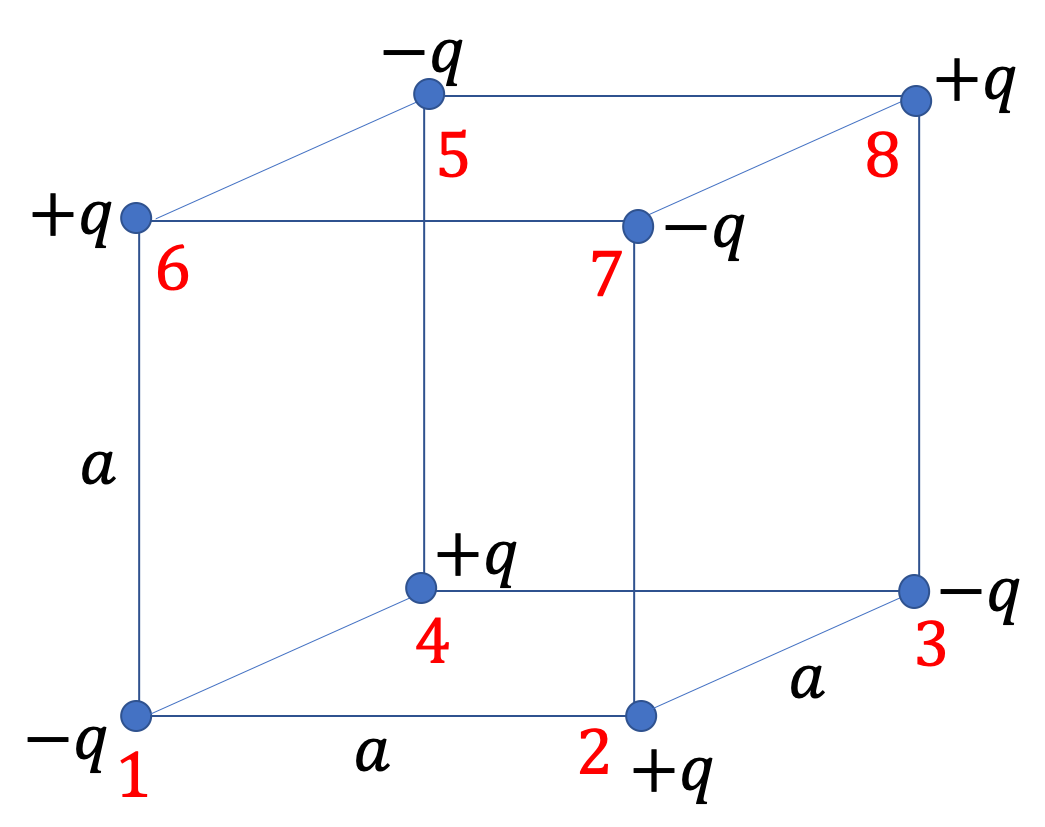
We will label the charges so that we can write down the unique pairs and work out their distances, which go directly into the sum that gives electrostatic energy. The following figure shows my choice.
We find that we have three types of distances, (i) edge, \(r = a \text{,}\) (ii) face diagonal, \(r = a \sqrt{2}\text{,}\) and (iii) body diagnal, \(r = a\sqrt{3} \text{.}\) There are 12 adjacent pairs of opposite charges, 12 face diagonals of similar type charges, and 4 body diagonals of opposite types. Therefore, the sum over potential energies of all pairs gives
\begin{align*} U_8 \amp = \dfrac{1}{4\pi\epsilon_0}\, \dfrac{q^2}{a} \left( -12 + \dfrac{12}{\sqrt{2}} - \dfrac{4}{\sqrt{3}} \right). \\ \amp = - 2.4\times 10^{-17}\text{ J} = -14.9\text{ eV}. \end{align*}
We want electrostatic energy per ion, so we divide this by \(8\text{.}\)
\begin{equation*} U = \dfrac{U_8}{8} = -3.0\times 10^{-18}\text{ J} = -1.86\text{ eV}. \end{equation*}
23. Finding Equipotential Points in a Two-Charge System.
Two charges, \(q_1 = + 6.0\ \text{nC}\) and \(q_2 = -6.0 \ \text{nC}\) are separated by a distance of \(1.00\text{ m}\text{.}\) Place them along \(x\) axis symmetrically about the origin, and find the loci of the points in the \(xy\)-plane where potential is \(1.0\text{ V}\text{.}\)
Hint.
Use superposition principle.
Answer.
\(\frac{54}{\sqrt{ (x-0.5)^2 + y^2 }} -\frac{54}{\sqrt{ (x+0.5)^2 + y^2 }} = 1\text{.}\)
Solution.
Let \((x,y)\) be a representative point on the curve in \(xy\) plane that has potential equal to \(1.0\text{ V}\text{.}\) For brevity, will suppress units in our calculations. Let \(V_1(x,y)\) and \(V_2(x,y)\) be the potentials there by the two charges. Therefore, by using superposition we get
\begin{equation*} V_1(x,y) + V_2(x,y) = 1. \end{equation*}
Now, we can see what these individual potentials are.
\begin{align*} V_1(x,y) \amp = \frac{q_1}{4\pi\epsilon_0} \frac{1}{\sqrt{ (x-0.5)^2 + y^2 }} \\ \amp = 9\times 10^9 \times 6\times 10^{-9} \frac{1}{\sqrt{ (x-0.5)^2 + y^2 }} \\ \amp = \frac{54}{\sqrt{ (x-0.5)^2 + y^2 }} \\ V_2(x,y) \amp = \frac{q_2}{4\pi\epsilon_0} \frac{1}{\sqrt{ (x+0.5)^2 + y^2 }} \\ \amp = -\frac{54}{\sqrt{ (x+0.5)^2 + y^2 }} \end{align*}
Therefore, the loci are values of \(x,y\) that satisfy the following equation.
\begin{equation*} \frac{54}{\sqrt{ (x-0.5)^2 + y^2 }} -\frac{54}{\sqrt{ (x+0.5)^2 + y^2 }} = 1. \end{equation*}
24. Potential of Two Parallel Line Charges.
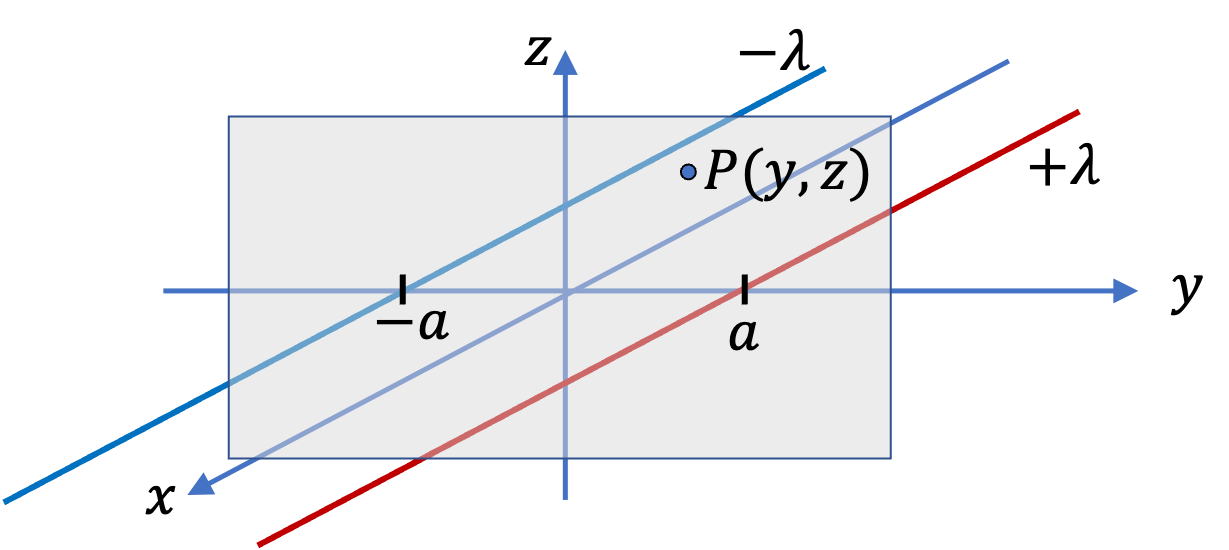
Two oppositely charged infinitely long wires are placed parallel to each other as shown in Figureย 31.29. Let wires be parallel to the \(x\)-axis. Let the wire with charge density \(+\lambda\) cross \(y\) axis at \(y=+a\) and that with charge density \(-\lambda\) cross \(y\) axis at \(y=-a\text{.}\) What is the potential at an arbitray point \(P(y,z)\) in the \(yz\)-plane?
Figure 31.29.
Hint.
Use superposition.
Answer.
\(\frac{\lambda}{4\pi\epsilon_0} \ln \dfrac{ (y-a)^2 + z^2}{ (y+a)^2 + z^2}\text{.}\)
Solution.
Let \(\phi_\pm\) be the potentials from \(\pm\lambda\text{.}\) Then, the net potential at P will be
\begin{equation*} \phi_P = \phi_+ + \phi_-. \end{equation*}
Now, potential \(\phi_+\) is already known to be
\begin{equation*} \phi_+ = \frac{\lambda}{2\pi\epsilon_0}\ln \dfrac{s}{s_\text{ref}}. \end{equation*}
Let reference zero be at origin, which will make \(s_\text{ref} = a\) from the positive wire. The distance to P is \(s= \sqrt{(y-a)^2 + z^2}\text{.}\) Therefore, we have
\begin{equation*} \phi_+ = \frac{\lambda}{2\pi\epsilon_0}\ln \dfrac{\sqrt{(y-a)^2 + z^2}}{a}. \end{equation*}
Similarly, we will get the following using the same reference point.
\begin{equation*} \phi_+ = -\frac{\lambda}{2\pi\epsilon_0}\ln \dfrac{\sqrt{(y+a)^2 + z^2}}{a}. \end{equation*}
Note: we must use the same reference point for all charges in one situation. Now, we can add them to get
\begin{equation*} \phi_P = \frac{\lambda}{4\pi\epsilon_0} \ln \dfrac{ (y-a)^2 + z^2}{ (y+a)^2 + z^2}. \end{equation*}
25. Potential of Two Overlapping Spherically Charged Clouds.
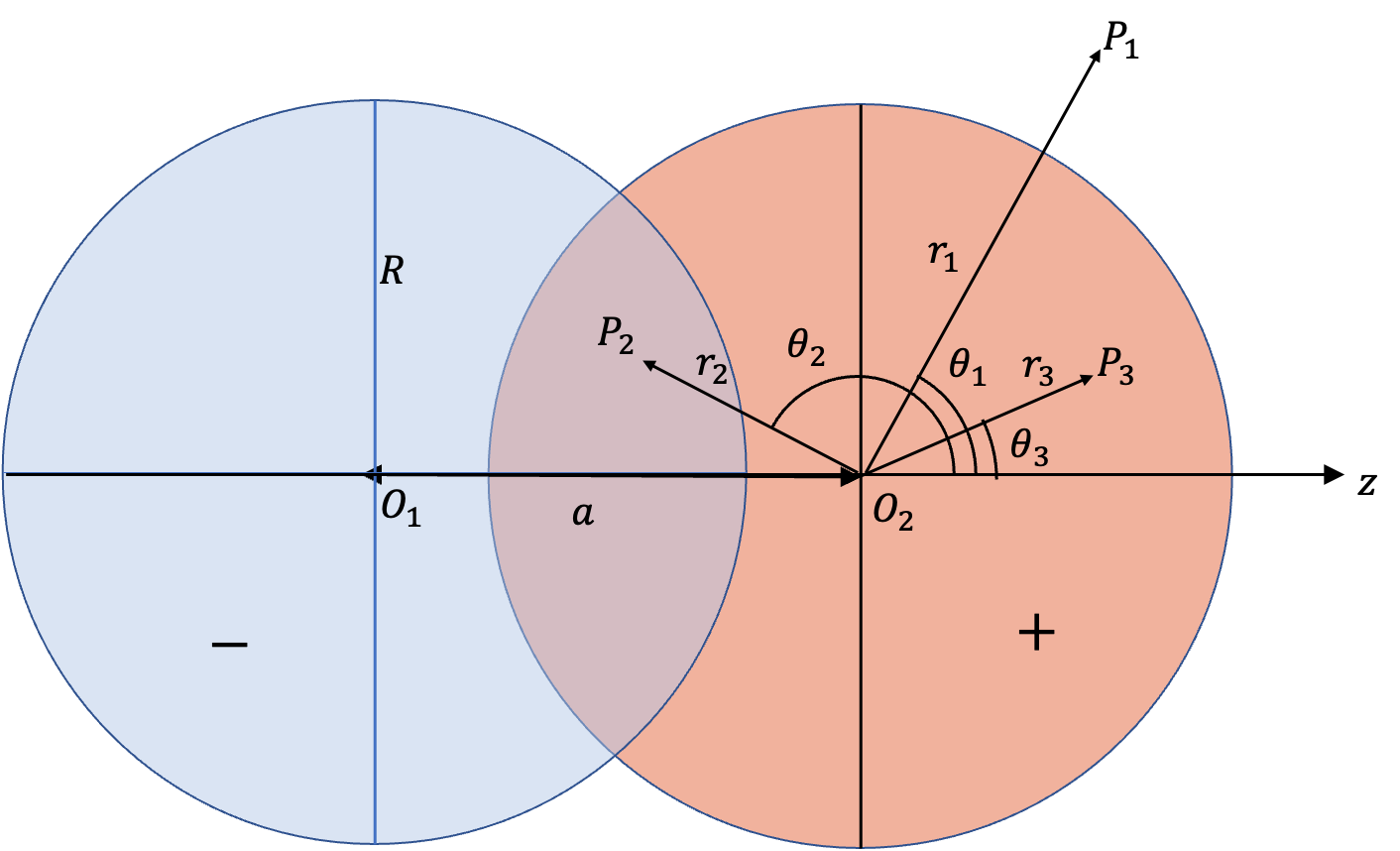
Two spherically charged clouds of equal radius \(R\) and opposite charge densities \(\pm \rho\) overlap so that their separation distance is \(a\) with \(a \lt 2R\text{.}\) Find the electric potentials (a) at a point outside the clouds, (b) at a point where the clouds overlap, and (c) at a point inside the positive cloud which is not in the overlap zone. Use Figureย 31.30 to express your answer.
Figure 31.30.
You can use the following result from Exerciseย 31.7.5.4. Let \(r\) be the distance from center of this cloud to the field point. Then, we have worked out the potentials at outisde and inside points to be
\begin{equation*} \phi(r) = \begin{cases} \frac{1}{4\pi\epsilon_0}\,\frac{q}{r}, \amp r \gt R\\ \frac{1}{4\pi\epsilon_0} \frac{q}{R} \left( \frac{3}{2} - \frac{1}{2}\; \frac{r^2}{R^2} \right), \amp r\le R. \end{cases} \end{equation*}
Hint.
Use superposition.
Answer.
(a) \(\frac{q}{4\pi\epsilon_0}\left(\frac{1}{r_1} - \frac{1}{\sqrt{r_1^2 + a^2 + 2 r_1 a \cos\, \theta_1}} \right)\text{,}\) (b) \(\frac{1}{4\pi\epsilon_0} \frac{q}{2R^3}\left( a^2 + 2 a r_2 \cos\,\theta_2 \right)\text{,}\) (c) \(\frac{1}{4\pi\epsilon_0} \frac{q}{R} \left( \frac{3}{2} - \frac{1}{2}\; \frac{r_{3}^2}{R^2} - \frac{R}{ \sqrt{r_3^2 + a^2 + 2 r_3 a \cos\, \theta_3} } \right)\text{.}\)
Solution 1. (a)
(a) We will use superposition to find the net potentials. We need the distance of the field point \(P_1\) from the centers of the two spheres. Let us call these distances \(r_\pm\text{.}\)
\begin{align*} r_+ \amp = r_1 \\ r_- \amp = \sqrt{r_1^2 + a^2 - 2 r_1 a \cos(\pi - \theta_1)} \\ \amp = \sqrt{r_1^2 + a^2 + 2 r_1 a \cos\, \theta_1} \end{align*}
Let total charges on the spheres be \(\pm q = \pm\dfrac{4}{3}\pi R^3 \rho\text{.}\) Then, we have the following for the net potential at \(P_1\text{.}\)
\begin{align*} \phi_1 \amp = \frac{q}{4\pi\epsilon_0}\left(\frac{1}{r_+} - \frac{1}{r_-} \right) \\ \amp = \frac{q}{4\pi\epsilon_0}\left(\frac{1}{r_1} - \frac{1}{\sqrt{r_1^2 + a^2 + 2 r_1 a \cos\, \theta_1}} \right) \end{align*}
Solution 2. (b)
(b) Here, point is inside point for both clouds. Therefore, we will use the inside formulas when superposing them. The distances are
\begin{align*} r_+ \amp = r_2 \\ r_- \amp = \sqrt{r_2^2 + a^2 - 2 r_2 a \cos(\pi - \theta_2)} \\ \amp = \sqrt{r_2^2 + a^2 + 2 r_2 a \cos\, \theta_2} \end{align*}
Using the same \(q\) as in (a), we have the following for the net potential at \(P_2\text{.}\)
\begin{align*} \phi_2 \amp = \frac{1}{4\pi\epsilon_0} \frac{q}{R} \left( \frac{3}{2} - \frac{1}{2}\; \frac{r_{+}^2}{R^2} \right) - \frac{1}{4\pi\epsilon_0} \frac{q}{R} \left( \frac{3}{2} - \frac{1}{2}\; \frac{r_{-}^2}{R^2} \right)\\ \amp = \frac{1}{4\pi\epsilon_0} \frac{q}{2R^3}\left( -r_{+}^2 + r_{-}^2\right) = \frac{1}{4\pi\epsilon_0} \frac{q}{2R^3}\left( a^2 + 2 a r_2 \cos\,\theta_2 \right). \end{align*}
Solution 3. (c)
(c) Now, the point is an inside point for the positive cloud and an outside point for the negative cloud. This will give
\begin{align*} \phi_3 \amp = \frac{1}{4\pi\epsilon_0} \frac{q}{R} \left( \frac{3}{2} - \frac{1}{2}\; \frac{r_{+}^2}{R^2} \right) - \frac{1}{4\pi\epsilon_0} \frac{q}{r_{-}}, \end{align*}
with
\begin{align*} r_+ \amp = r_3,\ \ r_- = \sqrt{r_3^2 + a^2 + 2 r_3 a \cos\, \theta_3}. \end{align*}
Writing the potential explicitly, we have
\begin{equation*} \phi_3 = \frac{1}{4\pi\epsilon_0} \frac{q}{R} \left( \frac{3}{2} - \frac{1}{2}\; \frac{r_{3}^2}{R^2} - \frac{R}{ \sqrt{r_3^2 + a^2 + 2 r_3 a \cos\, \theta_3} } \right). \end{equation*}