Recall that if we have a uniform magnetic field \(\vec B\text{,}\) whether changing in time or not, its flux through a flat surface of area \(A\) which is oriented so that the normal to the area makes an angle \(\theta\) with \(\vec B\text{,}\) then, magnetic flux through a loop around the edges of the flat surface is given by
\begin{equation*}
\Phi_{B} = B\, A\, \cos\,\theta.
\end{equation*}
By takng its time derivative we can immediately know various ways flux can change.
\begin{equation*}
\frac{d\Phi_B}{dt} = \frac{dB}{dt}\,A\, \cos\,\theta + B\,\frac{dA}{dt}\,\cos\,\theta + (-1)\, B\, A\, \sin\,\theta\,\frac{d\theta}{dt}.
\end{equation*}
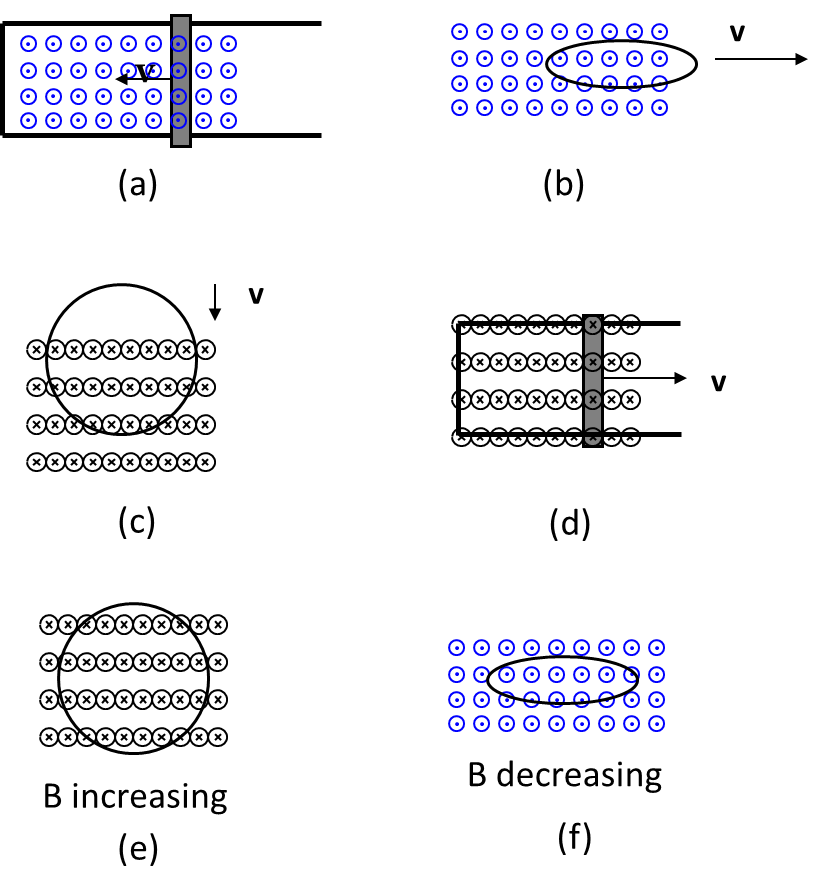
Therefore, a change in magnetic flux can occur in three ways:
-
\(\Delta \Phi_B\) due to changing \(B\text{,}\) i.e, changing strength of \(\vec B\text{,}\) which we indicate by adding \(B\) to the subscript.
\begin{equation*}
\Delta \Phi_{B,B} = (A \cos\,\theta )\Delta B,
\end{equation*}
-
\(\Delta \Phi_B\) due to changing \(A\text{,}\) i.e, changing area in the loop through which field lines may go through,
\begin{equation*}
\Delta \Phi_{B,A} = (B \cos\,\theta )\Delta A,
\end{equation*}
-
\(\Delta \Phi_B\) due to changing \(\theta\text{,}\) i.e, relative orientation of \(\vec B\) and area.
\begin{equation*}
\Delta \Phi_{B,\theta} = -(B A \sin\,\theta )\Delta \theta,
\end{equation*}
when you are looking at changing orientation with time.
Pooling the three types of contributions you will get the net change in flux in time \(\Delta t\text{.}\)
\begin{equation}
\Delta \Phi_B = \Delta \Phi_{B,B} + \Delta \Phi_{B,A} + \Delta \Phi_{B,\theta}.\tag{38.8}
\end{equation}
Therefore, in the case of uniform magnetic field through a flat area, induced EMF will come from three sources.
\begin{equation}
\mathcal{E}_\text{ind,ave} = - \dfrac{\Delta \Phi_{B,B}}{\Delta t} -\dfrac{\Delta \Phi_{B,A}}{\Delta t} - \dfrac{\Delta \Phi_{B,\theta}}{\Delta t}.\tag{38.9}
\end{equation}
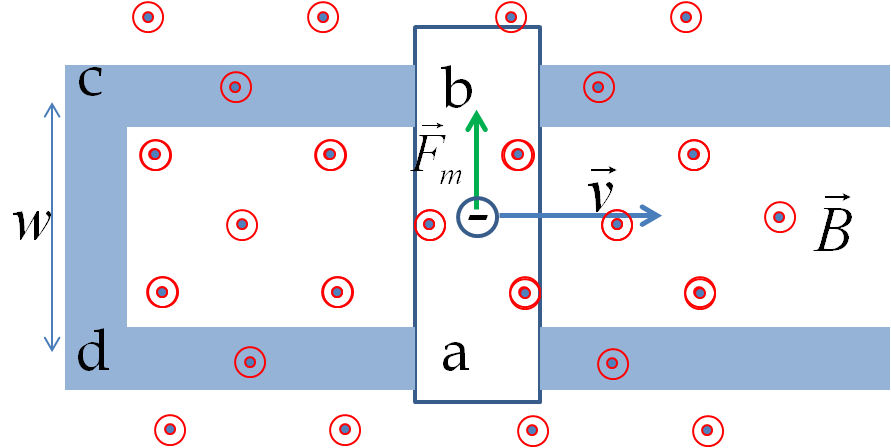
Faraday’s experiments described in
Section 38.1 illustrate these mechanisms by which flux can change in a closed loop.
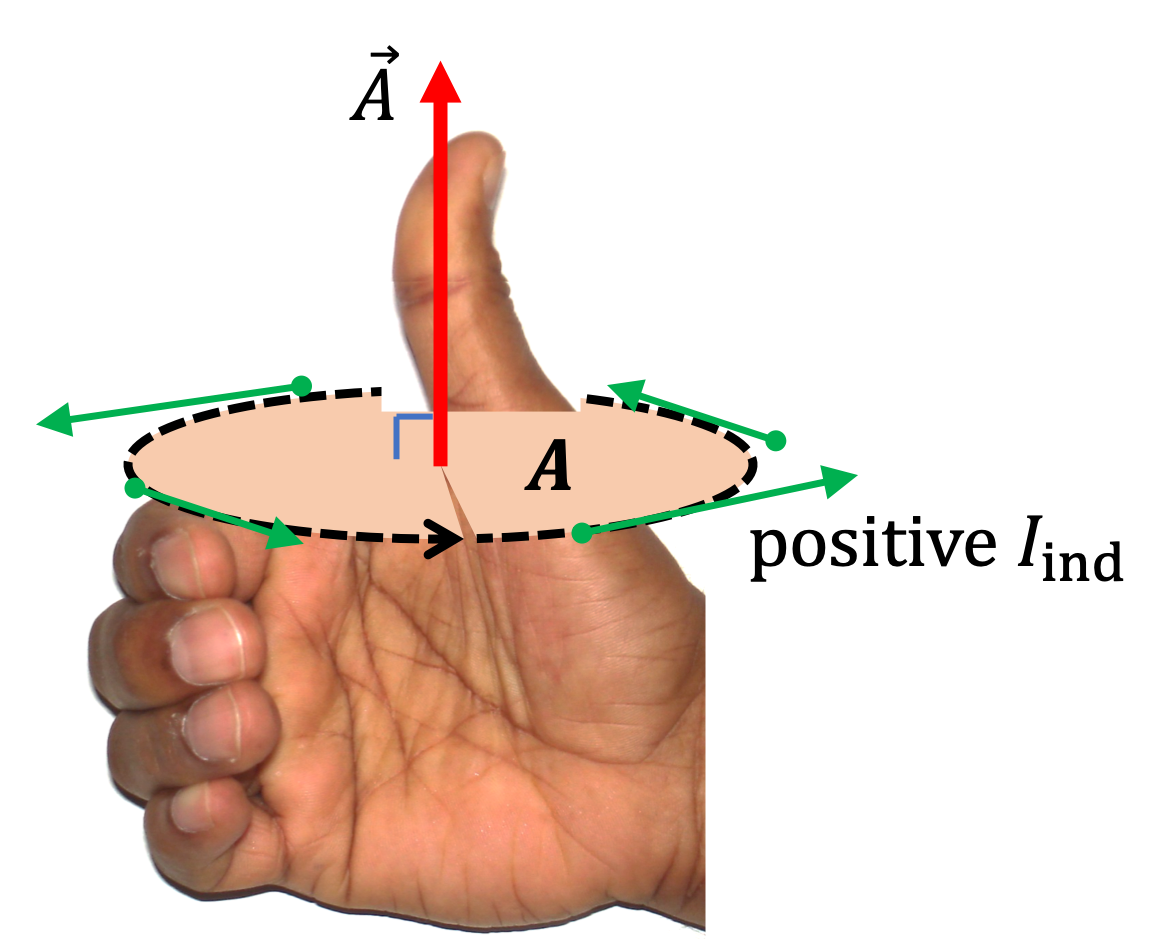
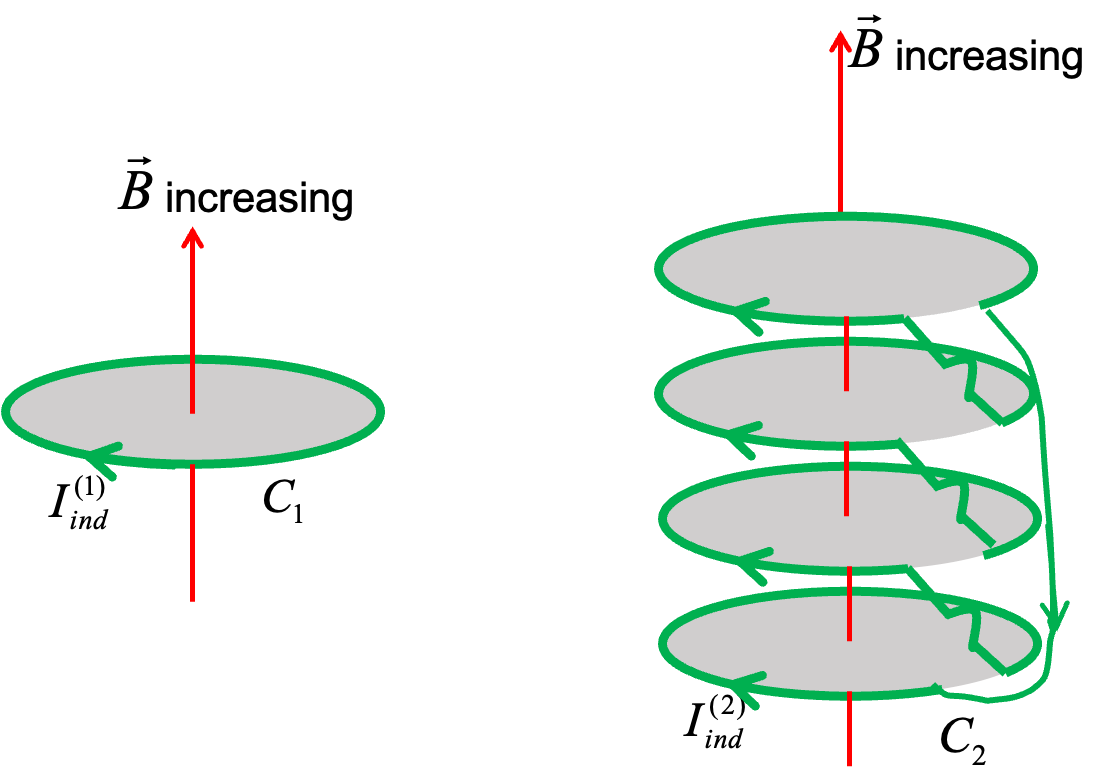
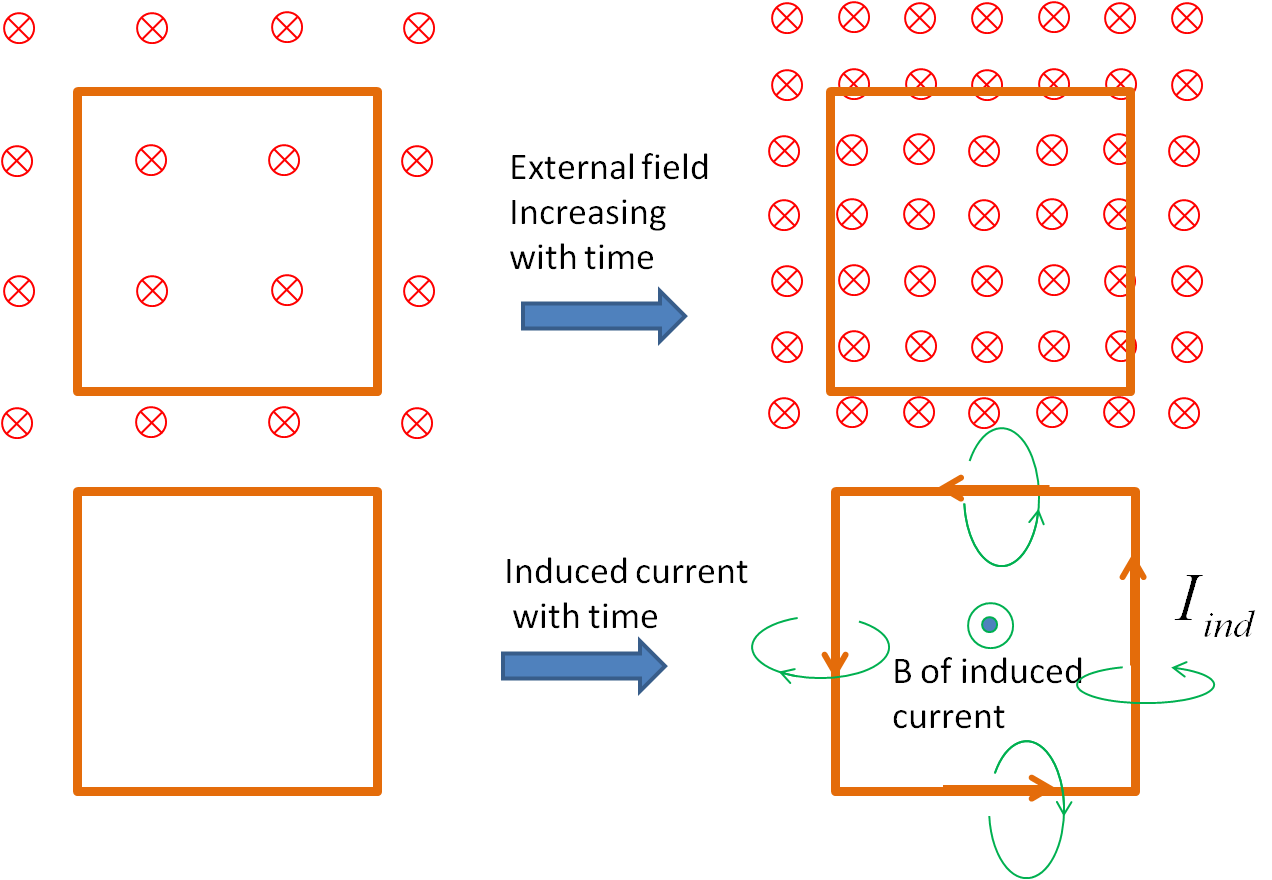
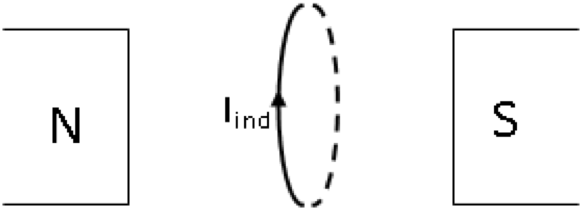
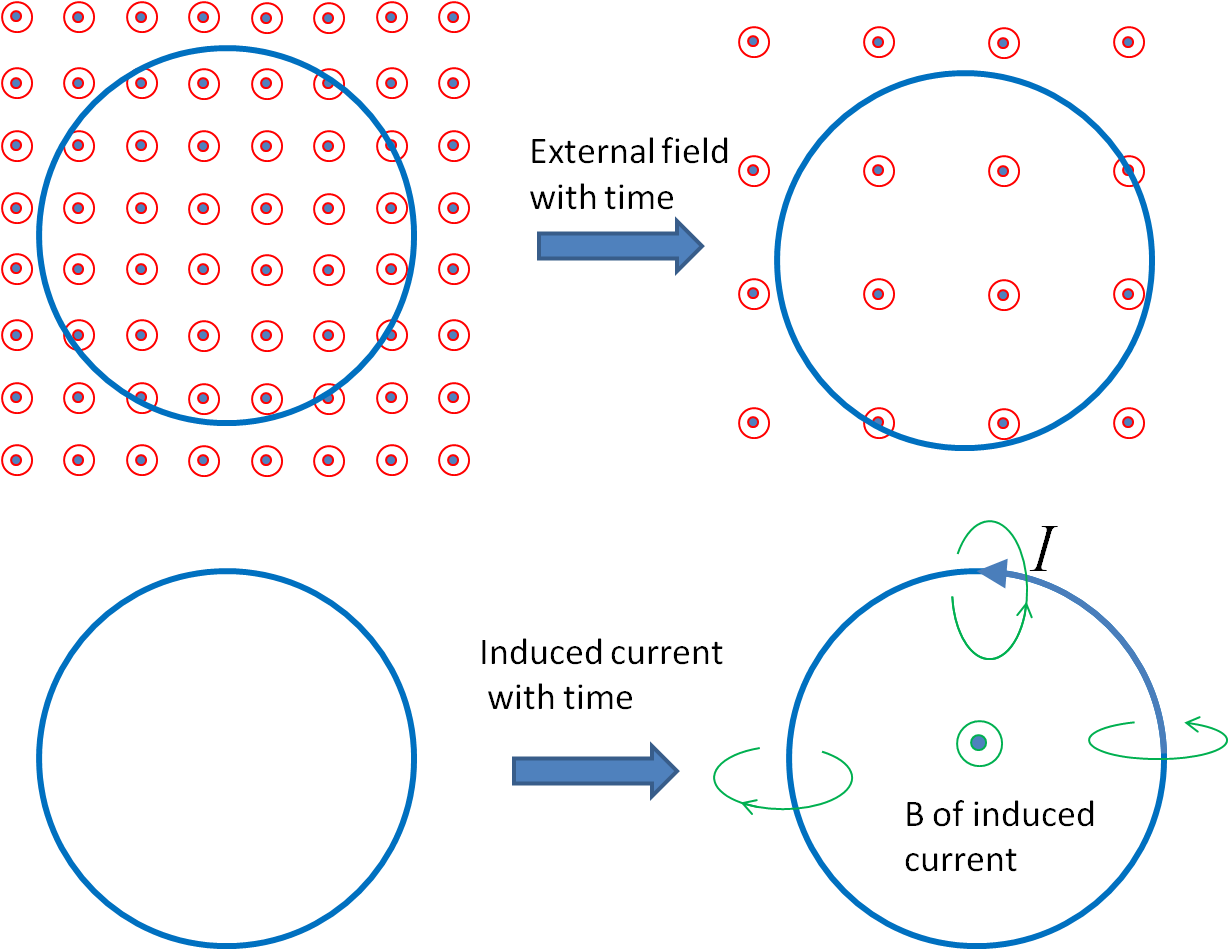
Direction of Induced Current. We will see below in
Subsection 38.3.5 that Lenz’s law is an easier way to glean the direction of induced current, but here we make the point that minus sign in Eq.
(38.7) tells us the direction of the induced EMF, itself, which is the direction of the induced current.
Magnitude of Induced Current. Let \(\mathcal{E}_\text{ind}\) be the induced EMF in a loop of wire that has resistance \(R\text{,}\) then by Ohm’s law we would get induced current \(I_\text{ind}\text{.}\)
\begin{equation}
I_\text{ind} = \dfrac{1}{R}\,\mathcal{E}_\text{ind}.\tag{38.10}
\end{equation}
So, how is \(\mathcal{E}_\text{ind}\) related to moving conductor, moving magnet, or changing magnetic field? We will work formulas out in particular situations below and then give a complete answer in the end.