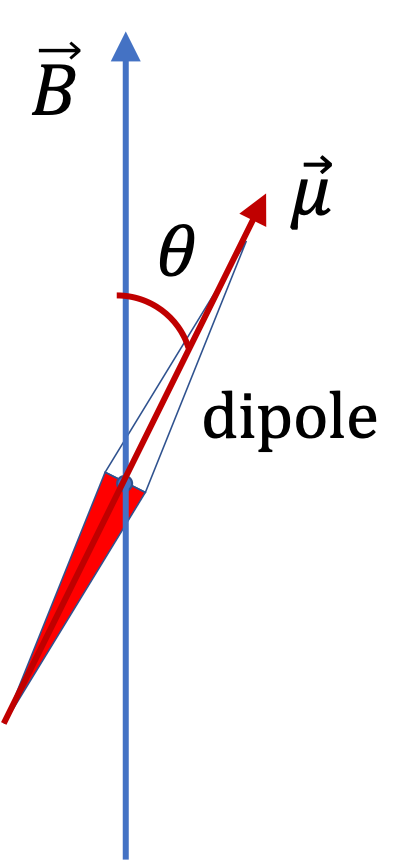
We have the following for the vector \(\vec \mu\text{.}\)
\begin{equation*}
\vec \mu = \mu\cos\,\theta\, \hat u_x + \mu\sin\,\theta\, \hat u_y.
\end{equation*}
Magnetic field is
\begin{equation*}
\vec B = B_x(x,y)\, \hat u_x + B_y(x,y)\, \hat u_y
\end{equation*}
Therefore, force on a dipole moment, written using Cartesian components of magnetic dipole moment and magnetic field is
\begin{align*}
\vec F \amp = \mu_x \partial_x\vec B + \mu_y \partial_y\vec B +\mu_z \partial_z\vec B \\
\amp = \left( \mu_x\,\partial_x B_x + \mu_y\,\partial_y B_x \right)\,\hat u_x + \left( \mu_x\,\partial_x B_y + \mu_y\partial_y B_y \right)\,\hat u_y
\end{align*}
Now, we need \(\partial_x B_x\text{,}\) \(\partial_x B_y\text{,}\) \(\partial_y B_x\text{,}\) and \(\partial_y B_y\text{.}\) They will be
\begin{align*}
\amp \partial_x B_x = -\dfrac{2xy}{ \left( x^2+y^2\right)^2 },\ \ \partial_x B_y = \dfrac{x^2 -y^2}{ \left( x^2+y^2\right)^2 }\\
\amp \partial_y B_x = \dfrac{x^2 -y^2}{ \left( x^2+y^2\right)^2 },\ \ \partial_y B_y = \dfrac{2xy}{ \left( x^2+y^2\right)^2 }
\end{align*}
Therefore, we get the following for the \(x\) and \(y\) components of the force
\begin{align*}
F_x \amp = \mu_x\,\partial_x B_x + \mu_y\,\partial_y B_x \\
\amp = -\mu_x\,\dfrac{2xy}{ \left( x^2+y^2\right)^2 } + \mu_y\,\dfrac{x^2 -y^2}{ \left( x^2+y^2\right)^2 } .\\
F_y \amp = \mu_x\,\partial_x B_y + \mu_y\,\partial_y B_y \\
\amp = \mu_x\,\dfrac{x^2 -y^2}{ \left( x^2+y^2\right)^2 } + \mu_y\,\dfrac{2xy}{ \left( x^2+y^2\right)^2 } .
\end{align*}
Therfore, the magnitude of the force is
\begin{equation*}
F = \sqrt{F_x^2 + F_y^2},
\end{equation*}
and the direction is in fourth quadrant at counter clockwise angle
\begin{equation*}
\theta = \tan^{-1} \dfrac{F_y}{F_x}.
\end{equation*}