
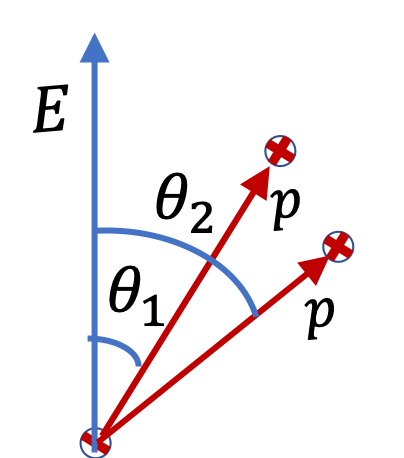
Example 33.10. Energy for Flipping a Dipole Upside Down.
A dipole of moment \(50 \times 10^{-12}\text{ C.m}\) is aligned with an electric field between two parallel plates separated by \(5\text{ mm}\) that have a potential difference of \(1\text{ kV}\text{.}\) How much energy will it take to flip the orientation of the dipole?
Solution.
From the potential different across two parallel polates and their separation, we find that the maginutde of constant electric field between the plates is
\begin{equation*}
E = \dfrac{\Delta \phi}{d} = \frac{1000\ \text{V}}{0.005\ \text{m}} = 2.0\times 10^{5}\text{ V/m}.
\end{equation*}
From the formula for the dipole potential energy we get the following expression for change in energy for flipping from \(\theta=0\) to \(\theta=\pi\text{ rad}\text{.}\)
\begin{equation*}
\Delta U = \left(-pE\cos\pi\right) - \left(-pE\cos 0 \right) = 2pE.
\end{equation*}
Putting numbers in now, we get
\begin{equation*}
\Delta U = 2\times 50 \times 10^{-12}\text{C.m} \times 2.0\times 10^{5}\text{ V/m} = 20\ \mu\text{J}.
\end{equation*}


