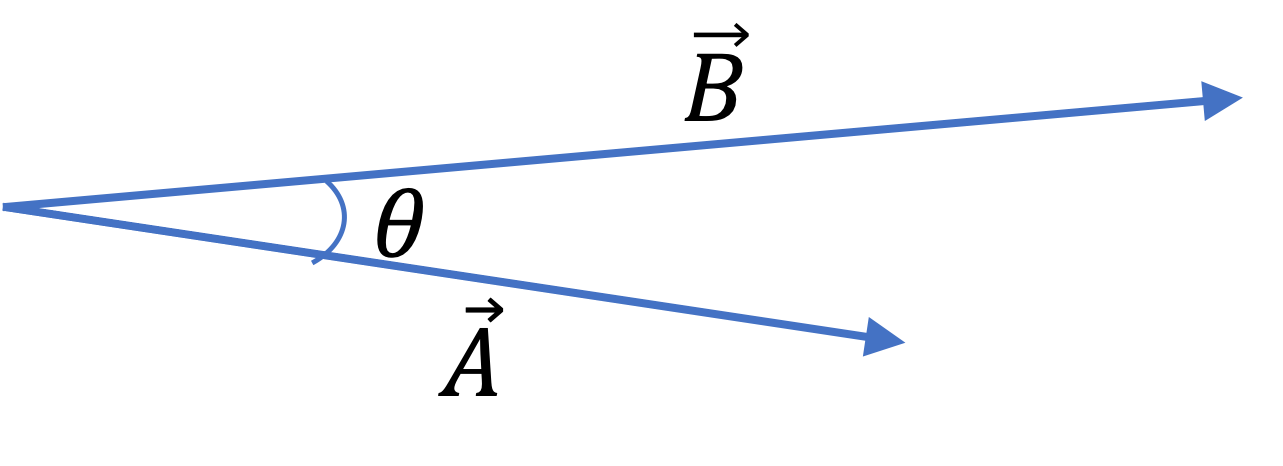
We have already discussed the definition of scalar products in
Subsubsection 3.1.8.1. To recap, the value of scalar product between two vectors
\(\vec A\) and
\(\vec B\) is ordinary multiplication of the magnitude of one of the vectors and the projection of the other vector on this vector.
Here, we will learn to make use of the Cartesian components of these vectors. Let us write each vector in terms of its Cartesian components.
\begin{align*}
\amp \vec A = A_x \hat u_x + A_y\hat u_y + A_z \hat u_z\\
\amp \vec B= B_x \hat u_x + B_y\hat u_y + B_z \hat u_z
\end{align*}
We can make us of the Distributive Property
Item 2 of scalar product to expand their product as follows.
\begin{align*}
\vec A \cdot \vec B \amp = \left(A_x \hat u_x + A_y\hat u_y + A_z \hat u_z\right) \cdot \left( B_x \hat u_x + B_y\hat u_y + B_z \hat u_z\right>)\\
\amp = A_xB_x \hat u_x\cdot \hat u_x + A_x B_y \hat u_x\cdot\hat u_y+\cdots
\end{align*}
Now, the dot product between the unit vectors along the axes is easily worked by using the angle form of the product in Eq.
(3.17) giving simple results.
\begin{align*}
\amp \hat u_x \cdot \hat u_x = |\hat u_x||\hat u_x|\cos\,0^\circ = 1 \times 1 \times 1 = 1. \\
\amp \hat u_x \cdot \hat u_y = |\hat u_x||\hat u_y|\cos\,90^\circ = 1 \times 1 \times 0 = 0.
\end{align*}
You can work out the other pairs you need. The upshot is that the product between Cartesian components equals \(1\) when they are the same vectors and zero otherwise.
\begin{equation}
\hat u_i \cdot \hat u_j =
\begin{cases}
1 \amp\quad \text{ if } i = j,\\
0 \amp\quad \text{ if } i e j,\\
\end{cases}\tag{3.18}
\end{equation}
where \(i\) and \(j\) stand for \(x,y,z\text{.}\) Now, we can complete the calculation for the dot product in terms of components left with \(\cdots\) above.
\begin{equation}
\vec A \cdot \vec B = A_xB_x \hat u_x\cdot \hat u_x + A_x B_y \hat u_x\cdot\hat u_y+\cdots = A_xB_x + A_yB_y + A_zB_z.\tag{3.19}
\end{equation}
Thus scalar product between \(\vec A \) and \(\vec B\) can be obtained in multiple ways. The following two are very useful for analytical work.
\begin{align}
\vec A \cdot\vec B \amp = A_x B_x + A_y B_y + A_z B_z,\tag{3.20}\\
\amp = A B \cos\theta,\tag{3.21}
\end{align}
where \(A \) and \(B \) are magnitudes of these vectors.
\begin{align*}
\amp A = \sqrt{A_x^2 + A_y^2 + A_z^2}\\
\amp B = \sqrt{B_x^2 + B_y^2 + B_z^2}
\end{align*}
An important use of these formulas to find the angle between two vectors, given their components. Equating these Eqs.
(3.20) and
(3.21), and solving for
\(\cos\theta \) we get
\begin{equation}
\cos\theta = \dfrac{A_x B_x + A_y B_y + A_z B_z}{A\, B}.\tag{3.22}
\end{equation}
Since components are simple numbers, their multiplication order does not matter, i.e., \(A_xB_x = B_xA_x\text{,}\) therefore, the order of vectors in the dot product does not matter. That is,
\begin{equation}
\vec A \cdot \vec B = \vec B \cdot \vec A.\tag{3.23}
\end{equation}
This will not be the case with the other product between vectors, called cross product, we will define below - we will find that reversing the order introduces a negative sign.