
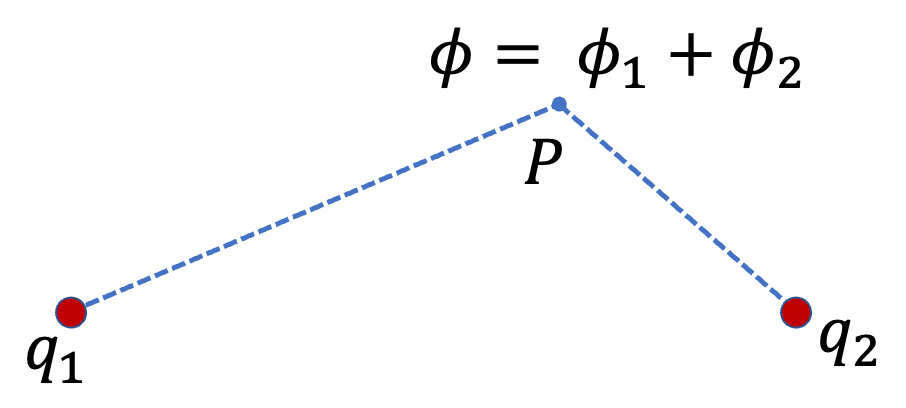
Example 31.14. Electric Potential and Electric Field of Charges at Three Corners of a Square.
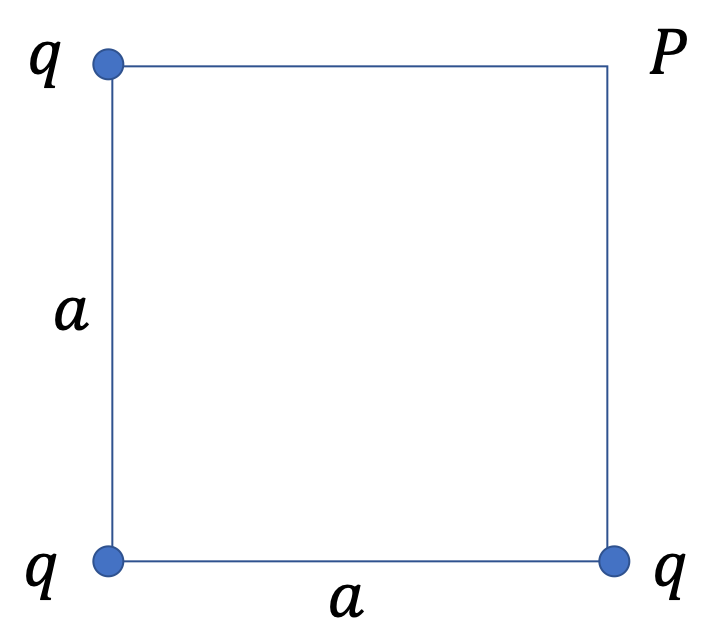
Answer.
Solution 1. (a)
Solution 2. (b)
For electric field, let us assume the given charges are positive. We now need to include the impact of directions of the forces.
Let \(x\) axis be horizontal to the right and \(y\) vertically up. Let us also use \(k\) for \(1/4\pi\epsilon_0 \text{.}\) Then, we get the following for the magnitudes of the electric fields.
\begin{align*}
E_1 \amp = k \dfrac{q}{a^2}\\
E_2 \amp = k \dfrac{q}{2a^2}\\
E_3 \amp = k \dfrac{q}{a^2}
\end{align*}
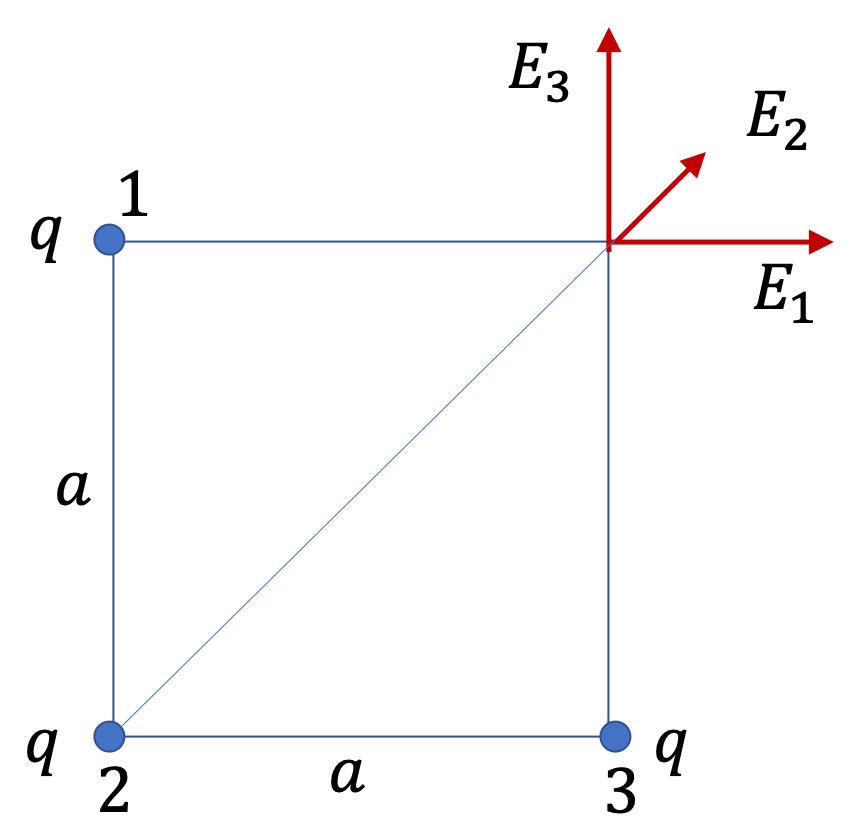
Note that net \(E\) at P is not just a simple sum of these.
\begin{equation*}
E e E_1 + E_2 + E_3.
\end{equation*}
We need to add them vectorially. This is simple enough to see that the magnitude of the field will be (we can get the same by working out the components, if you like)
\begin{align*}
E \amp = E_1\,\cos\,45^\circ + E_3\,\cos\,45^\circ + E_2, \\
\amp = k \dfrac{q}{a^2} \left( \dfrac{1}{\sqrt{2}} + \dfrac{1}{\sqrt{2}} + \dfrac{1}{2}\right), \\
\amp = k \dfrac{q}{a^2} \left( \sqrt{2} + \dfrac{1}{2}\right),
\end{align*}
and the direction is \(45^\circ\) in the direction of \(\vec E_2\text{.}\)

