
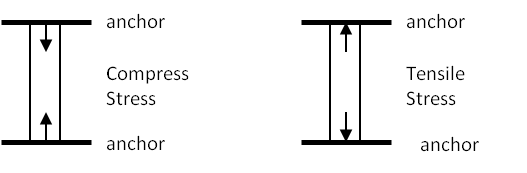
Example 20.12. Thermal Stress in Concrete.
Concrete blocks are laid out next to each other on a highway without any space between them such that they are prevented from expanding. The construction crew did their work on a winter day when the temperature was \(5^{\circ}\)C. What will be the stress in the blocks on a hot summer day when the temperature is \(38^{\circ}\)C ? (b) If the ultimate compressive strength of concrete is \(20\times10^6\ \text{N/m}^2\text{,}\) will the blocks fracture?
Data: Youngs modulus of concrete = \(20\times 10^9\ \text{N/m}^2\text{,}\) and the coefficient of linear expansion = \(12\times 10^{-6}\) per degree Celsius.
Solution.
(a) Using the formula given above, we find the thermal stress to be:
\begin{align*}
\text{Thermal Stress } \amp = - Y \alpha \Delta T \\
\amp = (20\times10^9\ \text{N/m}^2)(12\times 10^{-6}\text{C}^{-1})(38-5)^{\circ}\text{C} \\
\amp = 7.9\times 10^6\ \text{N/m}^2.
\end{align*}
(b) No, the concrete will not fracture by compressive stress as the stress does not exceed the ultimate compressive strength. But, it does exceed ultimate sheer strength of concrete which is only \(2\times 10^6\ \text{N/m}^2\) and it might chip off.

