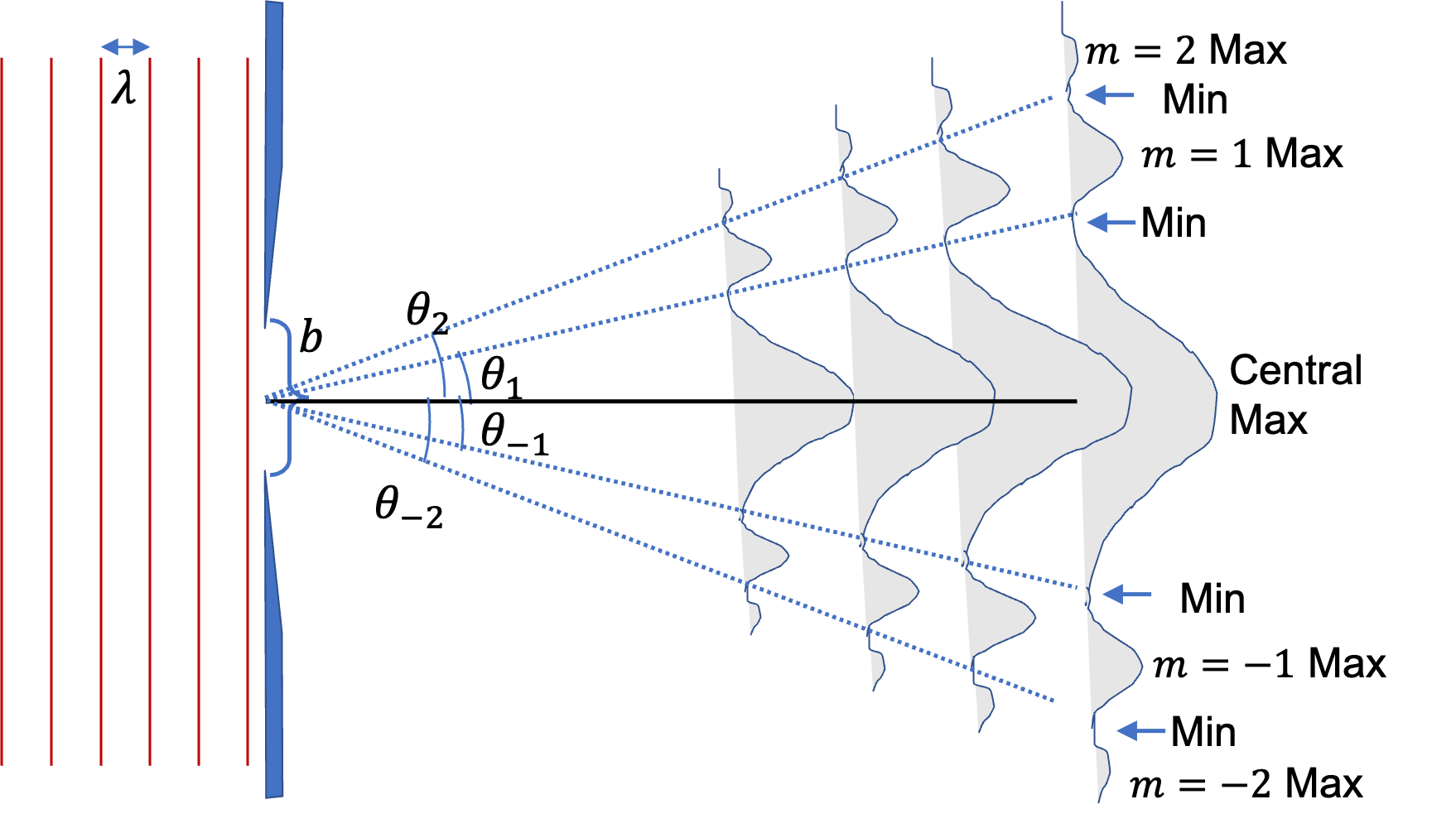
Suppose you block a wave except for a single slit through which wave can leak to the other side and produce diffraction pattern illustrated in
Figure 14.43. For example, you may place a small opening in an opaque board and shine light through it. If the opening is of the a few times more than the wavelength of wave, you will notice the diffraction effect in a pronounced way.
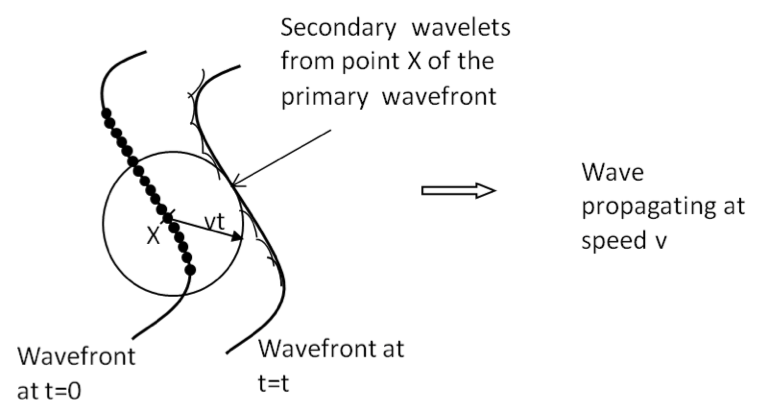
According to the Huygens-Fresnel principle, every point of the wavefront at the slit will be point source of new waves on the other side of the slit. These waves will interfere with each other when they superimpose on each other. These interferences produce a central bulge and side bulges in specific directions as illustrated in
Figure 14.43. The full calculations are beyond the scope of this text, but a simple argument can give us the direction in which waves will interfere destructively and hence will give zero intensity.
Let
\(\lambda\) be the wavelength of the wave and
\(b\) the width of the slit. Let us place a
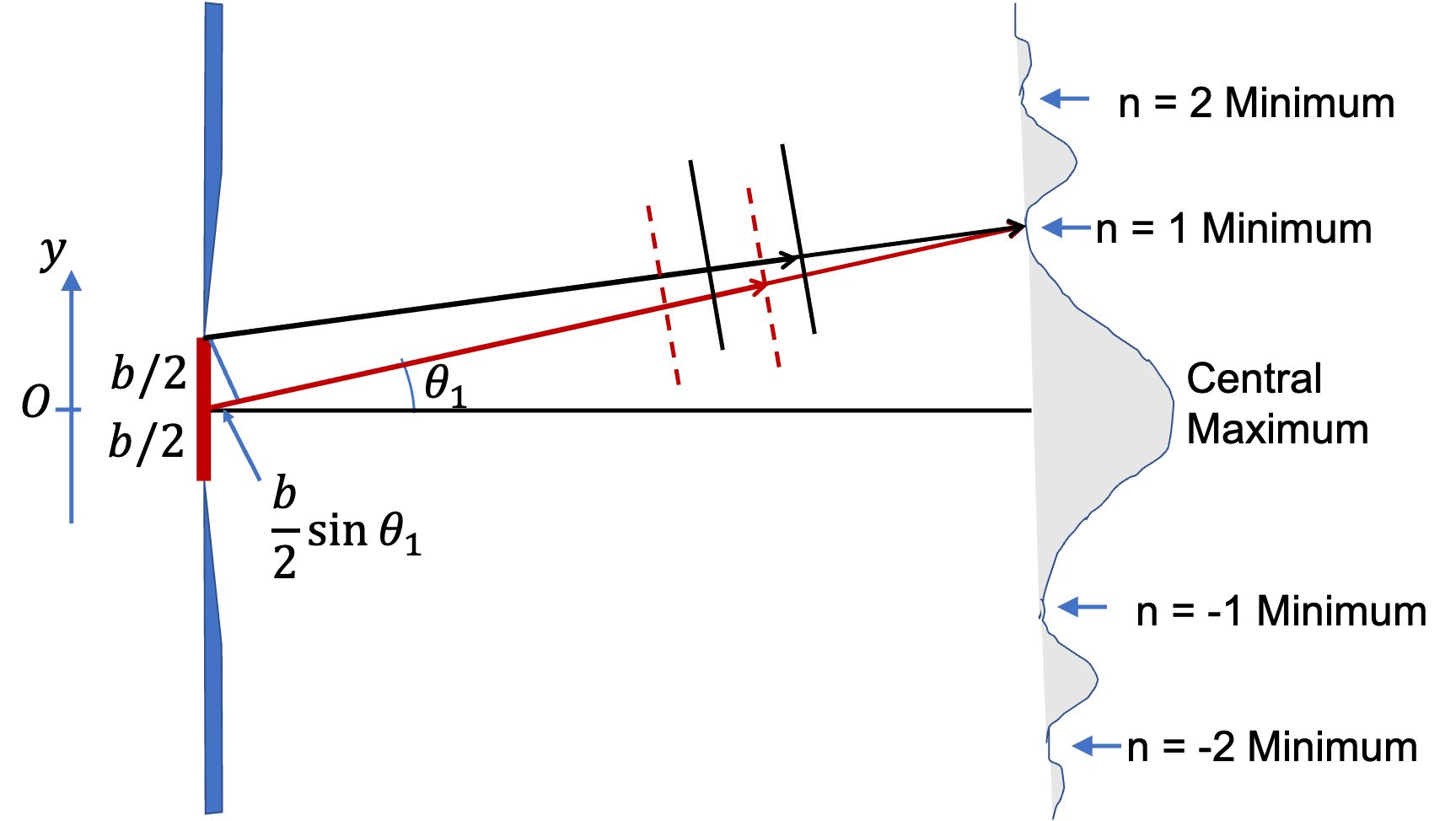
\(y\) axis at the slit with origin at the center. Then, the slit occupies
\(- b/2 \le y \le b/2 \) as shown in
Figure 14.44. Let us look at a spot on a screen far away, in the direction
\(\theta_1\) where wave from
\(y=-b/2\) arrives at peak and
\(y=0\) arrives at trough, and hence interfering destructively. Then, by pairing any point on the upper half of the slit with a corresponding lower point, we can say that in the direction
\(\theta_1\text{,}\) we will have minima of diffraction. The calculation is similar to that of interference of waves and gives the following relation. Equating difference in path,
\(\frac{b}{2}\sin\theta_1\text{,}\) to half a wave length for destructive interference, we get
\begin{equation*}
\frac{b}{2}\sin\theta_1 = \frac{\lambda}{2}.
\end{equation*}
Therefore, we have
\begin{equation}
b\sin\theta_1 = \lambda.\ \ \ (m= 1\text{ diffraction minimum})\tag{14.97}
\end{equation}
Similarly, if we split the wavefront in four parts, \(-b/4\le y\lt -b/2\text{,}\) \(-b/4\le y\lt 0\text{,}\) \(0\le y \lt b/4\text{,}\) \(b/4\le y \le b/2\text{.}\) We pair points in \(-b/4\le y\lt -b/2\) with points in \(-b/4\le y\lt 0\) as we did above for direction \(\theta_1\) above, to obtain a direction \(\theta_2\) in which these waves will interfere destructively. This gives
\begin{equation*}
\frac{b}{4}\sin\theta_2 = \frac{\lambda}{2}.
\end{equation*}
Therefore, we have
\begin{equation}
b\sin\theta_2 = 2\lambda.\ \ \ (m= 2\text{ diffraction minimum})\tag{14.98}
\end{equation}
Clearly, we can continue this process of splitting the wavefront at the slit and pairing waves to find directions in which neighboring parts will interfere destructively. This gives a general formula for order \(n\) diffraction minimum.
\begin{equation}
b\sin\theta_n = \pm n \lambda,\ \ \ n = 1, 2, 3, \cdots,\tag{14.99}
\end{equation}
with angles below horizontal line being taken to be negative. Note that since \(-1 \le \sin\theta \le 1\text{,}\) maximum value of \(n\) is limited to the case when multiple of wavelength exceeds the width of the slit. Thus, if the slit width was less than one wavelength, we will just see a central bulge and no minimum.
The central bulge is spread over a angle of \(\theta_1 + |\theta_{-1}|\text{.}\) central most intense part of the wave will be within an angle \(\theta\) about the center of the slit.
\begin{equation}
\Delta\theta_\text{central} = 2\sin\left(\frac{\lambda}{b} \right).\tag{14.100}
\end{equation}
In case of \(\lambda \le\le b\text{,}\) we can use small angle approximation of sine and simplify this to
\begin{equation}
\Delta\theta_\text{central} = \frac{2\lambda}{b}.\tag{14.101}
\end{equation}