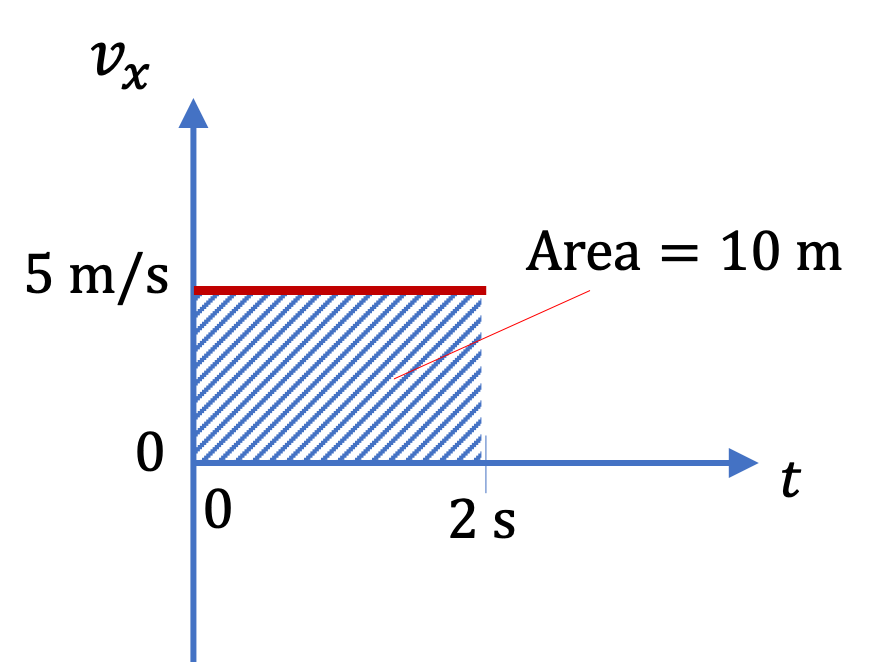
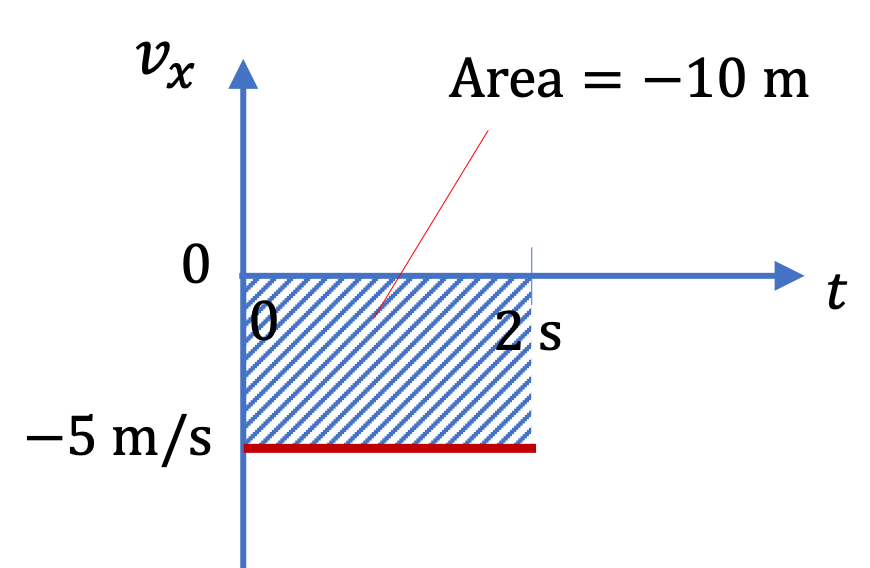
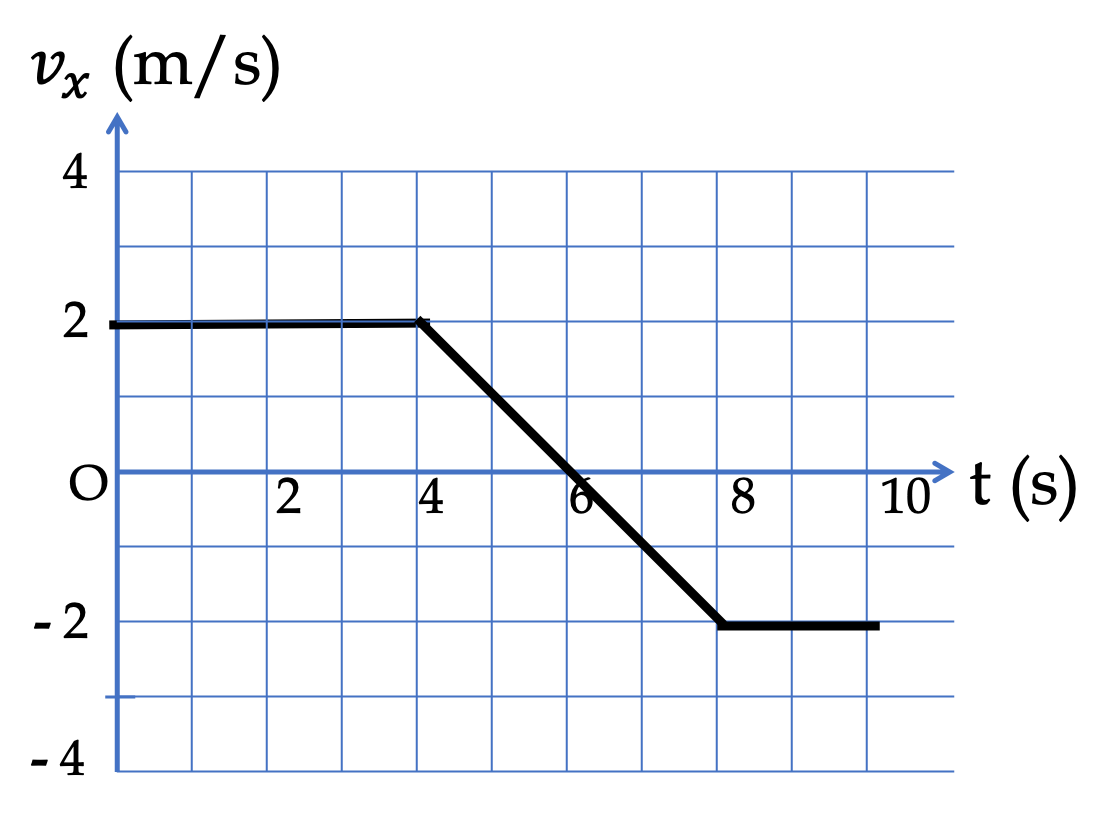
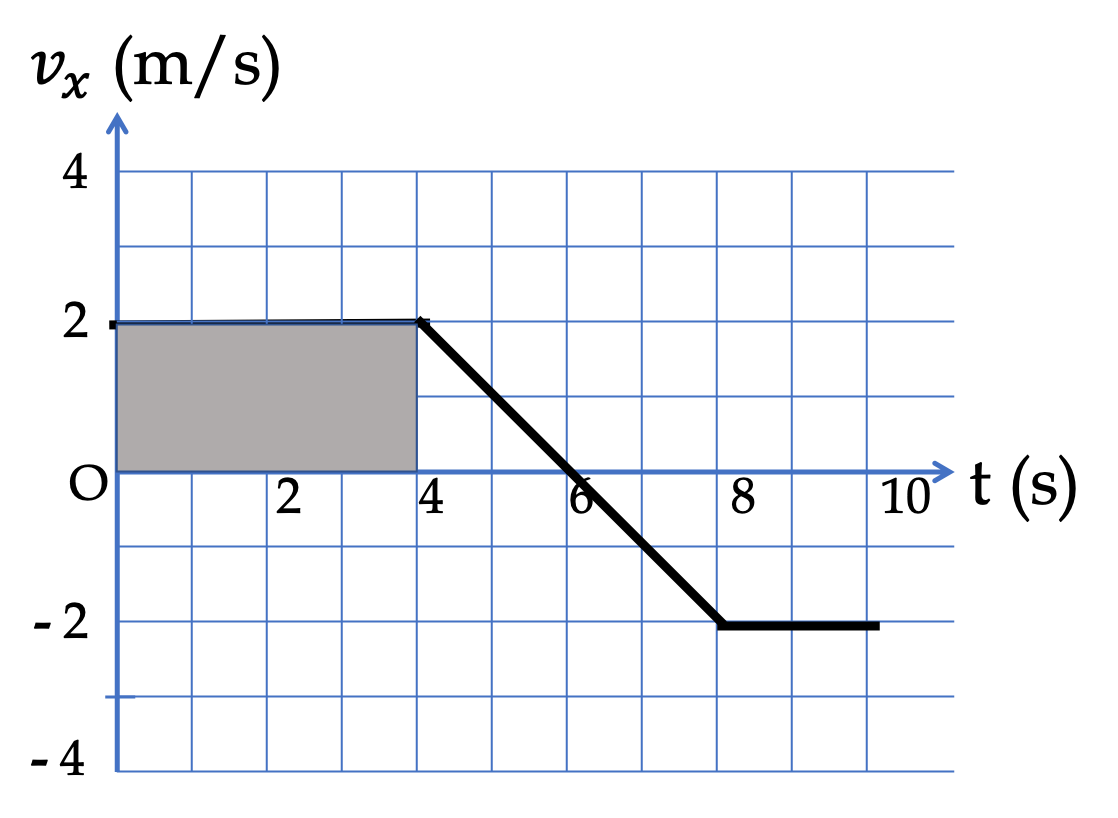
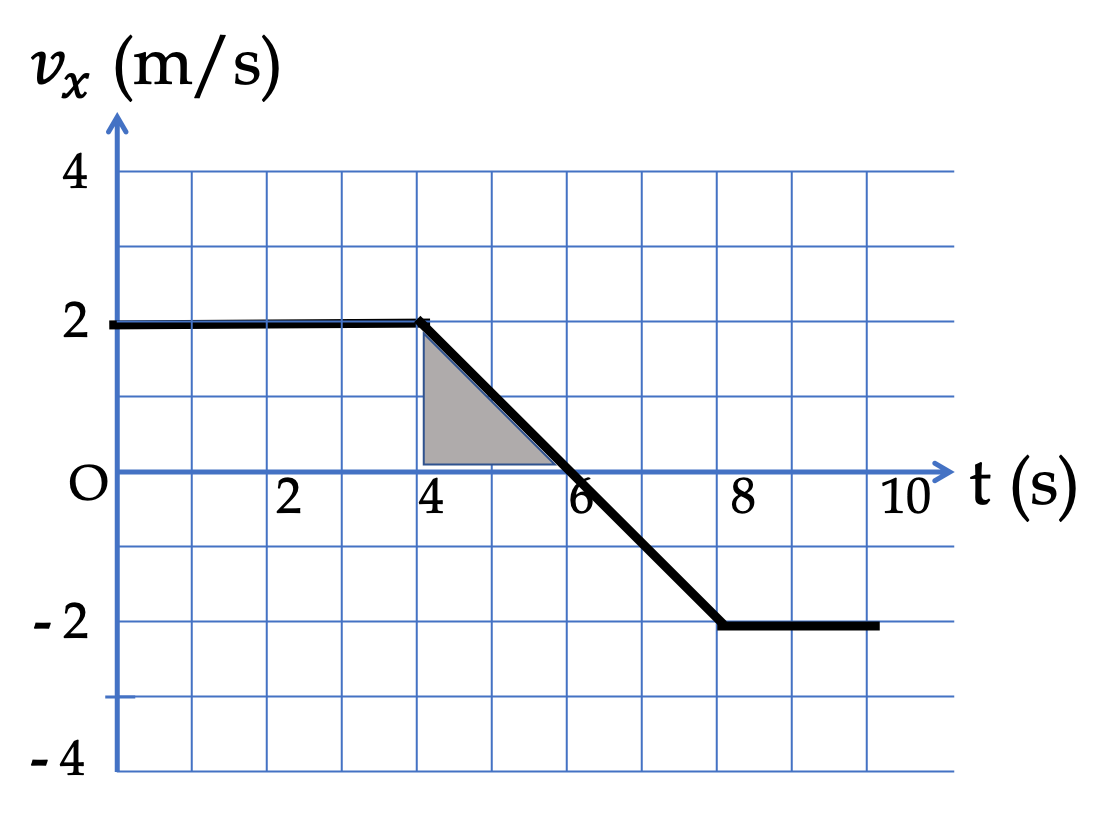
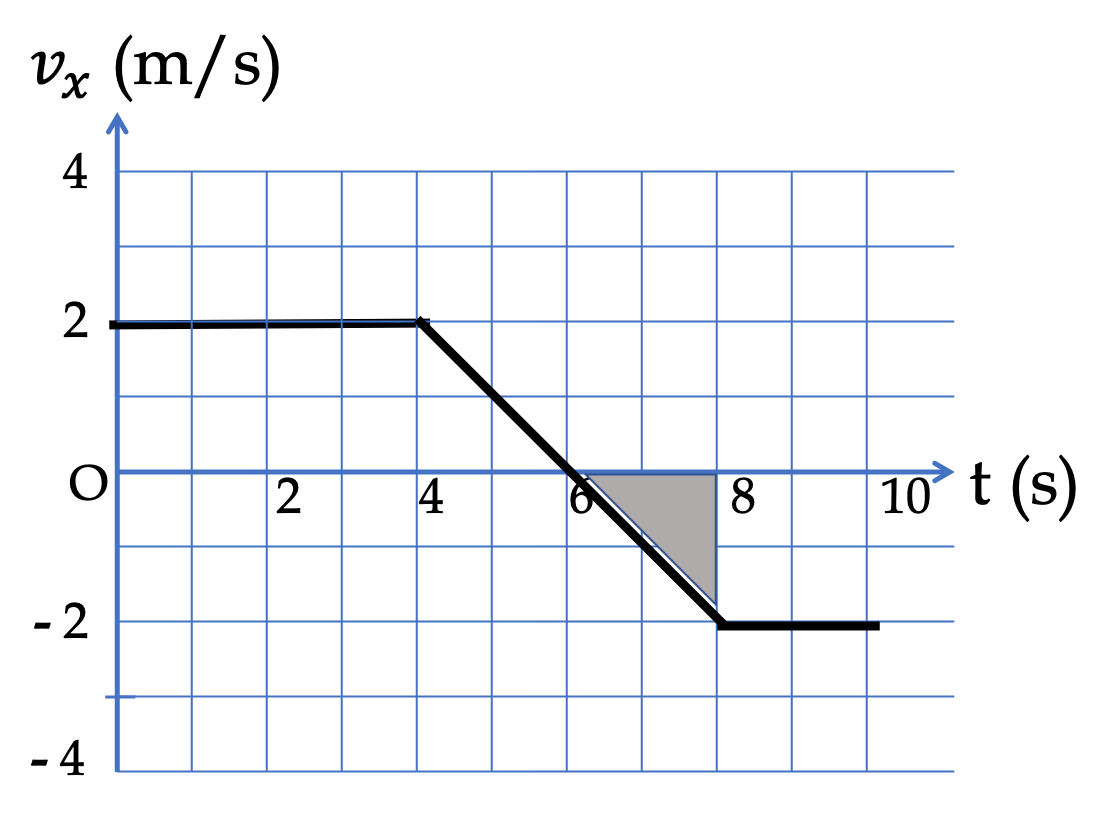
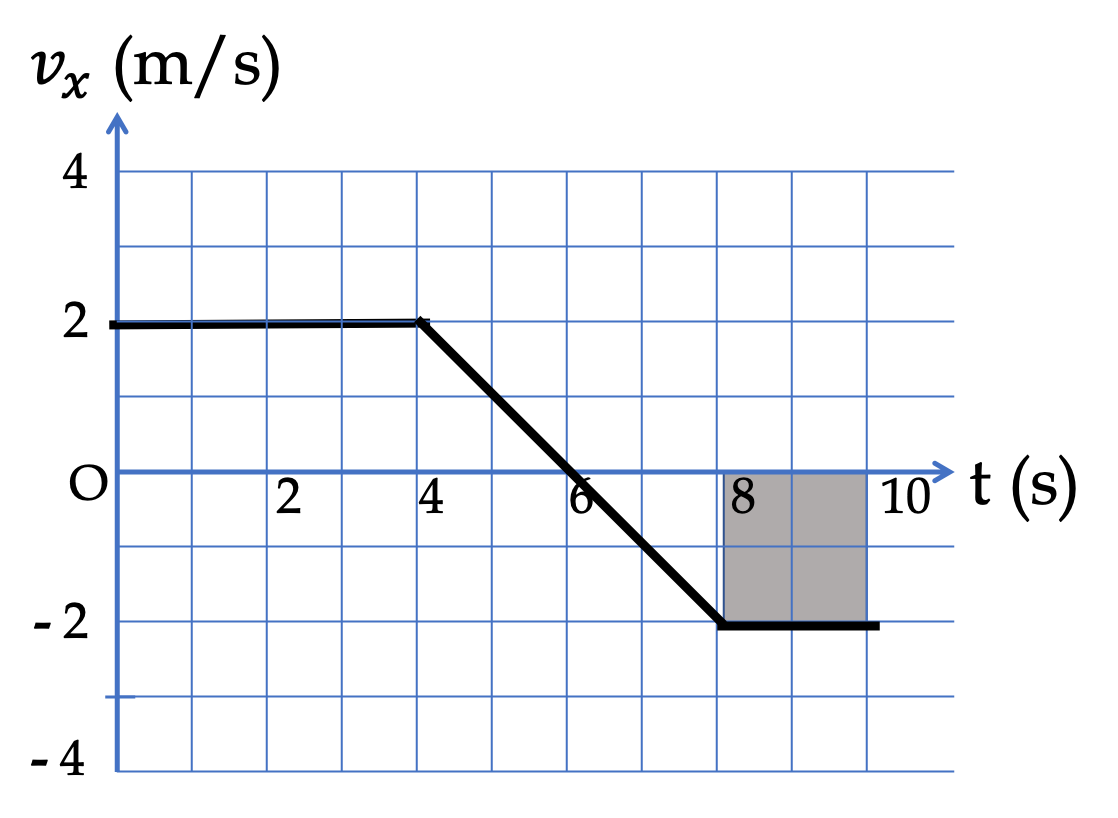
From our discussion we know that the rate of change in a coordinate is given by the derivative of the coordinate with time.
\begin{equation*}
\frac{dx}{dt} = \textrm{Rate of change of } x \textrm{ coordinate}.
\end{equation*}
Here the rate is given to be \(u_0\text{.}\) Therefore, we have the following equation for the derivative of \(x(t)\text{.}\)
\begin{equation*}
\frac{dx}{dt} = u_0.
\end{equation*}
This equation can also be written for differential elements, \(dx\) and \(dt\) by multiplying both sides by \(dt\text{.}\)
\begin{equation*}
dx = u_0dt,
\end{equation*}
which we can integrate on both sides. On the left side, the limit of integration is \(x_0\) to \(x(T)\) and the limit on the right side is the times for those \(x\) values, viz. from \(t_0\) to \(T\text{.}\)
\begin{equation*}
\int_{x_0}^{x(T)}dx = \int_{t_0}^{T}u_0dt,
\end{equation*}
which gives the following result.
\begin{equation*}
x(T) - x_0 = u_0(T-t_0).
\end{equation*}
An integration is actually not necessary here since the rate of change is constant in time. The constant rate implies that the average rate is the same as instantaneous rate of change. Therefore,
\begin{equation*}
\frac{\Delta x}{\Delta t} = u_0,
\end{equation*}
which can be multiplied both sided by \(\Delta t\) to solve for \(\Delta x\text{.}\) This immediately gives the change over the interval from \(t_0\) to \(T\) as
\begin{equation*}
x(T) - x_0 = u_0(T-t_0).
\end{equation*}