Example 2.70. Freely Falling Vertical Motion of a Ball.
A ball is thrown up with speed \(30.0 \text{ m/s}\text{.}\) (a) How high does the ball rise before coming down? (b) How long does it take to get there?
Solution 1. a
You should first note that there are other ways of doing this problem than what I will give below. For instance, you could find \(t \) first and then use \(v_{av} \) to find \(\Delta y\text{.}\)
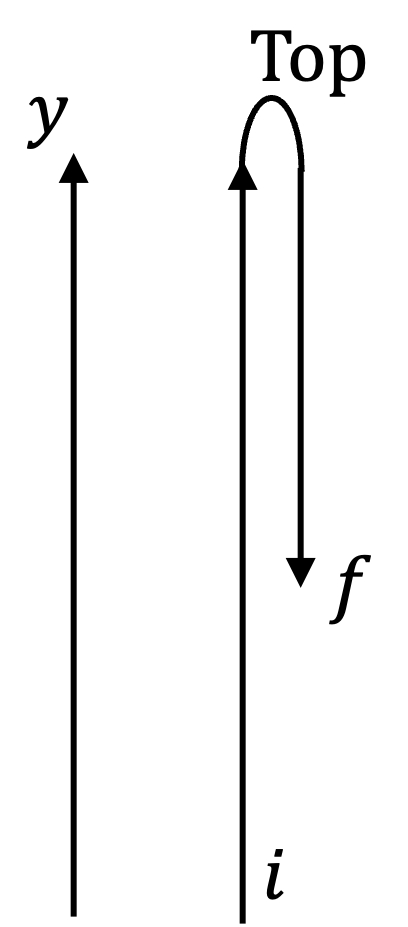
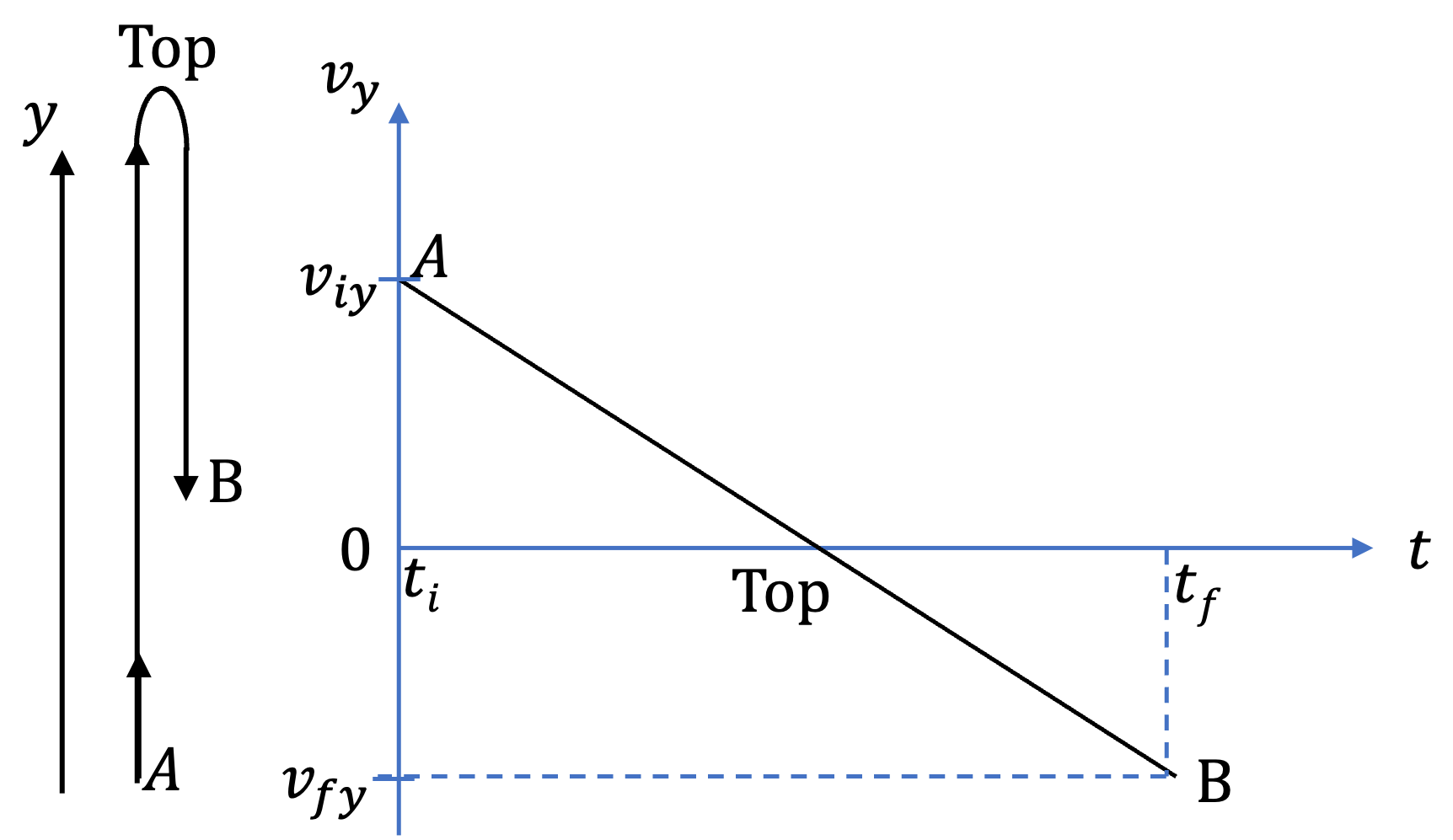
For the sake of brevity, we will drop the coordinate subscript \(y \) from the symbols and use \(t\) in place of \(\Delta t\text{.}\) Let us use \(y \) axis for the vertical motion with origin at the point the ball left and the direction of positive \(y \) being up (\(\uparrow\)). This will make \(a = -9.81\text{ m/s}^2\text{.}\)
We are given:
\begin{equation*}
v_i = 30.0 \text{ m/s}, \ \ v_f = 0, \ \ a = - 9.81 \text{ m/s}^2,
\end{equation*}
and we are to find \(\Delta y\text{,}\) which is another way to write \(y_f-y_i\text{,}\) or height \(h\text{,}\) in this case. Using the “no \(t\) equation” we get (I will omit units in calculations.)
\begin{equation*}
v_f^2 - v_i^2 = 2 a \Delta y \rightarrow 0 - 30^2 = 2 \times 9.81 \times \Delta y
\end{equation*}
This gives
\begin{equation*}
\Delta y = 45.9 \text{ m}.
\end{equation*}