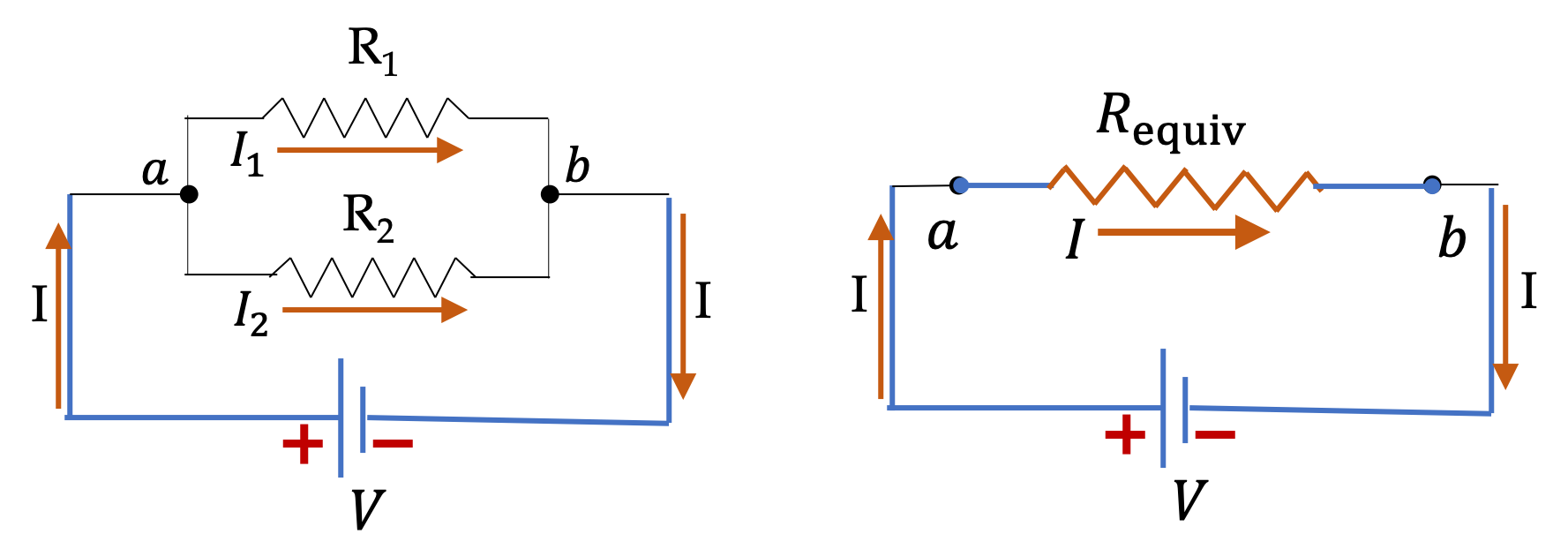
Example 34.37. A Current Divider.
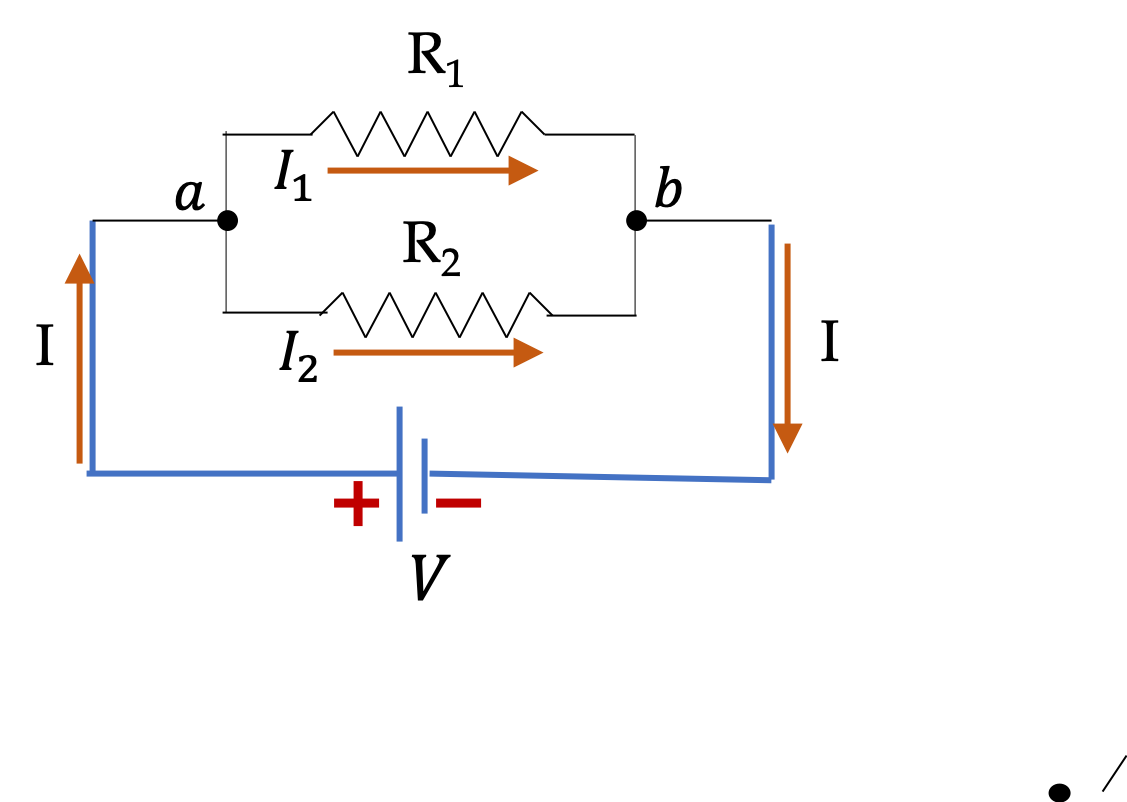
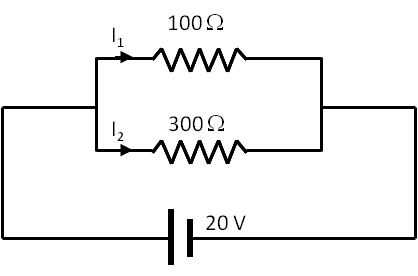
Consider the circuit given in Figure 34.38.
Answer.
Solution 1. (a)
(a) In this example, current \(I_1\) will be more than current \(I_2\) since \(I_1\) passes through the smaller resistance.
\begin{align*}
I_1 \amp = \left(\frac{300\Omega}{100\Omega + 300\Omega } \right) I = \frac{3}{4} I. \\
I_2 \amp = \left(\frac{100\Omega}{100\Omega + 300\Omega } \right) I = \frac{1}{4} I.
\end{align*}
Hence 75% of the total current passes through the \(100\;\Omega\) resistor and \(25\%\) through the \(300\; \Omega\) resistor.
Solution 2. (b)
(b) The equivalent resistance across the source is the equivalent resistance of parallel resitors.
\begin{align*}
R_\text{equiv} \amp = \left( \frac{1}{R_1} + \frac{1}{R_2} \right)^{-1} = \frac{R_1 R_2}{R_1 + R_2}\\
\amp = \frac{100\Omega \times 300\Omega }{100\Omega + 300\Omega } = 75\ \Omega.
\end{align*}