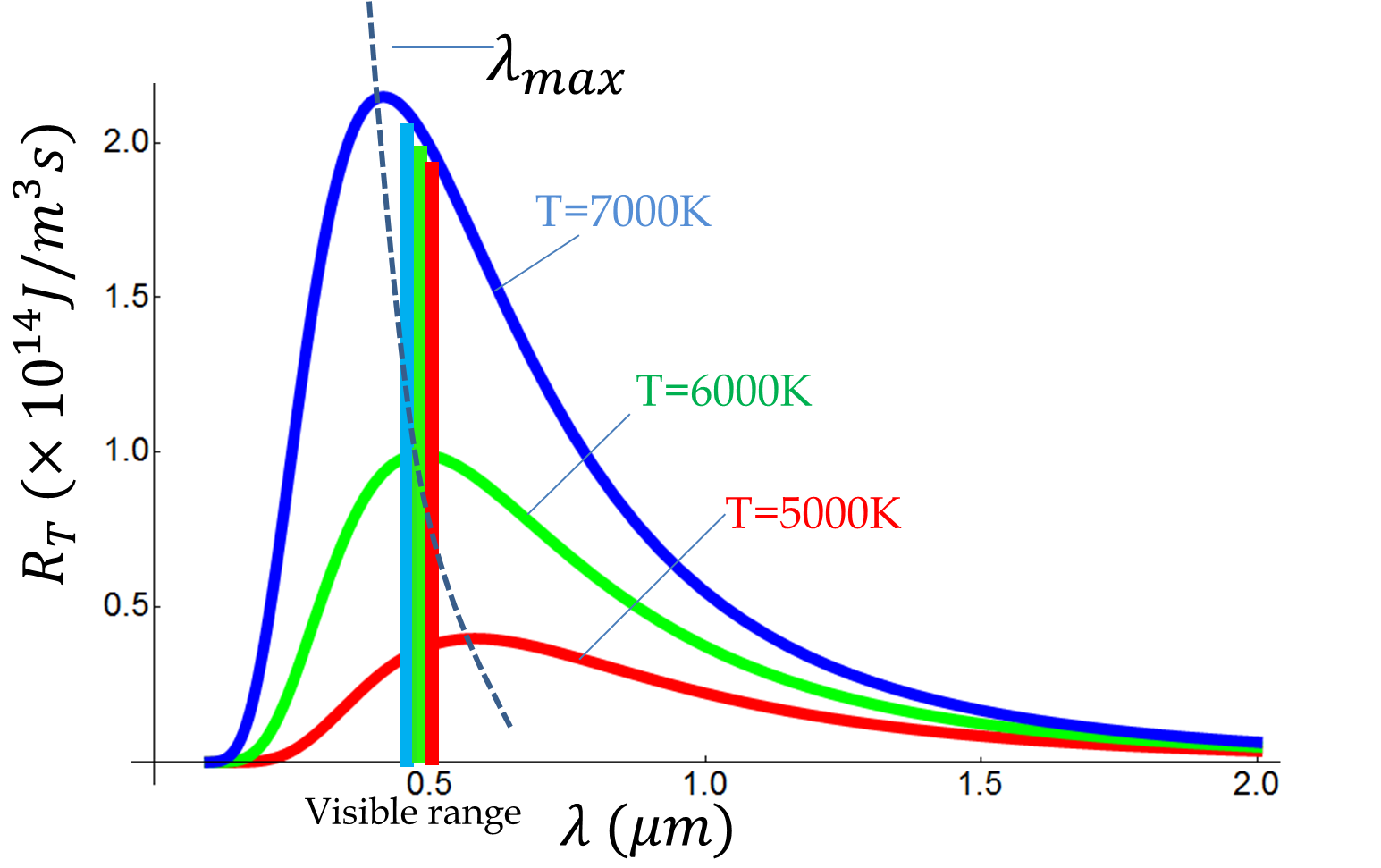
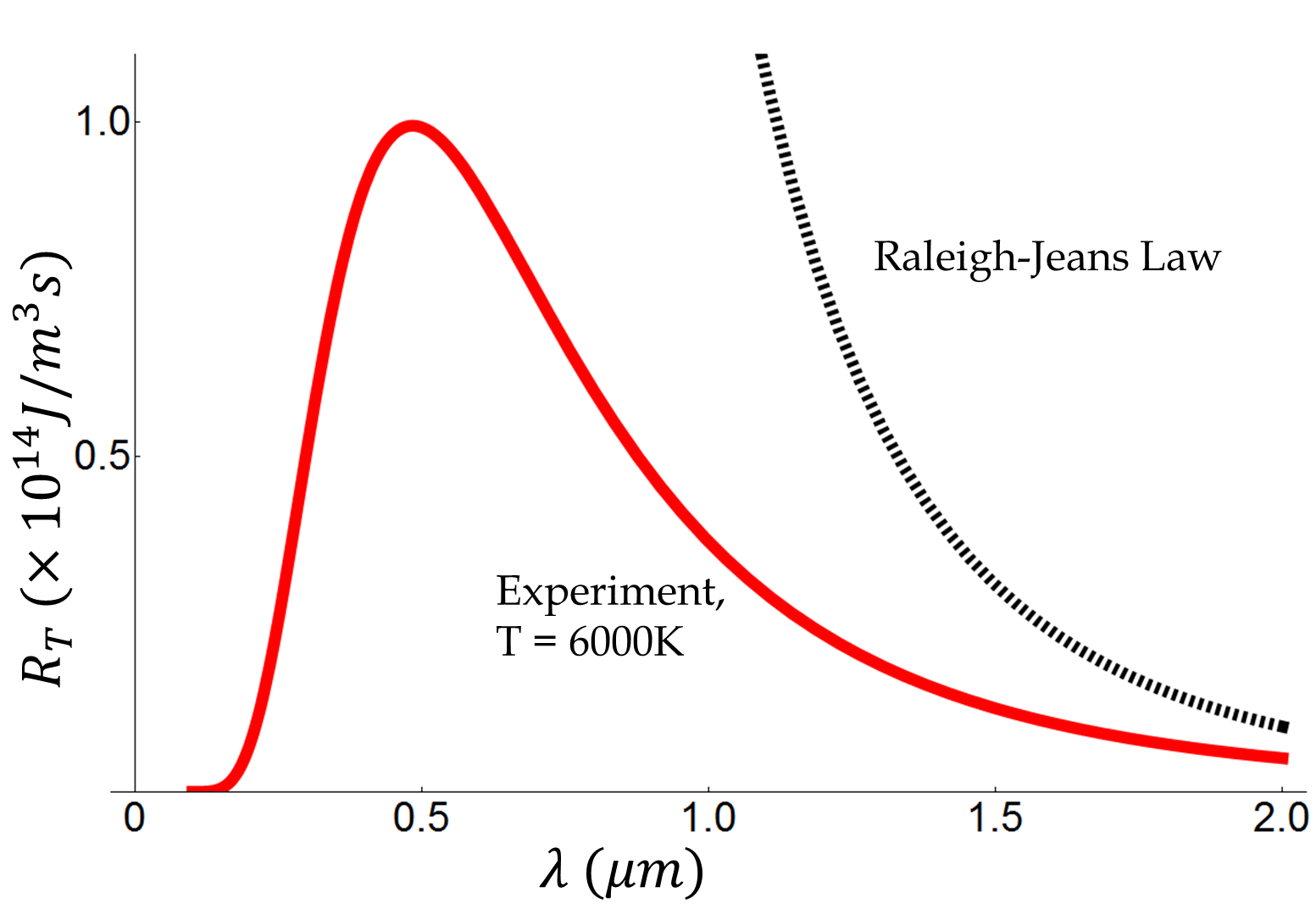
In 1900 Max Planck derived a formula for the radiancy based on a quantum assumption that fit the data at all wavelengths. Planck modeled the atoms in the cavity wall act as tiny springs which exchange energy with the electromagnetic radiation. The electric field of the electromagnetic radiation would accelerate electrons of the cavity wall which will then oscillate at the frequency of the electromagnetic radiation.
Before Planck it was assumed that any amount of energy can be exchanged between the radiation field and the atoms of the cavity wall. The Raleigh-Jeans formula is the result of such an approach. Planck introduced a quantum assumption - he assumed that the exchange would take place only in integral multiples of a quantum of energy proportional to the frequency \(f\) of the radiation.
\begin{equation*}
E_{\textrm{quantum}} \propto f,
\end{equation*}
and introduced a constant of proportionality \(h\text{,}\) which we now call Planck’s constant.
\begin{equation}
E_{\textrm{quantum}} = h f.\tag{50.13}
\end{equation}
Since frequency of light in vacuum is related to wavelength by
\begin{equation}
f \lambda = c,\tag{50.14}
\end{equation}
we can write energy formula also in terms of wavelength as
\begin{equation}
E_{\textrm{quantum}} = \frac{hc}{\lambda}.\tag{50.15}
\end{equation}
Planck then used methods of statistical mechanics to derive the following radiancy formula of the radiation in the cavity at thermal equilibrium at temperature \(T\text{.}\)
\begin{equation}
R_T(\lambda) = \left(2 \pi h c^2\right)\:\dfrac{1}{\lambda^5}\:\left[\dfrac{1}{e^{hc/\lambda k_B T}-1}\right], \tag{50.16}
\end{equation}
where \(k_B\) is the Boltmann constant and \(c\) the speed of light. This formula is known as Planck’s radiation law. This formula completely agreed with the experimental results at all wavelengths and at all temperatures for a universal value of \(h\) which he estimated to be \(6.55\times 10^{-34}\:\textrm{J.s}\text{.}\) The best experimental values now put the value of Planck constant at
\begin{equation*}
h = 6.63\times 10^{-34}\:\textrm{J.s}.
\end{equation*}
Although it is tempting to say that the fundamental quanta of energy \(hf\) correspond to the energy of elementary particles that make up the radiation of frequency \(f\) in the cavity, Planck, however, thought of the idea of the fundamental quantum of energy to be only a mathematical device and not representing some reality of the system in the cavity. It was difficult for scientists at the time to believe that the atoms of the cavity could not absorb arbitrary amounts of energy in a continuous spectrum.
In 1916 Einstein gave another derivation of Planck’s radiation law based on the quantized energy levels of atoms of the cavity. The quantization of energy of atoms give rise to the radiation with spectral radiancy given by the formula in Eq.
(50.16). Although, the quanta of energy in the cavity equal to
\(hf\) suggests strongly that electromagnetic radiation consists of particles, called photons, we will see that a more compelling case for the particle nature of light comes from Einstein’s explanation of the Photoelectric effect and and Compton’s explanation of the Compton effect. In modern time we are able to produce, manipulate, and detect single photons as if they were particles.