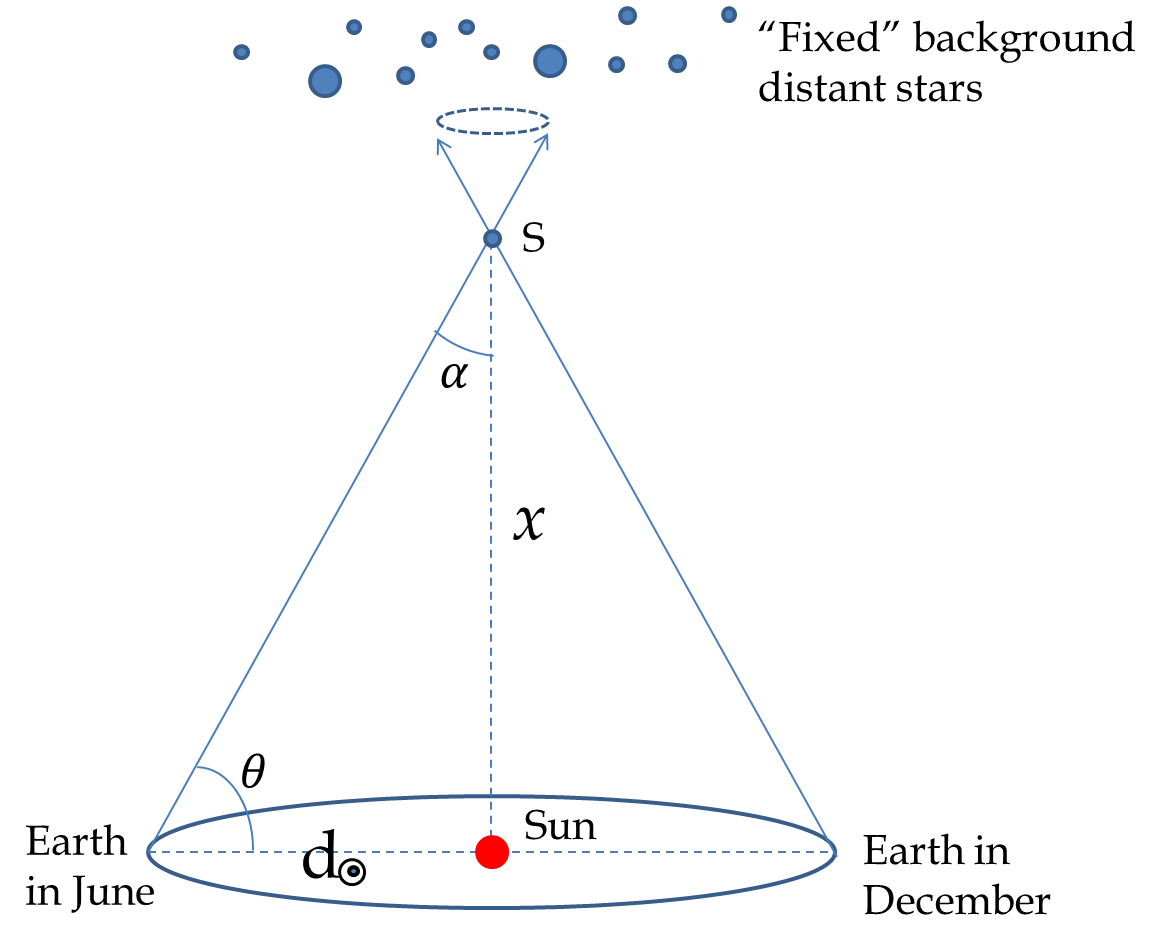
The parallax method makes use of the fact that when you look at an object from two positions, the object would appear to be in different directions in space. Suppose a star is directly overhead. When you look at such a star every day you would find that the star is in slightly different direction each night compared to the ``fixed stars’’ background. Over a period of one year the directions to the star would make a circle in the sky as illustrated in
Figure 56.1. In this diagram, we measure
\(\theta\text{,}\) the angle to the horizon, and deduce the apex angle,
\(\alpha\text{,}\) which is also called the
parallax angle.
The angle \(\alpha\) at the star S of the triangle is called the parallax angle. From the triangle with vertices at the Earth, the Sun, and the star, we see that the apex angle \(\alpha\) will be given by
\begin{equation*}
\alpha = 90^{\circ} - \theta.
\end{equation*}
In terms of the parallax angle the distance to the star will be
\begin{equation*}
x = \frac{d_{\odot}}{\tan\alpha}.
\end{equation*}
The angle \(\alpha\) is usually very small such that we can replace \(\tan\alpha\) by \(\alpha\) expressed in radians.
\begin{equation}
x = \frac{d_{\odot}}{\alpha}. \tag{56.1}
\end{equation}
The Earth-Sun distance \(d_{\odot}\) is approximately \(1.5\times 10^{11}\) m and referred to as 1 astronomical unit (AU).
\begin{equation*}
d_{\odot} = 1.5\times 10^{11}\:\text{m} \equiv 1\: \text{AU}.
\end{equation*}
In astronomy we deal with very large distances and unit meter is not convenient. In addition to AU unit of distance, there are two more units of distance in use - parsec (pc) and lightyear (ly). Parsec is defined by the parallax formula givenin Eq.
(56.1). We define one parsec to be the distance for which the parallax is one arcsec. That is, oneparsec is the value of
\(x\) in Eq.
(56.1) when
\begin{equation*}
\alpha = 1\:\text{arcsec} = 4.848\times10^{-6} \:\text{rad}.
\end{equation*}
This gives
\begin{equation*}
1\:\text{pc} = \frac{1.5\times 10^{11}\:\text{m}}{ 4.848\times10^{-6} \:\text{rad}} = 3.1\times10^{16}\:\text{m}.
\end{equation*}
Expressing this in AU we get
\begin{equation*}
1\:\text{pc} = 3.1\times10^{16}\:\text{m} = 2.1 \times 10^{5}\:\text{AU}.
\end{equation*}
There is another convenience in using the unit parsec. Let \(\alpha\) be given in arcsec, then the distance is parsec will be simply the inverse of the angle in arcsec.
\begin{equation}
x[\text{pc}] = \frac{1}{\alpha[\text{arcsec}]}. \tag{56.2}
\end{equation}
This is easily seen by dividing both sides of Eq.
(56.1) by 1 pc. The cancellation of
\(d_{\odot}\) leaves the simple formula for the relation of the distance in parsec and the parallax angle in arcsec.
\begin{equation*}
\frac{x}{1\:\text{pc}} = \frac{d_{\odot}/\alpha}{d_{\odot}/1[\:\text{arcsec}]}\ \ \Longrightarrow\ \ x[\text{pc}] = \frac{1}{\alpha[\text{arcsec}]}.
\end{equation*}
Most of the stars visible to the naked eye are within about 100 pc from us. For larger distances, we successively use metric system prefixes such as, kilo-parsec (kpc), mega-parsec (Mpc), and giga-parsec (Gpc).
Sometimes distances are expressed in yet another unit of distance called lightyear (ly). This name is misleading since the name ends in the word year, which would imply that this is a unit of time, but, a light year is a distance traveled by light in one year.
\begin{equation*}
1\:\text{ly} = 3.0\times 10^{8}\:\text{m/s} \times \frac{3.156 \times 10^{7}\:\text{s}}{1\:\text{y}} \times 1\:\text{y} = 9.468\times 10^{15}\:\text{m}.
\end{equation*}
The conversion between light years and parsec will be
\begin{equation*}
1\:\text{pc} = \frac{3.1\times10^{16}\:\text{m}}{9.468\times 10^{15}\:\text{m}}\:\text{ly} = 3.3\:\text{ly}.
\end{equation*}