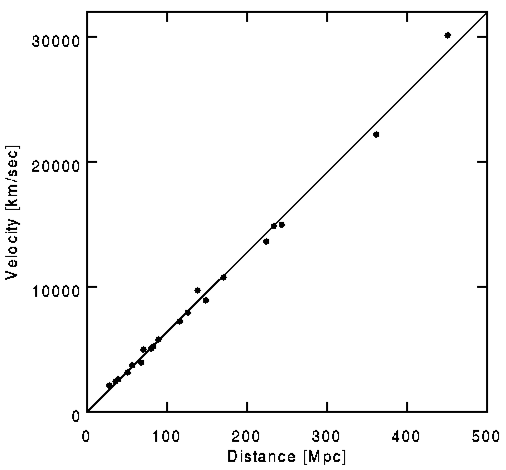
In 1912 Vesto Melvin Slipher reported the redshift of spectral lines from Andromeda galaxy. Throughout 1910s Slipher studied the spectra of several nubulae (which, at the time, were not known to be separate galaxies) at the Lowell Observatory, Arizona, USA. To determine the recession velocity of a star we first identify a characteristic spectral line for an element in the spectrum of the star, and then, compare the wavelength measured to the wavelength seen in an experiment in the lab. From the fractional difference we can deduce the speed of recession of the galaxy by using the Doppler formula as illustrated below.
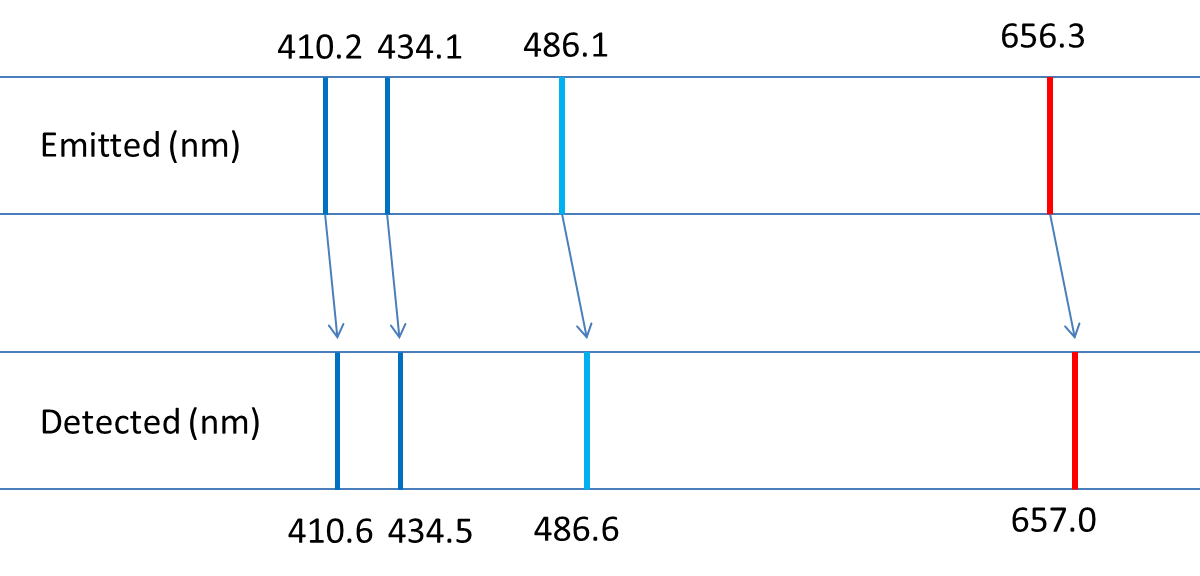
If a star emits a light of wavelength \(\lambda_0\text{,}\) the wavelength \(\lambda\) detected at the Earth will be longer if Earth and star are moving away from each other and shorter if the Earth and the star are moving towards each other. When the measured wavelength is longer we say the light is red shifted and when it is shorter we say the light is blue shifted. For instance, a hydrogen emission spectrum in the lab where the hydrogen gas and the detector are at rest with respect to each other contains light of wavelengths
\begin{equation*}
\text{Balmer lines:}\ \text{H}_{\alpha}\ 656.3\ \text{nm},\ \text{H}_{\beta}\ 486.1\ \text{nm},\ \text{H}_{\gamma}\ 434.1\ \text{nm},\ \text{H}_{\delta}\ 410.2\ \text{nm}.
\end{equation*}
If a star is receding at a speed of 300 km/s these lines will appear at
\begin{equation*}
\text{Red shifted Balmer lines:}\ \text{H}_{\alpha}^{\prime}\ 656.957\ \text{nm},\ \text{H}_{\beta}^{\prime}\ 486.586\ \text{nm},\ \text{H}_{\gamma}^{\prime}\ 434.534\ \text{nm},\ \text{H}_{\delta}^{\prime}\ 410.61\ \text{nm}.
\end{equation*}
This effect is called Doppler effect. With a relative speed \(v\) along the line of sight of the star from Earth, the Doppler effect of electromagnetic waves gives the following relation
\begin{equation}
\frac{\lambda}{\lambda_0} = \sqrt{\frac{1+v/c}{1-v/c}}, \tag{56.18}
\end{equation}
where \(c\) is the speed of light. It is customary to define a dimensionless parameter \(z\) that measures fractional change in the wavelength.
\begin{equation*}
z = \frac{\lambda - \lambda_0}{\lambda_0}.
\end{equation*}
Thus, the relativistic Doppler shift, Eq.
(56.18), in terms of red shift becomes
\begin{equation}
1 + z = \sqrt{\frac{1+v/c}{1-v/c}}, \tag{56.19}
\end{equation}
Solving for \(v\) we get
\begin{equation}
\frac{v}{c} = \frac{z(2+z)}{1 + (1+z)^2}. \tag{56.20}
\end{equation}
If \(v \ll c\text{,}\) we get a much simpler formula,
\begin{equation*}
v = z c.\ \ \ \ (v \ll c).
\end{equation*}
These Doppler shifts were later interpreted as red shifts due to the cosmological expansion of space after Hubble discovered that the recession velocities correlated with the distance to the galaxies. We will examine this later interpretation below.