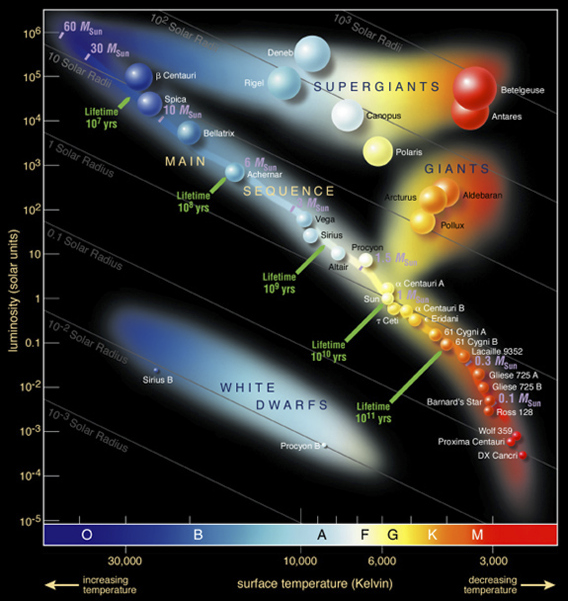
The total amount of energy radiated by a star per unit time is called its luminosity \(L\text{,}\) absolute luminosity. Luminosity is an intrinsic property of a star. The emitted radiation spreads out in space. Suppose the spreading of energy happens uniformly in all directions. Let \(F_{*}\) be the flux, i.e., the amount of radiant energy per unit time per unit area, at the surface of the star of radius \(r_{*}\text{.}\) Then, the total energy leaving the star in unit time will be
\begin{equation*}
L = 4\pi {r_{*}}^2 F_{*}.
\end{equation*}
This energy will pass a larger spherical surface at a later time. Let \(F\) be the intensity of the radiation at a distance \(r\) from the star. Since the total energy per unit time emitted from the star is same regardless of where the energy is observed, we must also have
\begin{equation*}
L = 4\pi r^2 F,
\end{equation*}
at any distance \(r\) from the star. Therefore, the flux observed at a distance \(r\) from the star must drop as the square of the distance.
\begin{equation}
F = \frac{L}{4\pi r^2}.\tag{56.3}
\end{equation}
Now, if \(F\) is measured on Earth and the distance from Earth to the star \(r\) is obtained from some other method, such as the parallax method we have discussed above, we can deduce \(L\) of the star. Now, think about it: just by making appropriate measurements from Earth we can know something intrinsic to a star! For instance, the average flux of sunlight observed on Earth, called the solar constant, is \(F = 1.361\: \textrm{kW/m}^2\text{,}\) and the distance to the sun is \(1.5 \times 10^{11}\:\textrm{m}\text{.}\) Therefore, the sun must have the following luminosity.
\begin{equation*}
L =4\pi r^2 F = 3.8\times 10^{26}\:\textrm{W}.
\end{equation*}
That is, the Sun is putting out
\(3.8\times 10^{26}\) Joules of energy per second. Of course, if you can figure out
\(L\) somehow and measure
\(F\) then you can use Eq.
(56.3) to deduce the distance to the star.
\begin{equation}
r=\sqrt{L/4\pi F}. \tag{56.4}
\end{equation}
The flux \(F\) of a star measured on Earth is called its apparent brightness. Sometimes, we designate the apparent brightness by \(F_m\) to distinguish it from a related quantity called absolute brightness which is the brightness of the star if the said star were 10 pc away instead of \(r\) away. We will denote the absolute brightness by \(F_M\text{.}\)
\begin{equation*}
F_m = \frac{L}{4\pi r^2};\ \ \ F_M= \frac{L}{4\pi (10\:\textrm{pc})^2};
\end{equation*}
Here \(F_m\) is the measured quantity, not \(F_M\text{.}\) The ratio of the fluxes gives
\begin{equation}
\frac{F_M}{F_m} = \left( \frac{r\ [\textrm{pc}]}{10\:\textrm{pc}} \right)^2. \tag{56.5}
\end{equation}