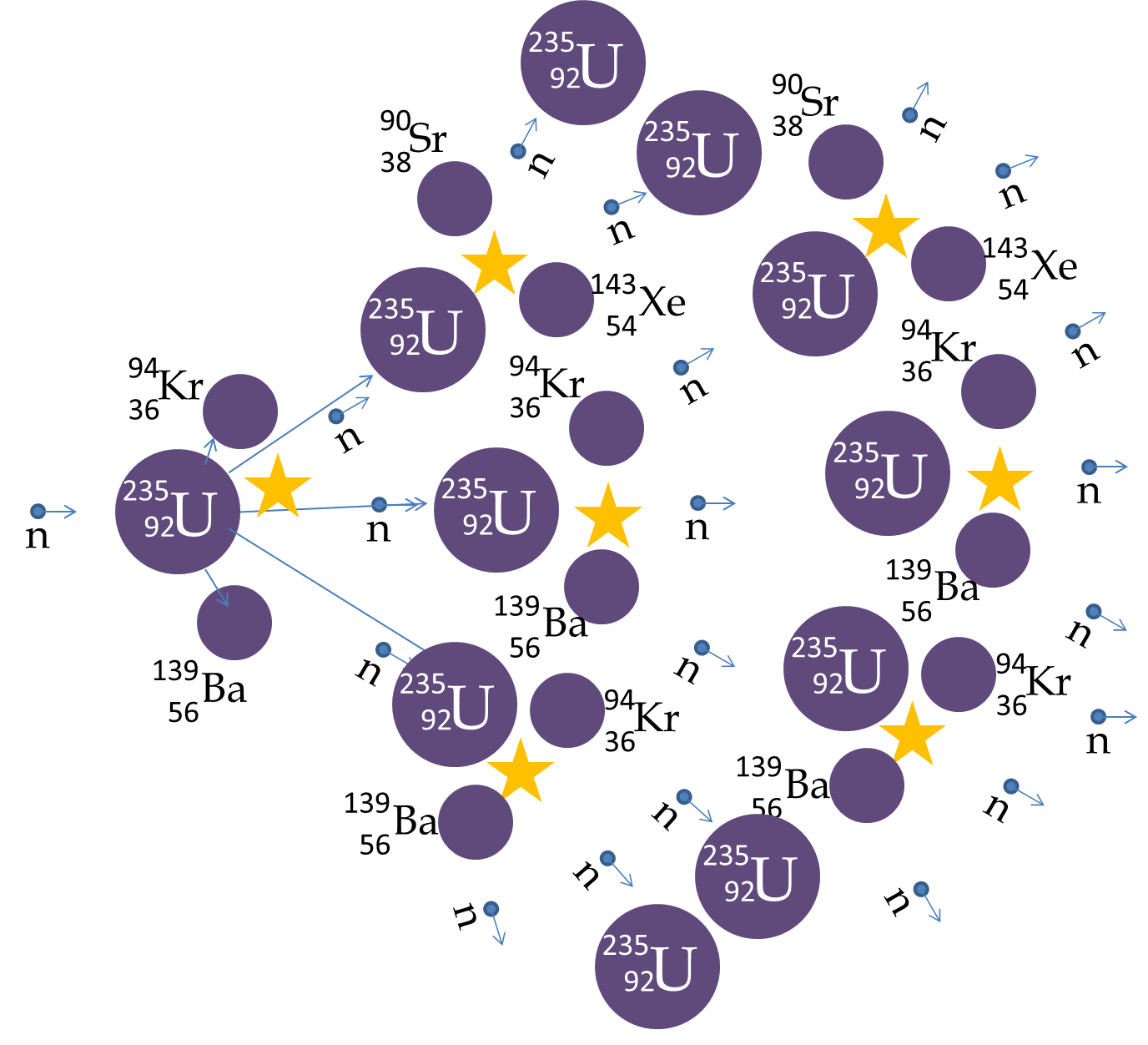
The nuclear chain reaction outlined above is an uncontrolled process. If unchecked, the chain reaction will release enormous amount of energy. Fission of each atom will release around 212 MeV of energy as you can see from a quick calculation. The binding energy per nucleon in \(^{235}\)U is approximately 7.6 MeV and in the product nuclei of the fission, the binding energy is about 8.5 MeV. Therefore, the energy released will be
\begin{equation*}
Q \approx \left( 8.5\: \textrm{MeV/nuc} - 7.9\: \textrm{MeV/nuc}\right) \times 235\:\textrm{nuc} = 212\:\textrm{MeV}.
\end{equation*}
In one kg of \(^{235}\)U there are approximately,
\begin{equation*}
N = \frac{1.0\:\textrm{kg}}{0.235\:\textrm{kg/mole}}\times 6.022\times 10^{23}\:\frac{\textrm{atoms}}{\textrm{mole}} =2.56\times 10^{24}\: \textrm{atoms}
\end{equation*}
Therefore, if all energy in 1 kg of \(^{235}\)U were to be released, we will get
\begin{equation*}
E = NQ = 5.43\times 10^26\:\textrm{MeV} = 8.69\times10^{13}\:\textrm{J}.
\end{equation*}
As a comparison a trinitrotoluene (TNT) i.e. dynamite explosion releases about \(4.184\times 10^{9}\) J of energy. Therefore, the energy released by fission of 1 kg of \(^{235}\)U will release energy equivalent of about 20,000 TNT explosions. Atomic bombs use this fact about uncontrolled nuclear chain reactions.
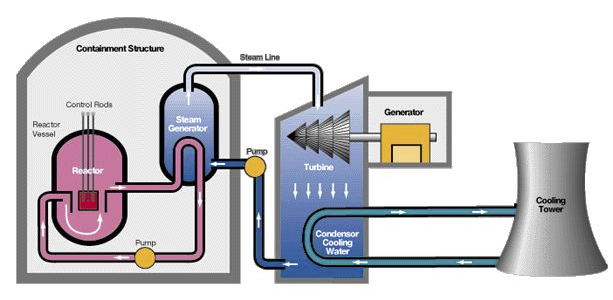
However, it is possible to control the chain reaction by materials that would absorb some of the excess neutrons produced in the fission. This is done in a system called
nuclear reactor, first invented by Enrico Fermi in the US.
Figure 54.29 shows parts of a nuclear reactor and the power plant based on the nuclear reactor.
Subsubsection 54.5.2.1 Sustainable chain reaction
Recall that in the fission process on average 2.5 neutrons are released for each neutron absorbed. Therefore, in an uncontrolled chain reaction, each fission event will lead to two or three new fission events. Let \(K\) denote the number of fission events induced by neutrons released by one fission event.
\begin{equation*}
K = \textrm{Number of fission events induced by neutrons released by one fission event.}
\end{equation*}
This factor \(K\) is called reproduction constant. When \(K>1\text{,}\) the nuclear reaction is a runaway chain reaction, \(K \lt 1\text{,}\) there are fewer and fewer fission reactions with time, and when \(K=1\text{,}\) the reaction is sustained at a particular level of activity, neither increasing nor decreasing. The condition \(K=1\) is called the critical condition for the operation of a nuclear reactor. For sustainable chain reaction we desire to operate first at \(K>1\text{,}\) reach a desired level of activity, and then maintain with \(K=1\text{.}\) To operate a nuclear reactor we need mechanisms of controlling the reaction rates.
Subsubsection 54.5.2.2 Moderator
The neutron emitted in the fission process have energy of the order of 2 MeV. They have a very small cross-section of capture by
\(^{235}\)U. The cross-section for neutron capture by
\(^{235}\)U is highest for slow neutrons. To slow the neutrons, the fuel rods containing the fissile material
\(^235\)U are surrounded by moderating materials, such as water or graphite, called
moderators. Neutrons scatter from the nuclei of the moderators which thermalzes neutrons, making them prime for capture by
\(^235\)U. The presence of moderator material increases the probability of neutron capture by the
\(^{235}\)U nuclide.
Subsubsection 54.5.2.4 Enrichment
Finally, the uranium fuel rods are mostly
\(^{238}\)U, not
\(^{235}\)U. The uranium ore contains 99.3\%
\(^{238}\)U and only 0.7\%
\(^{235}\)U. The isotope
\(^{238}\)U is not as fissile as the isotope
\(^{235}\)U. Furthermore, nuclide
\(^{238}\)U has a high probability of capture of neutron of high energy. In this sense,
\(^{238}\)U nuclide deplete the fuel rod of high energy neutrons. If the fuel rods are made with the natural abundance levels of each isotope, the neutrons released from the fission of
\(^{235}\)U will be quickly absorbed by
\(^{238}\)U and no chain reaction will ensue. Therefore, fuel rods are made by enriching uranium to a higher level than 0.7%, usually between 3 and 5%.