Example 29.55. Motion of an Electron with Initial Velocity Parallel to the Electric Field.
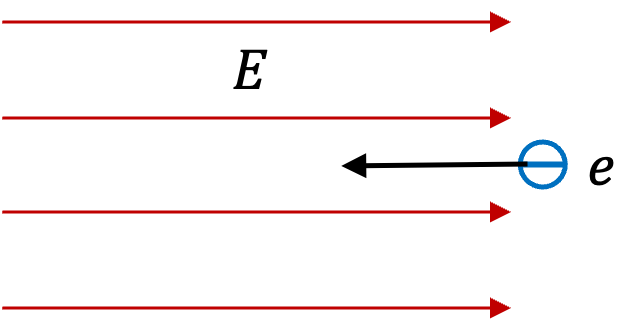
(a) What is the magnitude and direction of acceleration of the electron?
(b) What is the velocity of the electron after \(5.0\ \text{ ns}\text{?}\)
(c) What is the velocity of the electron after it has covered a distance of \(4.0\text{ mm}\) in the non-zero electric field region?
Answer.
Solution 1. (a)
(a) Since electron is negatively charged, force on the electron will be in the opposite direction of the electric field. Let electric field direction be towards \(x\) axis. Then, we see that the acceleration will have only \(x\) component.
\begin{align*}
a_x \amp = \frac{F_x}{m} = \frac{q E_x}{m} \\
\amp = \frac{-1.60\times 10^{-19}\text{ C}\times 1000\text{ N/C}}{9.1\times 10^{-31}\text{ kg} } = - 1.8\times 10^{14}\text{ m/s}^2
\end{align*}
Solution 2. (b)
(b) The initial velocity is pointed in the negative \(x\) axis. Therefore, we have
\begin{equation*}
v_{ix} = -2.0\times 10^5\text{ m/s}.
\end{equation*}
Since acceleration is constant, we will get
\begin{align*}
v_{fx} \amp = v_{ix} + a_x t \\
\amp = -2.0\times 10^5\text{ m/s} - 1.8\times 10^{14}\text{ m/s}^2\times 5.0\times 10^{-9}\text{ s}\\
\amp = -2.0\times 10^5\text{ m/s} - 9\times 10^{5} \text{ m/s} = -1.1\times 10^6\text{ m/s}.
\end{align*}
Solution 3. (c)
(c) Using constant acceleration formula we have
\begin{equation*}
v_{fx} = - \sqrt{ v_{ix}^2 + 2 a_x \Delta x },
\end{equation*}
where I used the negative root since velocity is pointed towards negative \(x\) axis. Here, both \(a_x\) and \(\Delta x \) are negative. Now, using the given numbers we get
\begin{align*}
v_{fx} \amp = - \sqrt{ (2.0\times 10^5)^2 + 2 \times 1.8\times 10^{14}\text{ m/s}^2 \times 5.0\times 10^{-3}\text{ m}} \\
\amp = - 1.36 \times 10^{6} \text{ m/s}.
\end{align*}