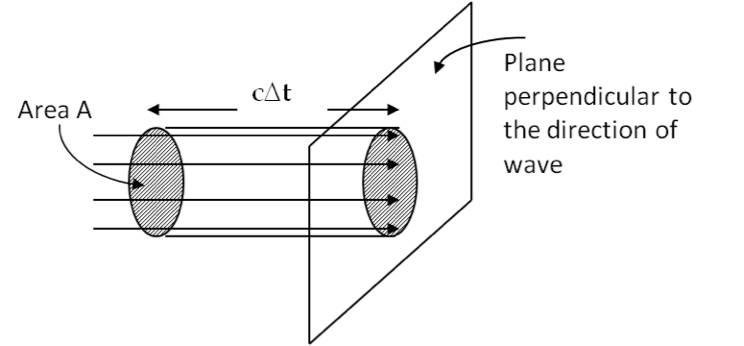
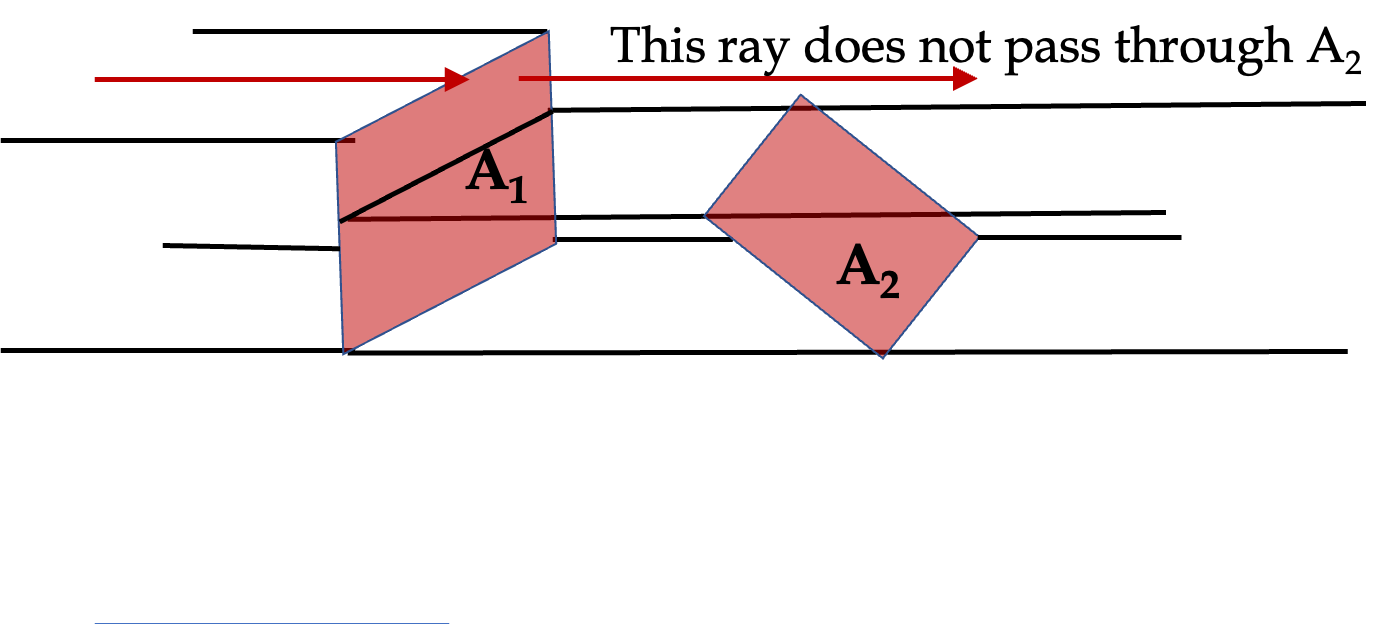
In
Figure 46.6, notice that some of the rays passign through
\(A_1\) will not pass through area
\(A_2\) even though the two surfaces are equal in value. This is due to mismatch of the perpendicular to the area direction and the direction of the wave. It is easy to incorporate this if we use vector notation for the area.
Introduce a power flux vector \(\vec S\text{,}\) also called the Poynting vector, by the following defining equation.
\begin{equation}
\vec S = \frac{1}{\mu_0} \vec E \times \vec B.\tag{46.25}
\end{equation}
The vector product of \(\vec E\) and \(\vec B\) makes it evident that the Poynting vector \(\vec S\) points in the direction of the propagation of the electromagnetic wave. Now, that takes care of the direction of the energy wave. Now, to take care of the orientation of the area, we introduce an area vector of a plane by its magnitude equal to the area and its direction perpendicular to the surface. Let \(A\) be the magnitude of the area and \(\hat n\) a unit vector in the perpendicular direction. Then, define area vector as
\begin{equation}
\vec A = A\;\hat n.\tag{46.26}
\end{equation}
Actually, there are two normal directions to a flat area. Here, we choose it arbitrarily. Then energy crossing an area vector \(\vec A\) per unit time will be
\begin{equation}
\vec S \cdot \vec A.\tag{46.27}
\end{equation}
If surface is not flat but some other surface, we can divide the surface into smaller patches and define area vectors in each “flat” patch. Then on each patch, \(\Delta \vec A\text{,}\) we will get
\begin{equation}
\vec S \cdot \Delta \vec A,\tag{46.28}
\end{equation}
and we must sum over all patches to obtain the total.
\begin{equation}
\text{total power} = \sum_i \left( \vec S \cdot \Delta \vec A \right)_i.\tag{46.29}
\end{equation}
To cover an arbitrary surface with flat patches, we will need infintely many patches, each of infinitesimal area. This gives the following general formula for power crossing any arbitrary surface.
\begin{equation}
\text{Power crossing any surface}\ = \iint\vec S \cdot d\vec A.\tag{46.30}
\end{equation}